“PVC” looks precise on a product page. It still leaves most of the blind unspecified. Two sellers can place a product under the same material label while offering a different vane curve, surface, light-control class, headrail, wand and stack arrangement.
Choose PVC vertical blinds only after the quote identifies the finished vane and the complete operating system. The useful record is not simply “PVC”: it is one named product, one vane profile, one closed state, one headrail, one control set and one service path for your opening.
If the opening is still at the treatment-family stage, use the motorized shade type comparison to settle that broader choice. This guide begins later, when a vertical blind is a serious candidate and the material label is doing too much work.
Read the listing in three layers
A comparable quote needs three layers. A product page that closes only the first layer has named something for sale; it has not yet described the blind you will operate.
| Evidence layer | Fields that belong together | What an unresolved layer means |
|---|---|---|
| Listing | Manufacturer, exact product or collection, market, seller, current document or sample reference | You cannot attach later claims to a stable product identity |
| Vane | Disclosed material, width, crown/S-shaped/other profile, smooth or embossed surface, named light-control class, color and sample identity | “PVC” cannot predict the visible closed surface or how adjacent vanes meet |
| System | Headrail, tilt and traverse controls, draw direction, stack side, included valance/hardware, care instructions, warranty and replacement route | A set of vanes has been compared, but the completed blind has not |
Do not score those layers. Listing identity cannot compensate for an unknown headrail, and a documented wand cannot compensate for an unidentified vane. A missing material adjective may be harmless if the exact construction is otherwise disclosed; a missing control or stack can change whether the blind works at the opening.
The current Home Depot PVC vertical-blind results make the problem visible: PVC is one filter, while light-control and control choices still vary across the filtered products. Treat the filter as a search aid, not a finished specification.
The closed blind begins with the vane profile
Profile is not decorative trivia. It tells you what shape is trying to overlap when the blind rotates closed. Graber’s current vertical-blind range separates crown-profile vinyl vanes from S-shaped vinyl vanes; for its named S-shaped option, Graber describes better closure for more light control and privacy. The same page also offers smooth or embossed crown surfaces and fabric options across different light-filtering levels.
That is evidence of variation inside one manufacturer’s range, not a promise that every S-shaped product closes alike. Headrail spacing, vane orientation, finished length, installation and edge conditions still belong to the exact blind. “Room darkening” is also a product claim to verify, not a property that follows automatically from the letters PVC.
One current Blindster PVC product combines curved 3.5-inch vanes, smooth or embossed textures and a cordless wand. That combination is useful as a named example. It is not a default specification for every PVC vertical blind.
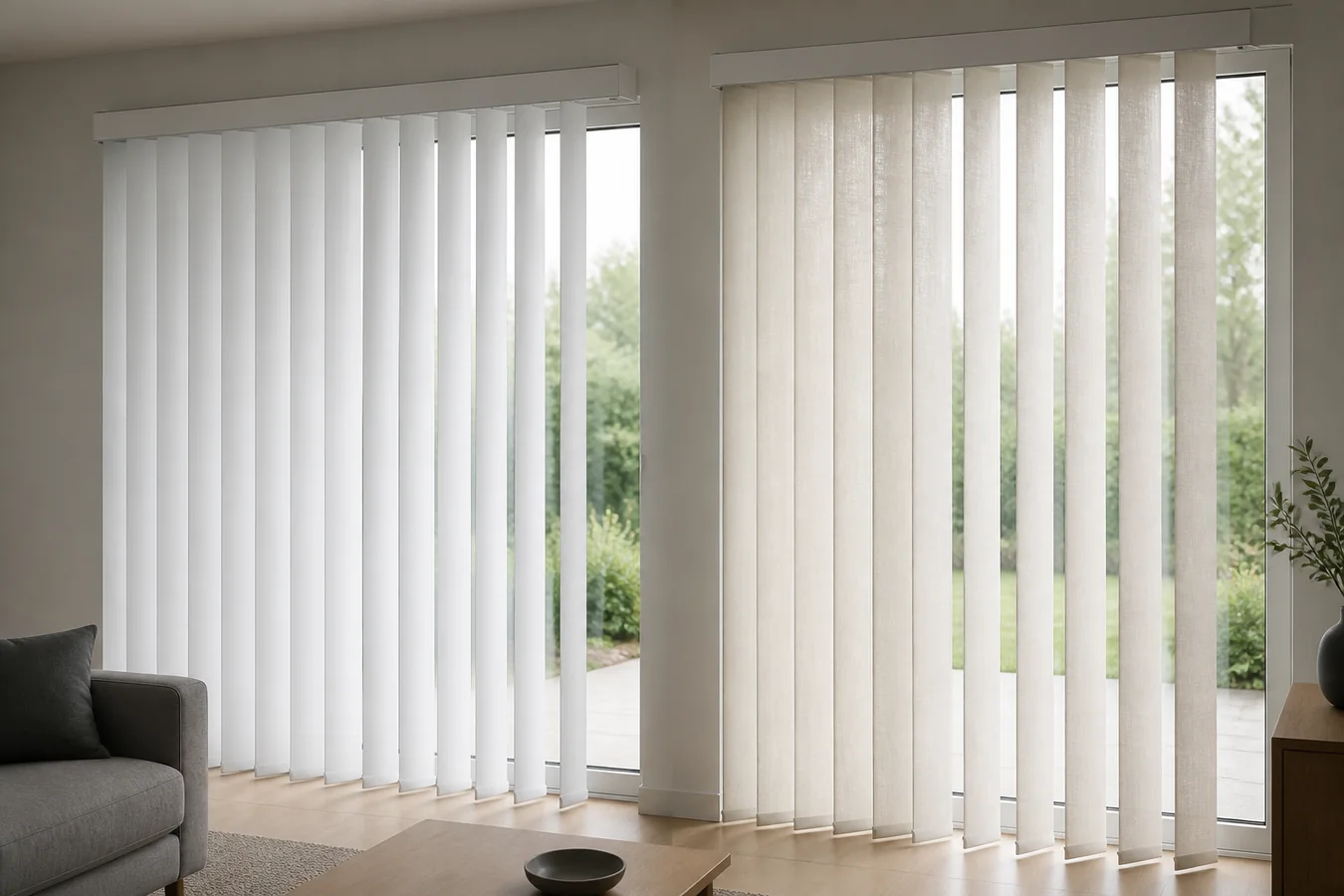
Ask the seller for a front view of the exact vanes closed on the proposed headrail and a shallow side view that reveals their curve and overlap. A loose color chip can answer finish and surface questions; it cannot show the installed spacing or closed edge.
Use one sample for three states
Do not turn a sample into an improvised durability test. Its job is narrower: connect the listing language to something you can identify and then ask the seller to show the same vane on the specified track.
- Open: Look along the vane edges. Record whether the sample is flat, crown-curved, S-shaped or another documented profile. Confirm which face is intended to point into the room.
- Tilted: Ask for a photo or showroom demonstration of the exact headrail holding that vane at a useful intermediate angle. This is where the vane, carrier spacing and control begin acting as a system.
- Closed: Check the named product’s overlap, visible seams and perimeter condition. Record what you see instead of translating it into “blackout,” “private” or “better” without the manufacturer’s exact claim and your required sightline.
Photograph the sample label beside the vane and save the current product link or quote revision. If the delivered order later uses a different collection or profile, the record makes that substitution visible.
For a whole new blind, keep these observations attached to the opening. The Smart Shade Measurement and Compatibility Checker preserves the raw width, height, mount and obstructions; the vertical-blind measurement guide handles the later headrail plane, stack and floor-clearance conversation. Neither tool should invent a deduction the seller has not accepted.
Compare fabric only after both records are complete
“PVC versus fabric” is too early when one side is a specified product and the other is a category. Build two complete columns. If the fabric quote names its weave but omits its headrail, or the PVC quote names its wand but omits its light-control class, the blank is the result.
| Same-basis field | Exact PVC system | Exact fabric system | Decision effect |
|---|---|---|---|
| Product and vane identity | Maker, collection, profile, width, surface | Maker, collection, weave/insert, width, backing if any | Prevents category traits from replacing product evidence |
| Closed-state evidence | Named light-control class plus exact closed view | Named opacity/liner class plus exact closed view | Lets the required sightline meet a real configuration |
| Intermediate state | Supported tilt positions on the quoted headrail | Supported tilt positions on the quoted headrail | Keeps light control tied to mechanics, not softness |
| Open position | Draw, stack side and finished parked area | Draw, stack side and finished parked area | Protects passage and the active window or door |
| Care | Current manufacturer method for the exact collection | Current manufacturer method for the exact collection | Tests whether the room and maintenance routine are compatible |
| Service | Vane, carrier, headrail and control coverage/parts | Vane, carrier, headrail and control coverage/parts | Shows whether damage is repaired by a part, a set or the full blind |
There is no universal winning column. A rigid vane may be the better documented choice for one cleaning routine; an exact fabric product may provide the preferred filtered-light state or surface in another room. The decision is defensible only when those claims belong to the two products actually being quoted.
If changing the entire treatment family is still on the table, stop the material comparison and use the vertical-blind alternatives guide. It compares what another covering must inherit from the current doorway rather than forcing cellular shades, panels or drapery into a PVC-versus-fabric table.
Order the headrail with the vanes
Vertical blinds perform two separate motions: the vanes rotate, and the carriers traverse along the headrail. The order needs both. A seller’s phrase such as “cordless wand” still has to resolve how the wand rotates the vanes, how it moves the stack, which direction the blind draws and where the gathered vanes park.
LEVOLOR’s current custom vertical-blind instructions tell owners of that named system to open the vanes before traversing; they describe wand rotation and side-to-side travel as distinct actions. Follow the manual for the product you buy, but use this separation when auditing any quote. “Opens” is not enough.
For a patio door, mark the moving glass panel, screen, handle and everyday walking line before accepting the stack side. The large-window and sliding-door guide keeps those movements attached to the treatment layout. A symmetrical rendering does not prove that the active side stays clear.
If the quote adds a motor, the control question expands rather than disappears. Use the motorized vertical-blind motion audit to verify which commands rotate, which traverse, what happens at stop positions and how the system recovers. This PVC page does not assume that a motorized headrail accepts every vane or that every “smart” listing automates both motions.
Care instructions reveal the service unit
Generic advice often says PVC is easy to clean. The useful question is what the named manufacturer permits. Graber’s current cleaning instructions distinguish fabric and vinyl vertical-blind methods and state that its vinyl vanes may be removed and immersed in water. That permission belongs to Graber’s named product guidance; it does not authorize soaking an unidentified vane, headrail, weight or fabric insert.
Put the exact care page or manual in the quote record. Note whether the vane may be removed, which cleaner and water temperature are allowed, how it is dried, and which components stay out of water. If your room creates a recurring cleaning problem, compare that permitted routine rather than a seller’s one-word “washable” badge.
Then identify the service unit. Graber’s current warranty coverage gives vertical-blind vanes a defined coverage period and lists exclusions for its products. Another maker may divide coverage differently. Ask separately about the vane, carrier, headrail, control and labor, and obtain the replacement-parts route in writing.
When an existing headrail is being retained, this article is no longer the right decision owner. Use the replacement-vane compatibility record to match the connector, profile, finished length, weight and face direction to that track. A new PVC blind and a PVC replacement vane are different purchases.
Finish with one order sentence
Write the result without category shorthand:
For the recorded opening, quote [manufacturer and collection] with [PVC/vinyl construction], [vane width and profile], [surface and named light-control class], [headrail and control], [draw and stack side], [included hardware], and the current [care, warranty and replacement-parts route]. The seller owns the final deductions and confirms the closed and parked configuration shown in the attached record.
That sentence should lead to one of five outcomes:
- Approve the exact PVC system when every required field and opening state is documented.
- Compare one exact fabric system when both columns are complete on the same opening.
- Choose another treatment when neither vertical system returns the required light, passage, care or service configuration.
- Retain and repair when the existing headrail is serviceable and the smaller replacement unit is compatible.
- Hold when product identity, vane profile, closed state, headrail, controls, stack, care or service remains material and unknown.
The label gets you to the shelf. The finished-system record decides whether that blind belongs on the opening.