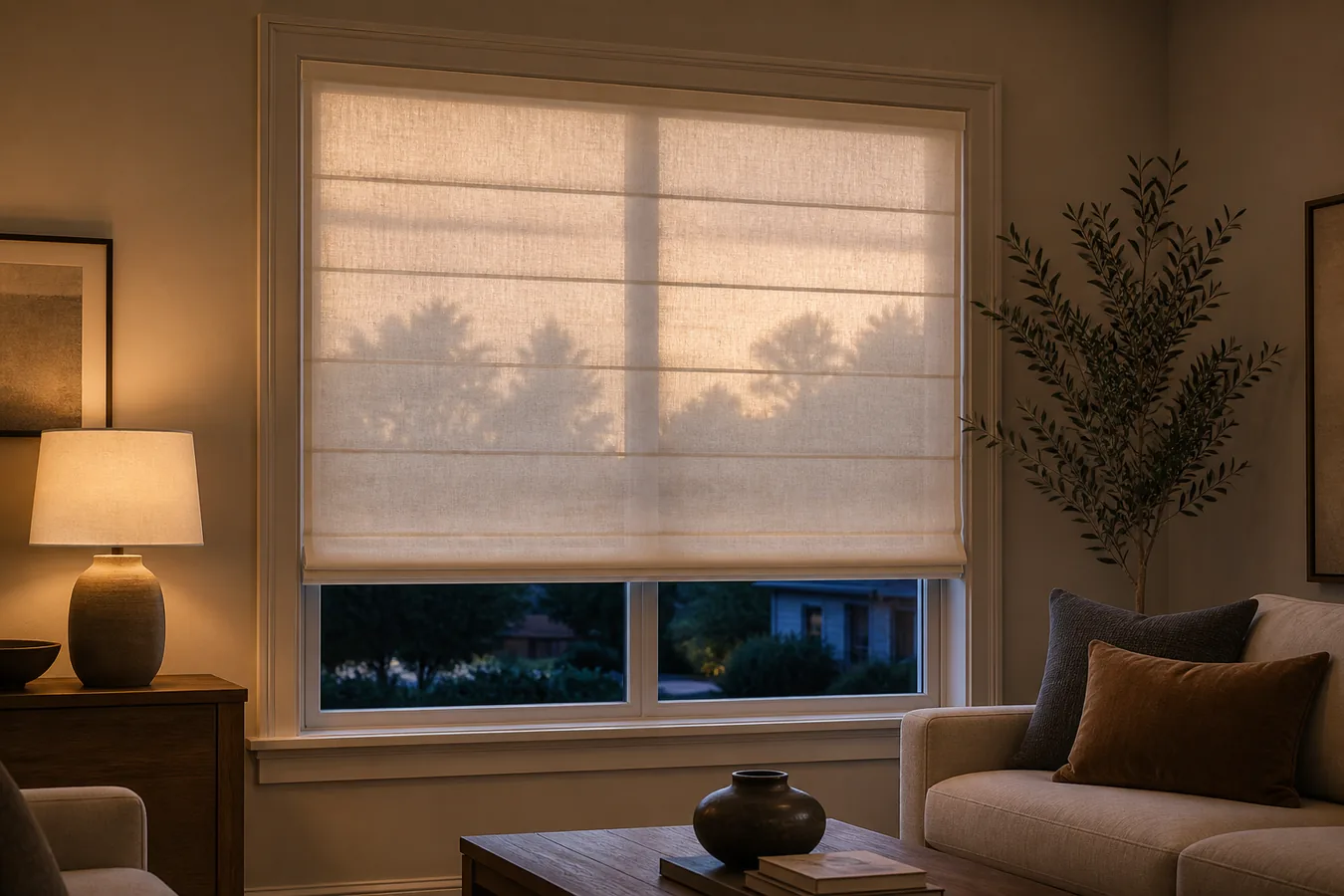
A sheer Roman shade can look softly screened at noon and much more revealing after dark. The fabric did not change; the brighter side did. Daylight can make the exterior the dominant light source. Once the room lamps are on and outdoors is dim, the interior becomes the brighter side of the same fabric.
Do not approve the shade from a daylight swatch or a styled room photo. Ask to see the exact fabric, color, lining, rear hardware, and control as one finished construction with outdoors brighter, with indoors brighter, and at the height where the shade will normally sit. If night privacy matters and the seller cannot return that evidence, treat the choice as unresolved.
Start with the brighter side of the glass
“Sheer” does not specify one measurable privacy result. A current Bali Classic Roman guide describes its sheer category as semitransparent and says images or shapes may be visible. The same guide notes that appearance can vary with lighting, time of day, and shade position. That is the useful boundary: the category tells you to expect transmission, not exactly what a person will see through your selected shade.
Define privacy as a room task before looking at fabrics. A second-floor living room with no direct sightline may only need glare softening. A street-facing bath or bedroom may need facial detail, body outline, and movement concealed after dark. “Looks airy” can fit the first room and fail the second without either description being dishonest.
If the shade family is still open, start with the roller, cellular, and Roman shade comparison. A Roman shade is useful when the fabric and folded appearance are part of the room, but that format also gives the sheer fabric seams, hems, folds, and rear lift hardware that a flat swatch cannot show.
Use one finished shade for two privacy views
Use the same finished construction for every view. Changing the fabric, liner, or exposure between photographs makes the comparison useless. Ask the fabricator to identify the fabric and color, lining, shade style, control, and approximate shade size on the evidence it returns.
| View to request | Shade state | Where to observe | What the result decides | Hold the order when |
|---|---|---|---|---|
| Daylight, outdoors brighter | Fully lowered in representative daylight | Normal seats inside and the relevant exterior approach | Daytime view, glare softening, fabric color, and outside detail retained | The only evidence is a backlit swatch or a different color or fabric |
| Room-lit night, indoors brighter | Fully lowered with the room’s ordinary lamps on | The real street, yard, neighboring-window, or hallway sightline | Whether silhouettes, movement, or interior detail exceed the room’s privacy requirement | The seller substitutes an opacity label for the finished night view |
| Ordinary stop or fold | At the height where the shade will commonly sit | From inside, then from the relevant outside sightline | Exposed glass, denser folded bands, rear hardware, hem, and stack appearance | The usual position is missing or the image hides the back of the shade |
Use objects rather than a person if a local view check is needed: a chair back, floor lamp, and printed card placed at the sensitive sightline can show outline and detail without asking anyone to stand on display. Record which lamps are on and where the observer stands. This is not a universal laboratory score; it is evidence for one room and one completed shade.
The broader light-filtering versus room-darkening guide can help define the room task. It cannot certify this sheer Roman shade because fabric class, construction, and lighting direction still have to match the order.
A Roman fold is not one layer everywhere
A swatch is usually one flat piece of fabric. A finished Roman shade can include doubled hems, side returns, seams, battens, pockets, rings, and attachment points. Those areas may look denser than the center field. When the shade rises, fabric stacks into horizontal folds while uncovered glass opens below it. The result is not one uniform opacity from headrail to sill in every position.
Ask for a front and back image of the same sample shade. Mark the center field, side edges, lower hem, any horizontal construction lines, and the normal stack. If the center passes but a hardware shadow or doubled band is distracting, you may need a different fabric, a liner, or a construction change. If the shade must remain fully lowered to preserve privacy, make sure that operating rule suits the room rather than assuming the attractive mid-height photograph represents a useful daily state.
Motorization does not erase the fold decision. It changes how the Roman shade moves and how power, controls, and service are provided. The motorized Roman shade guide covers that separate fit. Keep its approved motor/control configuration attached to the same fabric and lining evidence; do not approve a manual sample and assume the motorized construction looks identical.
Lining fixes one problem by changing the shade
A liner is not invisible. It can increase privacy and add body, but it also changes the transmitted light, view, color, thickness, and folds. The Shade Store’s current Roman-shade customization material says unlined construction preserves transparency, while its Roman-shade fabric guide describes lining as a way to add body, privacy, and light control. The exact result still belongs to the selected fabric-and-liner combination.
| Construction path | What it preserves | What it changes | Evidence to demand | Appropriate only when |
|---|---|---|---|---|
| Unlined sheer Roman | Most of the selected fabric’s transparency and view | Privacy remains unproved; rear construction may show | Finished shade in both light directions, front and back | The room can accept the proved night view |
| Self-lined sheer Roman | A related fabric expression with more body | Two layers can reduce view and alter folds without guaranteeing privacy | Exact two-layer sample, not two separate swatches | The returned combination meets the actual sightline |
| Privacy-lined Roman | Roman-shade format with greater privacy | Less view and transmitted light; different body and stack | Finished fabric/liner combination at full drop and normal fold | Privacy matters more than preserving the sheer view |
| Sheer Roman plus separate privacy layer | Sheer appearance when privacy is not needed | Adds another headrail, fabric path, control, and service job | One section showing both layers, clearances, controls, and removal | The window has space and the user accepts operating two layers |
| Another shade family | A different balance of view, adjustment, and closure | Gives up the fixed sheer-Roman expression | Same-room comparison based on the actual task | One Roman construction cannot meet both day and night needs |
Do not transfer a “privacy liner” result from one catalog to another. Some manufacturers also offer room-darkening or blackout liners, but the material, seams, edges, and mount determine the completed result. Use the blackout Roman shade guide when darkness—not just privacy—is the requirement.
Rear hardware becomes part of the view
The back of a sheer Roman shade is not private backstage. The Shade Store’s current customization guidance notes that rings, lifting cords, or mechanisms may be visible through sheer materials. Lightweight fabric can also reveal shadows from construction behind it. The exact layout varies, which is why the quote needs a backside image or drawing rather than a promise that the hardware is “minimal.”
Inspect the shade from the room and from outside. A regular row of rings may be acceptable as part of a tailored construction; a wandering lift line, visible control route, or uneven attachment may not be. Check whether the liner covers only the center or continues through hems and side areas, and whether stitching becomes more visible when the room is lit.
Control safety remains a completed-product decision. Where young children may be present, the US Consumer Product Safety Commission recommends cordless window coverings. Use the cordless and motorized blind safety guide to check the reachable finished configuration. Do not accept a visible loop simply because it was absent from the fabric sample or cropped out of a room photo.
Decide whether the sheer is the treatment or the first layer
One sheer Roman shade works cleanly when its proved night view is acceptable and the room values filtered daylight more than closure. It becomes the first layer of a two-layer system when the sheer daytime expression is wanted but a second function must take over for privacy or room darkening.
One current Hartmann & Forbes privacy-options guide presents Roman liners and a separate rear roller shade as distinct routes within its product family. Hunter Douglas also offers an exact Vignette Duolite configuration that pairs a front sheer or light-filtering Roman panel with a rear room-darkening panel. These are examples of engineered solutions, not permission to combine arbitrary products.
If two functions are required, ask for one drawing of both layers. It should show headrails, total depth, fabric paths, finished side gaps, controls, power or charging access, which layer sits closest to the glass, and how either unit is removed. The smart shade measurement checker can hold the opening, mount plane, depth, and obstructions; the supplier still owns the finished dimensions for both treatments.
An adjustable-vane sheer shade is another branch when changing the relationship between view and privacy during the day matters more than the Roman fold. Compare it with the sheer shade guide instead of assuming the two products behave alike because both use the word sheer.
Make the quote return the finished combination
The final quote should name the exact fabric and color, unlined/self-lined/privacy-lined construction, Roman style, doubled or reinforced areas, rear rings and lift path, manual/cordless/motorized control, finished size, mount, normal stack, edge gaps, and any second layer. Attach the two lighting views and the ordinary folded view to that same configuration.
Approve an unlined sheer Roman when the returned night view is acceptable. Choose a lined construction when its reduced view and altered body still fit the room. Specify a separate privacy layer only when the combined mount, controls, and service path are complete. If the seller changes the fabric, color, liner, control, or size, reopen the visual check instead of carrying the old result forward.
A sheer Roman shade can be the right treatment without pretending it performs the same at noon and at night. The reliable purchase is the one whose exact finished construction has already been viewed from both brighter sides of the glass.