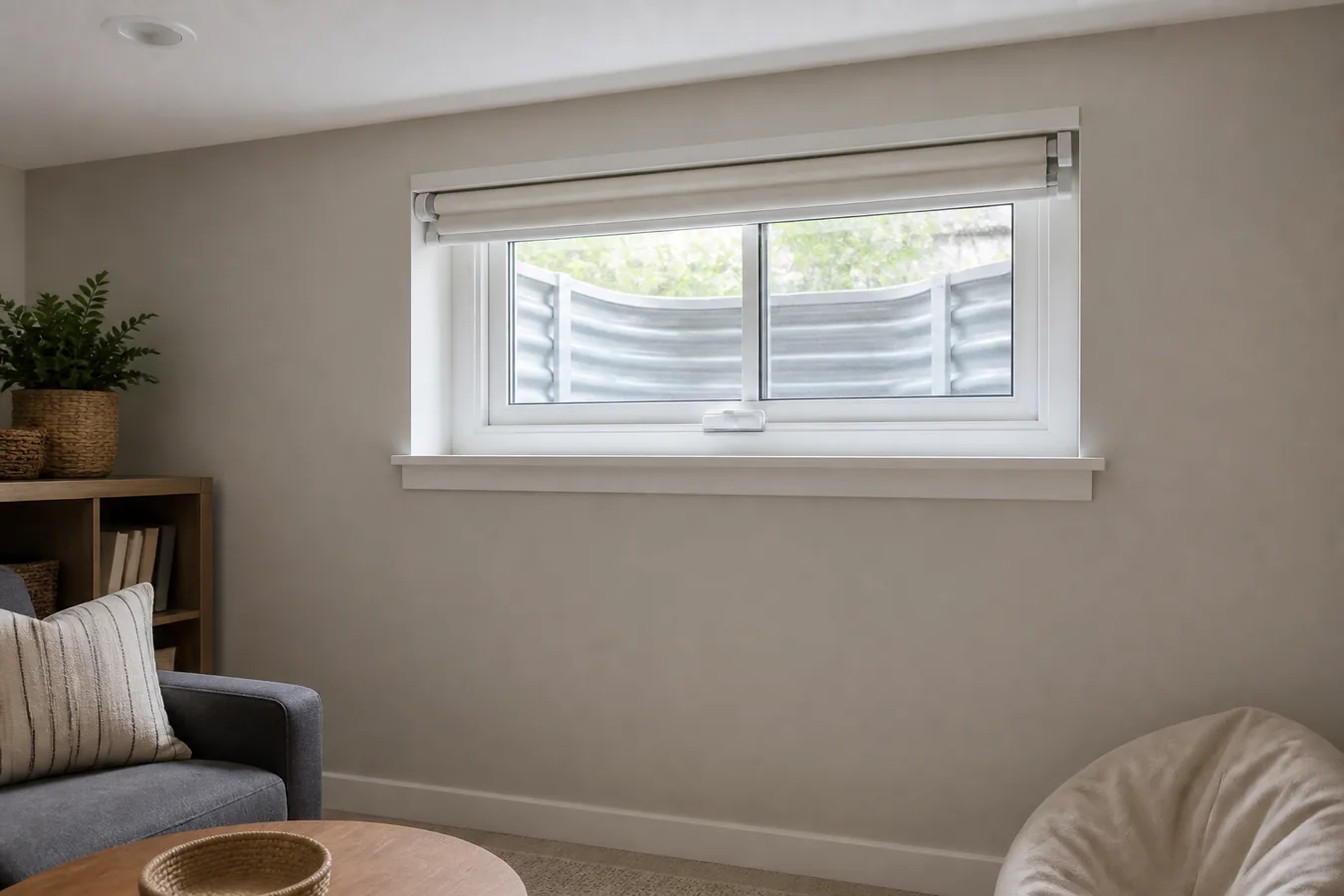
A basement blind is secondary hardware on a window that may have a more important job. The opening may provide emergency escape or rescue, ordinary ventilation, daylight, or access to a utility space. A treatment that solves the view from the sidewalk but crowds the latch, covers wet trim, or stays in the sash path is not ready to order.
Start by identifying the window’s duty. If a local building official, permit record, or qualified professional identifies it as a required emergency escape/rescue opening, keep its operation, clear opening, approach, and window-well path out of the treatment design until local requirements are confirmed. If it is not safety-critical, still draw every moving part. Then place privacy only across the sightline you can actually observe, address visible moisture, and ask for the proposed blind fully raised on the same drawing as the fully open window.
Give the window its job before giving it a blind
“Basement window” describes a location, not a function. Two identical-looking openings can impose very different limits. Complete one row in the card before comparing fabric or slat samples.
| Opening duty | What must remain available | What to observe in the room | Treatment direction | Do not order until |
|---|---|---|---|---|
| Required emergency escape or rescue, if confirmed locally | Inside operation, required clear opening, approach, release, and the usable window-well route | Sash, lock, screen, well cover, ladder or steps where present, furniture, and raised treatment | A locally accepted configuration that fully yields to the opening; leaving it uncovered is valid | The local classification and completed treatment/open-window layout are accepted by the appropriate authority or professional |
| Ordinary operable ventilation | Handle or crank, sash travel, screen access, and useful airflow position | Which hand reaches the control and where the shade rests while the window is open | Compact inside mount, clear outside mount, removable privacy layer, or no covering | The shade, window, screen, and hand can use their required positions without collision |
| Fixed daylight | Useful glass and the actual day/night privacy band | Outside eye lines, interior lighting, headrail/stack, and edge gaps | Targeted privacy, a compact shade, or leaving useful glass open | Finished coverage and open-stack dimensions are supplied |
| Utility or service opening | Panel, valve, vent, meter, cleanout, or other access route | Who services it, with what tool, and how the treatment comes off | Removable or offset treatment, or no covering | Removal and replacement do not block or damage service access |
The 2021 International Residential Code is useful here as a model-code boundary, not as a verdict on your home. Its emergency escape/rescue provisions say a required opening must be operable from inside and that an area well must let the opening fully open. It also addresses devices over such openings and wells. Read the current ICC text, then verify the locally adopted rule and this window’s status. Do not copy a national dimension from an article into a local compliance decision.
For the broader room decision, the room-by-room shade planner helps separate privacy, light, safety, and service constraints. This page narrows that work to one basement opening.
Draw the opening path wider than the glass
A tape measure around the glass misses most of the ways a basement treatment can interfere. Photograph the window straight on and from the side. On the photo or a simple sketch, add the parts that need space:
- the hand approach to the latch, lock, or crank;
- the complete sash movement, not only the first few inches;
- screen removal or hinge travel;
- the route into the window well and the movement of any well cover;
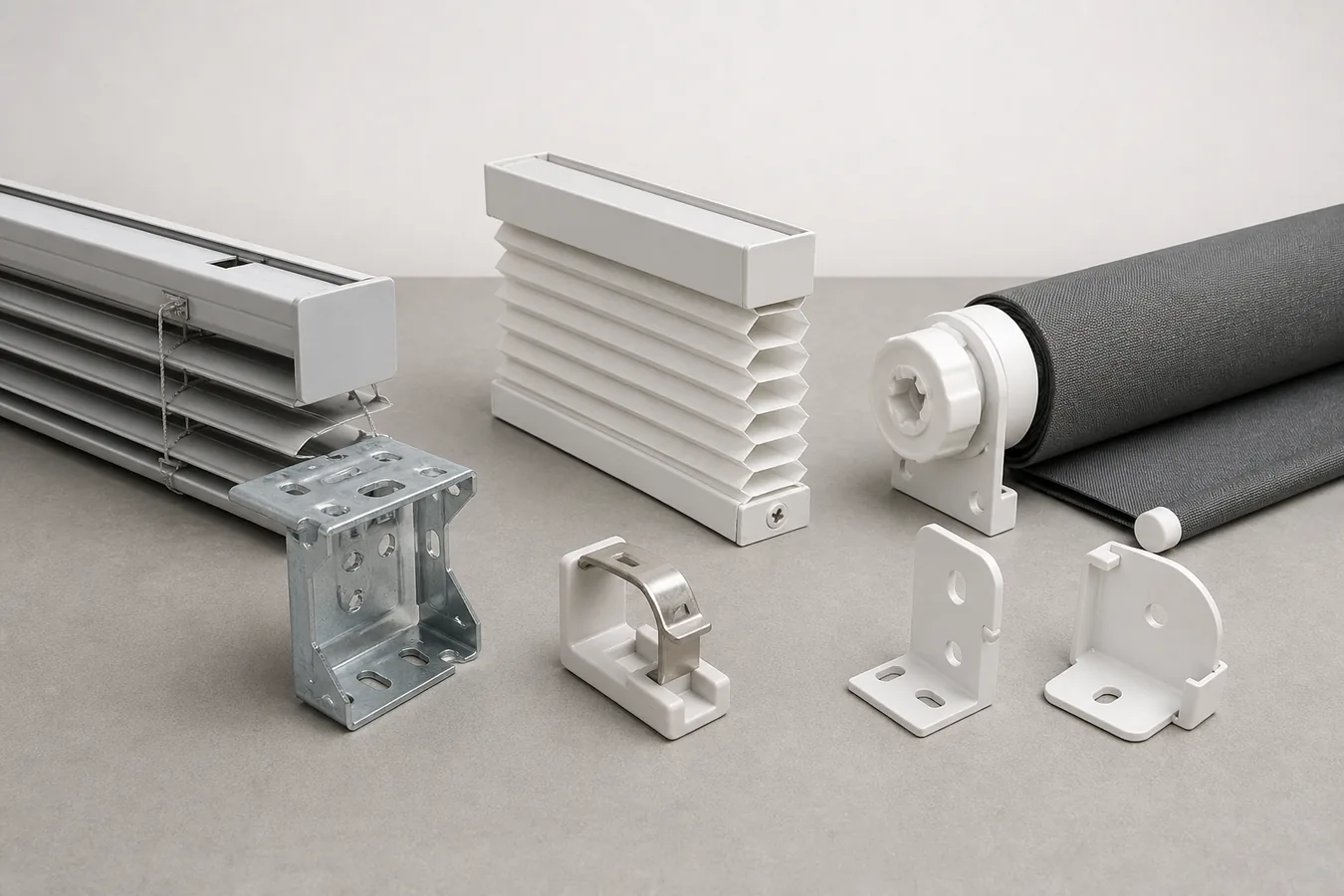
- the blind’s headrail, brackets, raised stack, bottom rail, and side gaps;
- the operating control and any charging or service access;
- nearby furniture or a ledge that narrows the approach.
Now draw the proposed treatment in its least convenient state: fully raised but still carrying its largest stack or roll. Put the window in its fully open state on the same image. If the two objects overlap, or if a person cannot reach the window hardware without negotiating the shade, a product label cannot close the decision.
This is also where a small-window article and a basement article part company. The small-window blind guide calculates how much glass survives the hardware. Here, hardware can also consume an operating or access path. A little more exposed glass does not compensate for a latch hidden behind a rail.
Cover the sightline, not all the daylight
Ground-level privacy can look severe from inside because the glass is near the ceiling. The view from outside may be much narrower. Check it rather than guessing.
Stand at the realistic outside positions: sidewalk, driveway, neighboring path, patio, or window-well edge. Have another person mark the part of the room visible through the glass in daytime. Repeat after dark with the basement lights in their normal state. Record the highest and lowest privacy lines on a photograph.
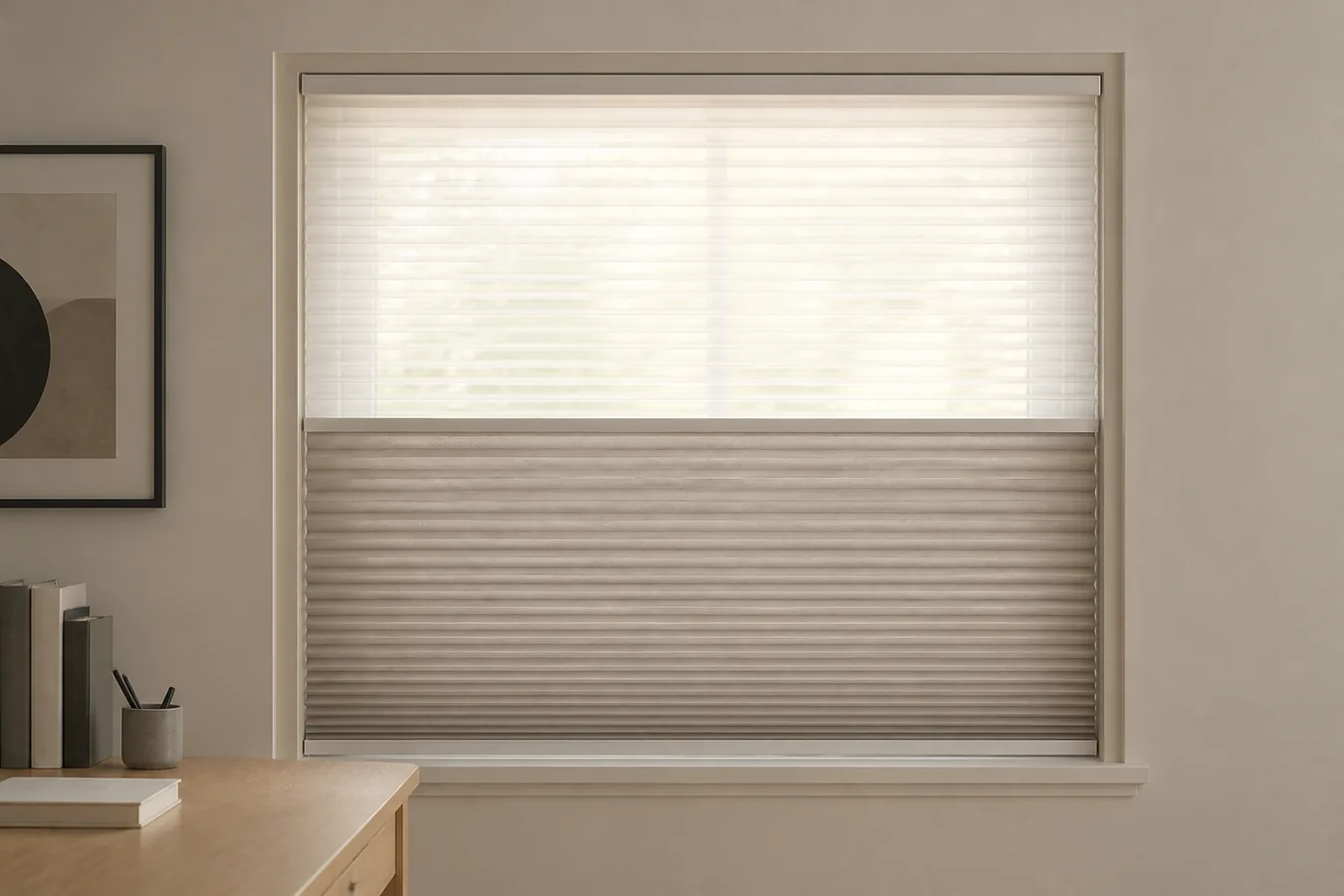
That observation can produce a smaller treatment footprint. A partial fixed privacy layer may cover the true eye line while leaving the upper glass open. A top-down/bottom-up shade may be relevant only if its exact rails, controls, and open position stay outside the window path. An ordinary shade may still be best when the entire pane is exposed after dark. If no meaningful interior view exists, leaving the window uncovered remains a real outcome.
Do not assume film, a café layer, or an inside mount is automatically compatible. Verify the glazing, frame, condensation exposure, adhesive/removal instructions, and window operation for the exact product. Privacy geometry chooses the area to cover; product evidence decides how to cover it.
Condensation changes the order of work
A water-resistant blind does not repair a wet window. If you see condensation on the glass, a wet sill, staining, peeling finish, or evidence of leakage, pause the covering order and document when and where it appears.
The US EPA says moisture control is the key to mold control and advises acting quickly when condensation or moisture collects on windows, walls, or pipes: dry the surface and reduce the moisture source. Its mold and moisture guide also explains that cleaning without fixing the water problem is unlikely to be a durable solution. EPA’s basement remodeling guidance tells homeowners to check for leaks or other moisture signs and correct problems before proceeding with other work.
This does not mean one article can diagnose the cause. Condensation, infiltration, drainage, insulation, ventilation, and equipment can require different responses. It means “moisture-resistant” cannot be the first or only answer. Establish the source-control or professional path, let the area be inspectable and serviceable, and then choose a treatment whose exact material and care instructions fit the resolved condition.
Bathroom coverings face a different exposure pattern. Use the bathroom window treatment guide for splash, drying, cleaning, and ventilation overlays; do not transfer a bathroom material recommendation to an unresolved basement moisture problem.
Choose by how completely it disappears
The most useful product question is not “Which blind is best for basements?” It is “What remains in front of this window when the treatment is open or removed?”
| Treatment path | It remains plausible when | Exact proof to request | Change course when |
|---|---|---|---|
| Compact cordless roller or cellular shade | The raised roll or stack, rails, gaps, and controls sit outside every required window movement and sightline | Completed dimensions for headrail, stack, fabric or rail edges, control, and removal | “Low profile” is the only evidence, or the stack crowds the latch or opening |
| Outside-mounted shade or blind | A flat, secure wall or trim plane moves all hardware clear of the opening without narrowing the approach | Mounting substrate, projection, overlap, fully raised position, and removal sequence | The wider outline blocks well access, trim, furniture, or hand reach |
| Slatted blind | The exact headrail, raised slat stack, tilt/lift controls, and bottom rail all yield enough space | Product-specific minimums, finished stack, control layout, and full-open drawing | The blind can tilt but cannot leave the opening as required |
| Targeted fixed privacy | The observed sightline is narrow and the exact material suits the glazing and resolved moisture condition | Covered band, day/night view, compatibility, removability, and cleaning method | Adjustable light or ventilation is needed, or the material interferes with operation |
| Removable soft treatment | It can be removed quickly and predictably without tools or a storage obstacle, where that is acceptable | Attachment, removal direction, stored location, and reinstallation method | “Removable” depends on dismantling hardware or moving furniture |
| Leave uncovered | The room has no material privacy/glare problem or the opening’s other job dominates | A documented reason, not a substitute for missing research | A real privacy need remains unsolved |
Where young children may be present, control choice is not merely convenient. The US Consumer Product Safety Commission advises cordless window coverings in those rooms. The cordless blinds and child-safety guide explains why the completed product and child-reachable zone still matter after the operating cord is removed.
Motorization can solve a high reach problem, but it does not erase the headrail, battery, wire, charging, manual fallback, or service path. Treat it as one exact configuration, not as a way to bypass an opening conflict.
Make the quote show the window open
Use the smart shade measurement checker for the raw opening, depth, mount plane, and obstructions. Keep those observations separate from the seller’s finished-product numbers. Before paying, ask for one drawing or written schedule that includes:
- the window’s locally verified duty when safety or code status affects the choice;
- the window type, latch/crank, screen, full sash movement, area well, and interior approach;
- the exact product, mount, headrail/brackets, raised stack, finished coverage, and edge gaps;
- the control, child-reach decision, power or charging route, and manual/service access;
- the treatment fully raised or removed at the same time the window is fully open;
- the privacy band under the actual daytime and lights-on-night sightlines;
- the resolved moisture condition and product-specific care/compatibility evidence;
- who confirms local constraints, who installs it, and who corrects a treatment that occupies the agreed clear path.
Missing local authority cannot be replaced by a retailer’s reassurance. Missing finished dimensions cannot be replaced by a category name. If either is material, pause the order.
The right basement blind is the one that becomes unimportant when the window has a more important job. It covers the real view, leaves the needed daylight, and gets its hardware, controls, and stack out of the opening’s way.