A replacement vane can click into a carrier and still be wrong for the blind. The top opening may load the hook differently, a curved vane may face the wrong way, or a slightly different profile may break the overlap that controls privacy. The track may also be the failed part, making a new set of vanes an expensive disguise.
Before ordering, make the existing blind pass two tests. First, prove that the headrail and carriers still traverse and tilt as the exact product instructions describe. Second, build a match card from one intact vane: attachment, width, profile, material, finished length, bottom hardware, face direction and acceptable color variation. If either test stays unresolved, the order stays on hold.
First decide whether the track has earned another set
Open the blind’s own instructions before moving anything. LEVOLOR’s current vertical-blind guide, for example, tells users to place the vanes in the open position before traversing and not to force the wand or cord. That procedure applies to the named products in the guide; another headrail may have a different control sequence.
With the vanes positioned as the manual requires, observe one complete trip across the opening and one tilt in each supported direction. The question is not whether the blind moves somehow. Look for the same carrier refusing to travel, uneven carrier spacing, a vane that remains crooked after it is correctly attached, clicking or grinding from the track, or several vanes that will not rotate with the others.
Those symptoms can move the repair away from the vanes. Hunter Douglas’ current vertical-blind repair guidance identifies uneven spacing, poor tilt, crooked hanging and abnormal track noise among reasons to investigate carriers on its named product families. It also ties replacement carriers to particular headrail types and part numbers. Use those symptom categories to ask a better question, not to diagnose an unidentified blind with Hunter Douglas parts.
If every carrier travels and rotates smoothly, retaining the track remains plausible. If one carrier fails, identify the headrail and current supported repair before buying a vane for that position. If many positions misbehave or the track cannot be identified, price and assess the headrail or complete blind as a separate service unit.
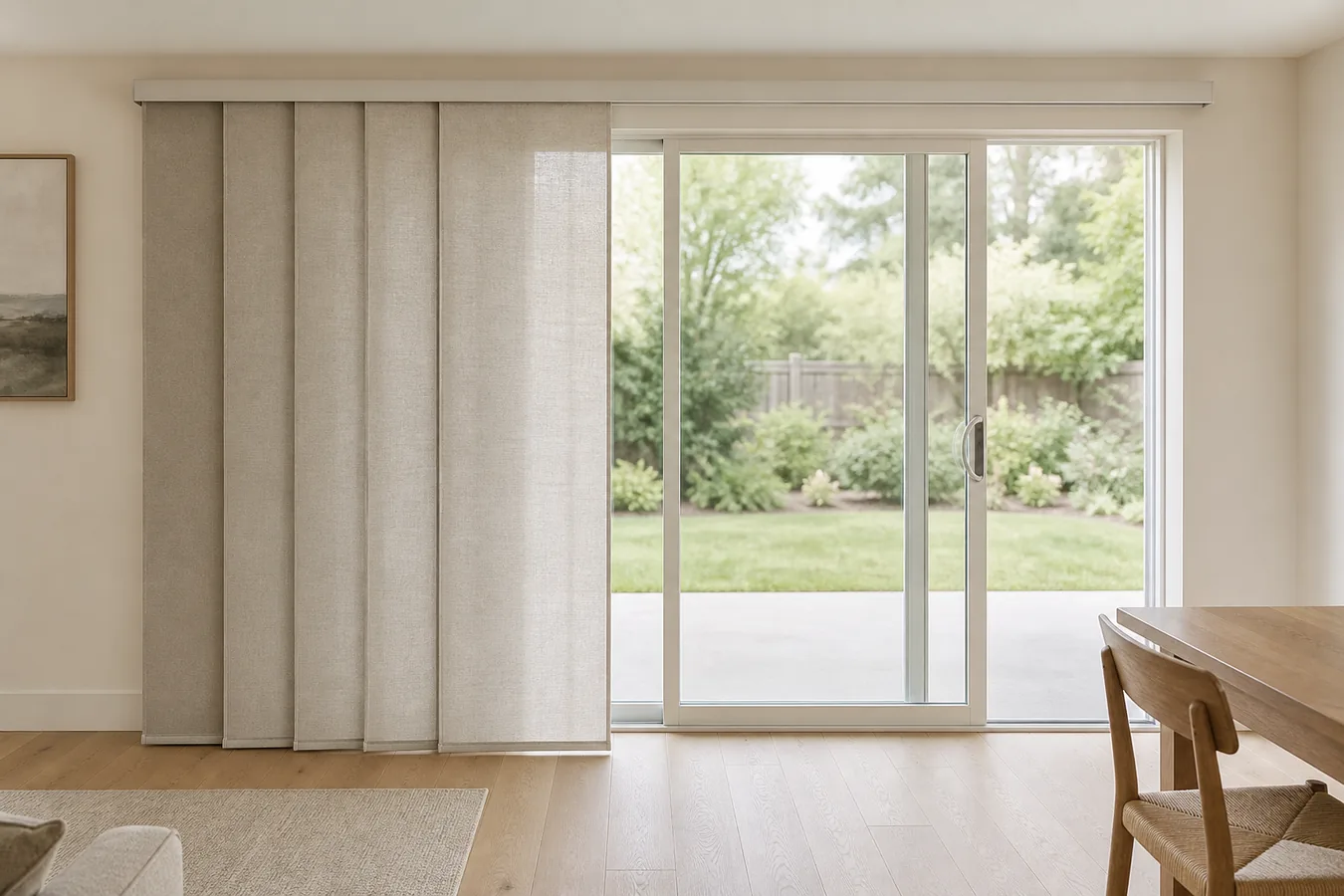
On a sliding door, a new headrail can also change stack width and the clear walking lane. Reopen the large-opening and sliding-door shade guide before treating a same-width replacement as the same fit. If the exact service instructions require the headrail to come down, use the blind-removal guide to identify its release hardware rather than pulling on the vanes.
Build a match card from one intact vane
Choose an undamaged vane from the blind, not the broken piece that triggered the search. Photograph the full vane and both faces, then record the fields below. Put a ruler in the connector and width photographs, but do not make a supplier infer a dimension from perspective alone.
| Match field | What to record | Why it changes the order |
|---|---|---|
| Blind identity | Brand, product family, order number, approximate order date and headrail label | The original dealer or manufacturer may retrieve the correct vane and color from the order instead of guessing across systems. |
| Top connection | Shape, position and size of the punch, slot or hanger; vane thickness around it; carrier hook or stem photo | A similar opening is not proof that the replacement loads the carrier correctly. |
| Width and profile | Exact width; flat, curved or S-shaped section; edge shape; rigid or fabric construction | Carrier spacing and vane profile work together to create overlap and nesting. |
| Finished vane length | Top of the individual vane or hanger to its finished bottom, using the seller’s stated measuring basis | This is not necessarily the installed blind height or a new blind’s order height. |
| Material and weight | PVC or vinyl, fabric or another material; rigid or flexible; lining or insert if present | A different weight or stiffness can hang and move differently even when the outline looks close. |
| Bottom hardware | Sewn or inserted weight, chain or link holes, clips and direction | Fabric-vane bottom parts can make a mixed set hang or move inconsistently. |
| Face and overlap | Which face points into the room when open, curve direction, stack side and control side | Curved and patterned vanes may need a defined orientation to nest and close correctly. |
| Match tolerance | One hidden repair, one visible repair or a whole set; acceptable color, texture and pattern difference in daylight and at night | Age and light exposure can make a nominal color look different beside the existing set. |
| Current support | Supplier’s written compatibility statement, sample or minimum quantity, return terms and available repair parts | “Universal” language is not an exact connector and product boundary. |
Blinds Chalet’s current replacement-vane page makes the attachment risk unusually explicit: its vanes are made for the connectors on its own headrails, other manufacturers may use different top punch patterns, and it guarantees fit only for headrails it sells. That is one seller’s boundary, but it is a useful reason to send the match card instead of asking whether a generic “3.5-inch vane” will work.
Hunter Douglas recommends using original-order information for its best color-match coordination. Its support page also distinguishes reinforcement pieces for fabric and vinyl vane tops on named products. If the only damage is at the top connection, ask whether an exact, currently supported reinforcement closes the defect before converting a repairable vane into a replacement order. Do not improvise a patch that changes the connector thickness or loads the carrier differently.
Length is the easiest field to get wrong twice
Two honest suppliers can request different-looking height numbers because they are selling different objects.
For the replacement vanes on its product page, Blinds Chalet tells buyers to measure the exact length of an existing vane. LEVOLOR’s vertical-blind installation guide explains that the height measurement for its complete blind includes the headrail and that the vane pack receives a deduction. Those statements do not conflict: one is an individual-vane order and the other describes a complete named blind.
Write the measuring contract beside the number:
finished existing vane length, measured on the seller’s stated basis;whole blind or opening height, used only when the complete-product instructions request it; ormanufacturer replacement order, retrieved from the original record.
Never subtract a remembered headrail allowance from an existing vane unless the replacement supplier explicitly tells you to. Never send an opening height to a vane-only seller because it resembles the number on an old invoice. There is no universal deduction to borrow across brands.
Lay two or three intact vanes flat without stretching fabric. Measure each on the same basis and note any real difference instead of averaging it away. A single short vane may have been cut, damaged or hung from different top hardware. For fabric vanes, record whether the top hanger and bottom weight are included in the seller’s stated finished length.
Finish with the installed clearance. The replacement should neither drag on the floor or sill nor sit conspicuously above the set. On a patio door, check it through the door’s ordinary opening path as well as in a static photograph.
A vane can hang and still close badly
Attachment proves only that gravity has somewhere to act. A useful replacement must join the blind’s movement and closed pattern.
LEVOLOR’s installation guide notes that a vane installed in the wrong direction can prevent proper tilt on the products it covers. Its technical guide goes further for named S-shaped vanes: face direction is tied to the control and stack arrangement so the curves nest for the intended light control. Do not copy its left/right chart onto a different headrail. Record the existing blind’s profile and direction, then require the supplier to confirm the replacement configuration.
Once a sample is confirmed safe to attach under the exact instructions, compare it in four states:
- Vanes open and carriers spread across the opening.
- Vanes tilted to each supported closed direction.
- Carriers traversed to the full stack with vanes in the documented travel position.
- Blind closed after dark with the room lights on, viewed from the privacy side that matters.
Look for a reversed curve, a larger light stripe, a leading edge that meets the neighboring vane differently, bottom hardware that pulls one fabric vane out of line, or a top connector that lets the sample sit higher or lower. Stop if the carrier resists, flexes or needs an altered hole. A successful sample should operate without force or a home-made adapter.
Color deserves the same completed-state test. Compare the sample beside the old set in direct daylight, diffuse daylight and the room’s evening light. If the repair sits behind a curtain return, a small difference may be acceptable. In the center of a broad patio door, replacing the full vane set can be the more coherent choice even when one new vane is mechanically compatible.
Choose the smallest service unit that closes the defect
The number of damaged vanes is not a universal replacement threshold. Track condition, part support and visual tolerance matter more than an invented rule such as “three means replace everything.”
| Evidence at the blind | Sensible starting unit | What must be true before proceeding |
|---|---|---|
| One worn top or one damaged vane; all carriers move and tilt correctly | Exact supported top repair or one replacement vane | Current product-specific repair or compatibility, matching geometry and acceptable appearance are confirmed. |
| Several vanes are damaged or one new color will be conspicuous; headrail is smooth and supported | Full vane set on the existing headrail | One sample proves connector, profile, direction, clearance and movement before the full order. |
| One position will not travel, space or tilt correctly while the vane itself is sound | Carrier repair or carrier replacement | Headrail family and exact supported part or service procedure are identified. |
| Multiple carriers bind, the track grinds, controls are failing or compatible internal parts are unavailable | Headrail replacement | New rail’s brackets, stack, draw, controls, vane compatibility and service access are documented. |
| The opening now needs a different stack, safer passage, different light or privacy states, or automation | Complete blind or another covering family | Whole-opening requirements are reconsidered instead of preserving the old format by default. |
| Identity or compatibility remains uncertain | HOLD | Supplier or manufacturer closes the missing fields without forced modification. |
Hunter Douglas’ repair guidance is a useful example of why these units stay separate: it lists vane-top reinforcement, vane removal and carrier replacement as different supported jobs on named products, while steering unsupported or older cases back to a dealer. The transferable lesson is the separation of parts—not the use of those parts on another brand.
If a complete replacement becomes the better unit, compare slatted blinds with continuous-material shades in the blinds-versus-shades guide. If you still need a vertical system but want automated rotation and traversal, the motorized vertical-blinds guide shows why both motions and the final stack must be specified.
Buy one proof before a roomful of mistakes
Ask the supplier for the least irreversible proof it offers: an exact sample vane, a small allowed quantity, or written confirmation tied to your order record and match-card photographs. Some sellers set minimum quantities, so “one proof” may be a sample or the smallest returnable order rather than one retail unit.
Keep the package and do not alter the sample. Confirm the top connection against the carrier with the exact instructions in hand. If the supplier or manufacturer cannot say that the two are compatible, do not enlarge the opening or add an adapter to make the order look successful.
After the sample passes attachment, repeat the real operating sequence without force: open the vanes as documented, traverse across and back, tilt both ways, inspect the overlaps, check bottom clearance, then judge the visible match in day and night conditions. Record the result next to the supplier, product, material, color, finished length and order date.
That record belongs with the blind. It turns the next broken vane from another search for something that looks close into a known product decision—and it also shows when the old track has finally stopped being the part worth saving.