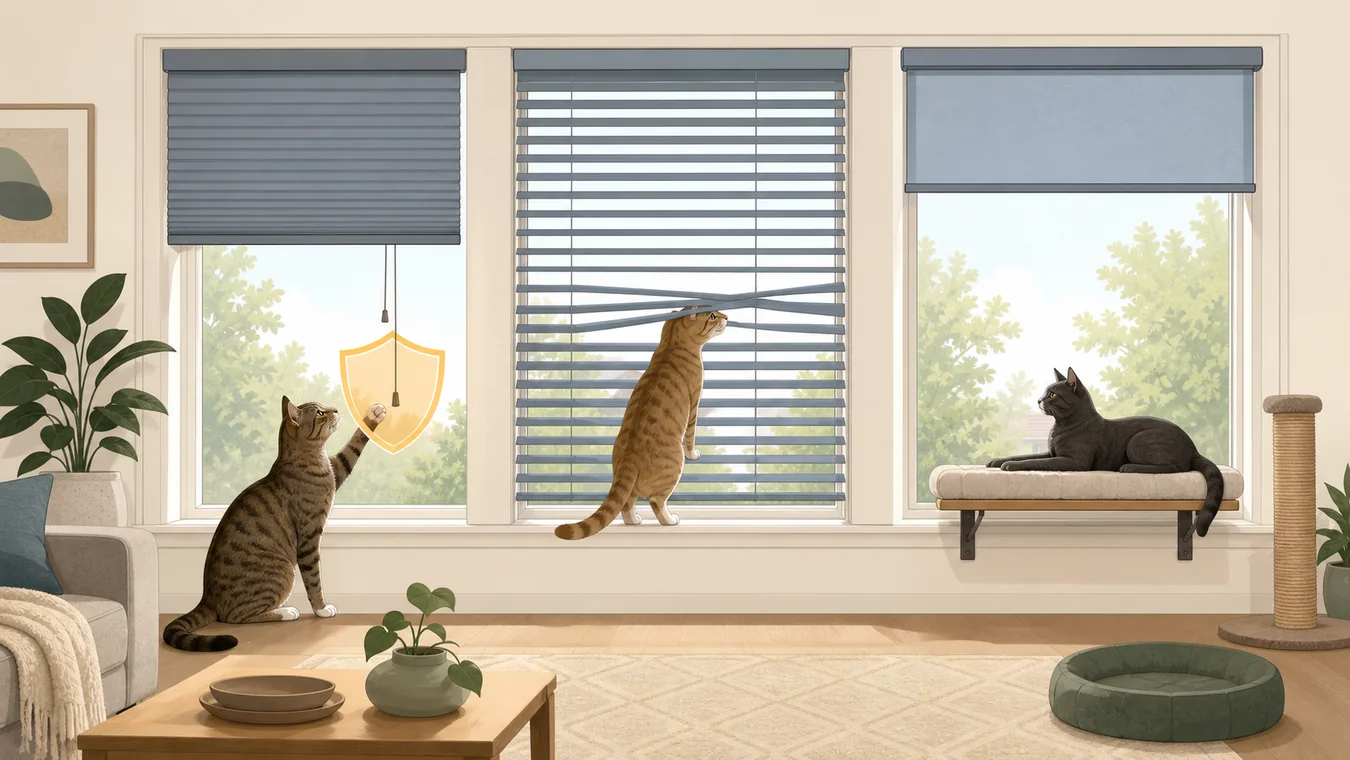
There is no blind that is cat-proof for every cat. A cordless roller shade removes a dangling lift cord, but it does not solve a cat that climbs fabric. A rigid horizontal blind removes that large fabric surface, but a cat determined to reach the sill may push through its slats.
The useful shopping question is not “Which material wins?” It is “What does my cat do at this window, and which part of the covering makes that behavior easy?” Watch the exact window before replacing anything.
Watch one window before choosing a material
Record the interaction rather than the damage alone. A bent slat can come from a cat squeezing toward a view, jumping onto the bottom rail or batting a moving control. Those are different problems, so they should not lead to the same purchase.
| What the cat does | What to investigate | Exposed failure point | Design direction to compare | Tradeoff that remains |
|---|---|---|---|---|
| Bats or chews a cord or chain | Whether the moving control is the attraction and whether any loop or loose end is reachable | Operating cord, chain, connector, tassel or charging lead | An exact cordless, wand or motorized configuration with all remaining leads routed out of reach | Power, charging, local control and service still need a usable plan. |
| Pushes between horizontal slats | Whether the cat is trying to reach the sill or view behind the blind | Slats, ladder material and the space between them | A covering that can park completely above a deliberate window route, paired with an independent perch | The open route changes privacy, glare and solar control. |
| Scratches or climbs fabric | Preferred surface and vertical or horizontal scratching motion | Reachable fabric panel, fold, edge or seam | Less reachable fabric, a rigid covering form, and a suitable scratching surface beside the current target | Rigid slats and louvers can still scratch, bend or be pushed, and light control changes by form. |
| Noses under or lifts the bottom edge | Whether the lower edge blocks a regular viewing or resting route | Bottom rail, hem bar or loose lower fabric | A repeatable raised position with a stable perch, or a separate privacy layer that does not occupy the route | A raised state may expose the room or admit unwanted light. |
| Chews plastic, wood or fabric pieces | Which reachable component is being bitten and whether pieces are missing | Slat edge, vane, bottom rail, end cap or fabric | Restrict access to the component; discuss swallowed or missing material with a veterinarian | Changing material does not prove that chewing will stop. |
| Jumps onto or hangs from the covering | Whether the cat lacks a stable landing or climbing route near the window | Bottom rail, headrail, brackets and mount surface | A separately supported perch or cat tree positioned so the blind carries no pet load | The perch must still clear the sash, screen, lock, travel path and covering movement. |
Do not treat the “design direction” column as a product ranking. It tells you what to compare next. The exact fabric, slat, control, bracket and warranty still decide whether a quoted product fits.
Give the cat a window route that does not use the blind
If the cat repeatedly goes through the covering, the view or sill may be the real destination. Ohio State’s Indoor Pet Initiative recommends window-adjacent perches as part of an engaging indoor environment. A stable perch beside a deliberately clear part of the window can be more useful than asking a fragile covering to serve as a door.
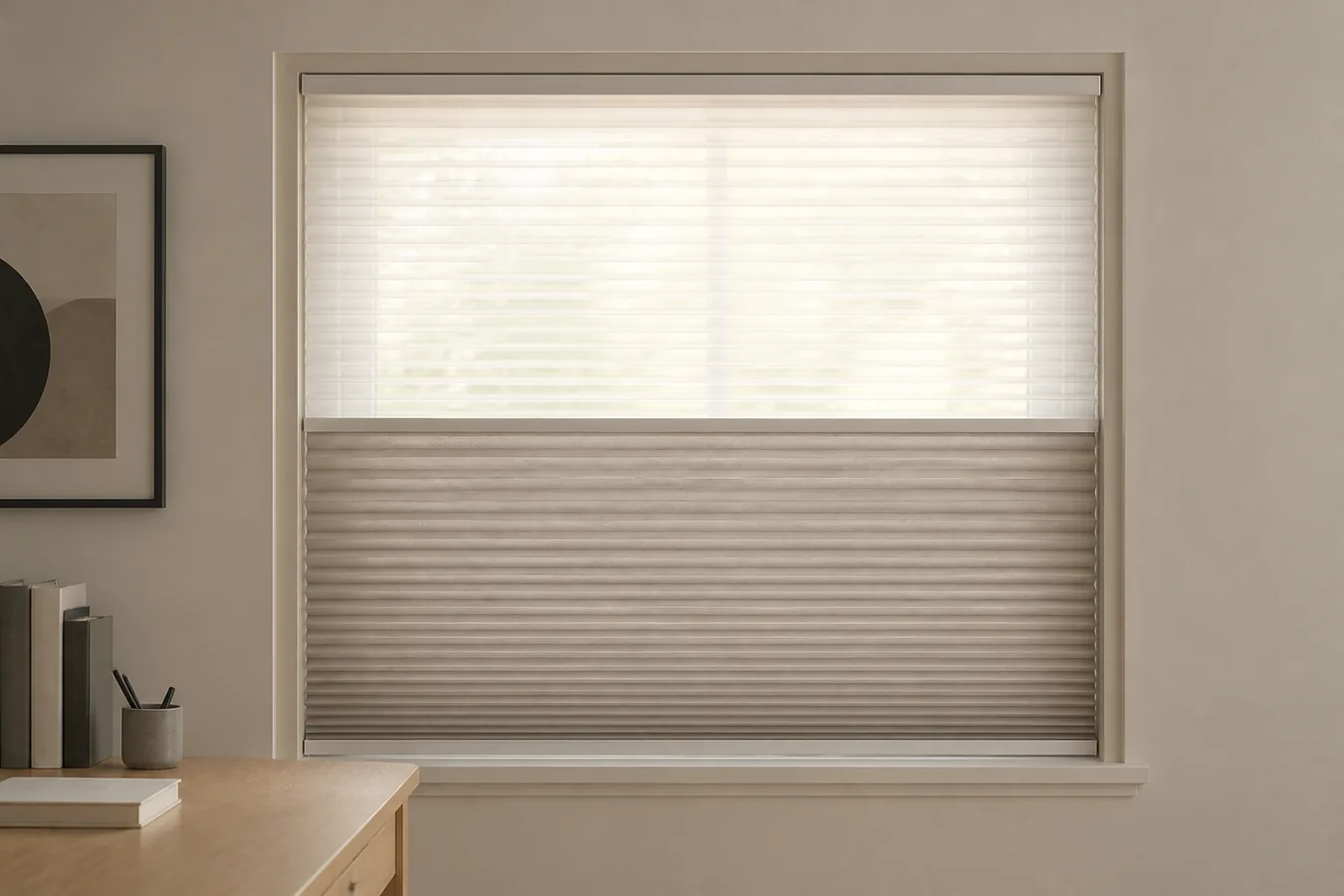
Choose the window state as carefully as the perch. A shade parked above the route gives access but also changes privacy and glare. A partial opening may leave fabric or a bottom rail exactly where the cat pushes. A top-down/bottom-up shade can preserve a covered lower zone in some rooms, but that is the opposite of what a cat seeking the sill may need. Start from the actual route, not a category name.
The perch must support the cat independently. Do not attach it to the blind, rest it on the bottom rail or place it where jumping loads the headrail. Keep the sash, screen, lock and required exit path usable. A window screen is also not a fall barrier unless its exact product and installation are intended and rated for that purpose.
A repeated open state can be manual or motorized. Automation may move a shade to a cat-access position on a schedule, but it does not make contact harmless. Check that the cat cannot enter the moving path, reach a charging lead or become trapped between the covering and furniture. If the view must remain blocked at certain times, another window or an offset perch may be the simpler answer.
Remove the string before ranking the surface
VCA advises securing window-blind cords out of reach because they present a strangling hazard to kittens. If the cat bats, chews or grabs the operating control, exposed cord and chain removal is the first requirement. A tougher slat or more expensive fabric does not address that hazard.
Cordless and motorized options can remove an exposed lift cord from an exact configuration. They do not automatically remove every cord-like part. Check the delivered control, any tilt wand, charging lead, battery cable, rear construction, secondary curtain or shade and the route used during service.
The cordless-blind safety guide explains why an operating label is only one part of the finished product. Its regulatory scope is child safety, not a claim that one blind is safe from every cat interaction. Use it to inspect the complete configuration, then return to the behavior at this window.
A cord cleat may store an existing pull cord when the exact manufacturer supports it, but a cleat is not the same as removing an accessible cord from the product. It also depends on consistent use. For a new order in a cat household, compare configurations that do not rely on remembering to wrap a tempting loose control after every operation.
Compare what the cat can actually reach
The useful difference between a blind and a shade is physical. Blinds expose slats that tilt; shades move a larger sheet or folded body. The blinds-versus-shades comparison covers their general light, privacy, cleaning and fit tradeoffs. For a cat household, add the reachable surface and path.
Horizontal blinds
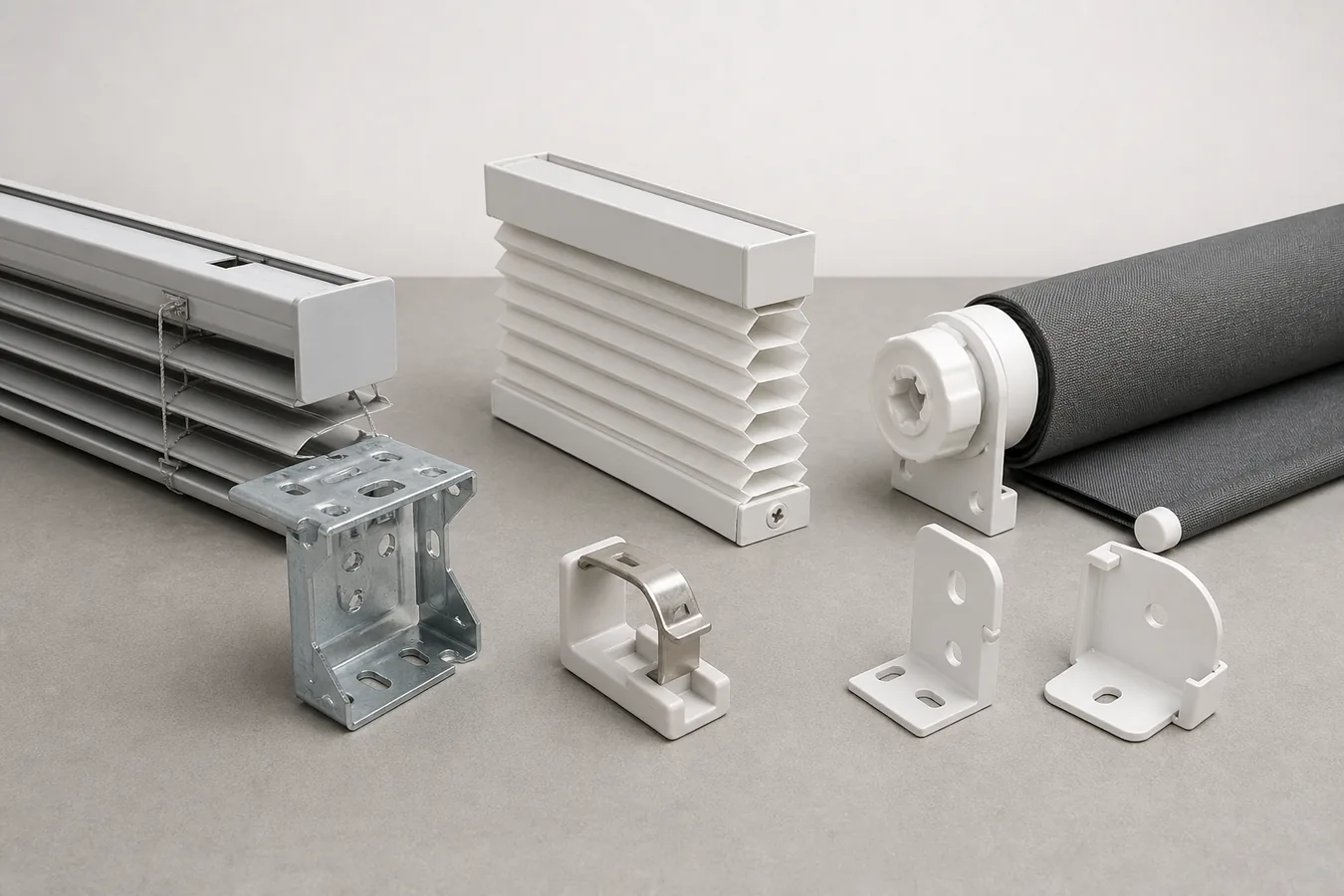
Horizontal blinds expose many slat edges, ladder material and a bottom rail. A rigid slat may be less attractive to a cat that scratches fabric, yet it creates gaps a cat may push through to reach the glass. Wider or thicker slats are not a cat-proof specification. Ask whether individual slats or the bottom rail can be replaced and how the blind parks when the cat is allowed at the window.
Roller, cellular and Roman shades
A roller shade presents one broad panel rather than multiple slats. Cellular and Roman shades add folds, cells, seams or rails. This can remove the push-through path of a horizontal blind but gives a scratching or climbing cat a larger fabric target. Compare the exact material’s care instructions and replacement options; do not infer claw resistance from opacity, thickness or a marketing photo.
Vertical blinds and panel tracks
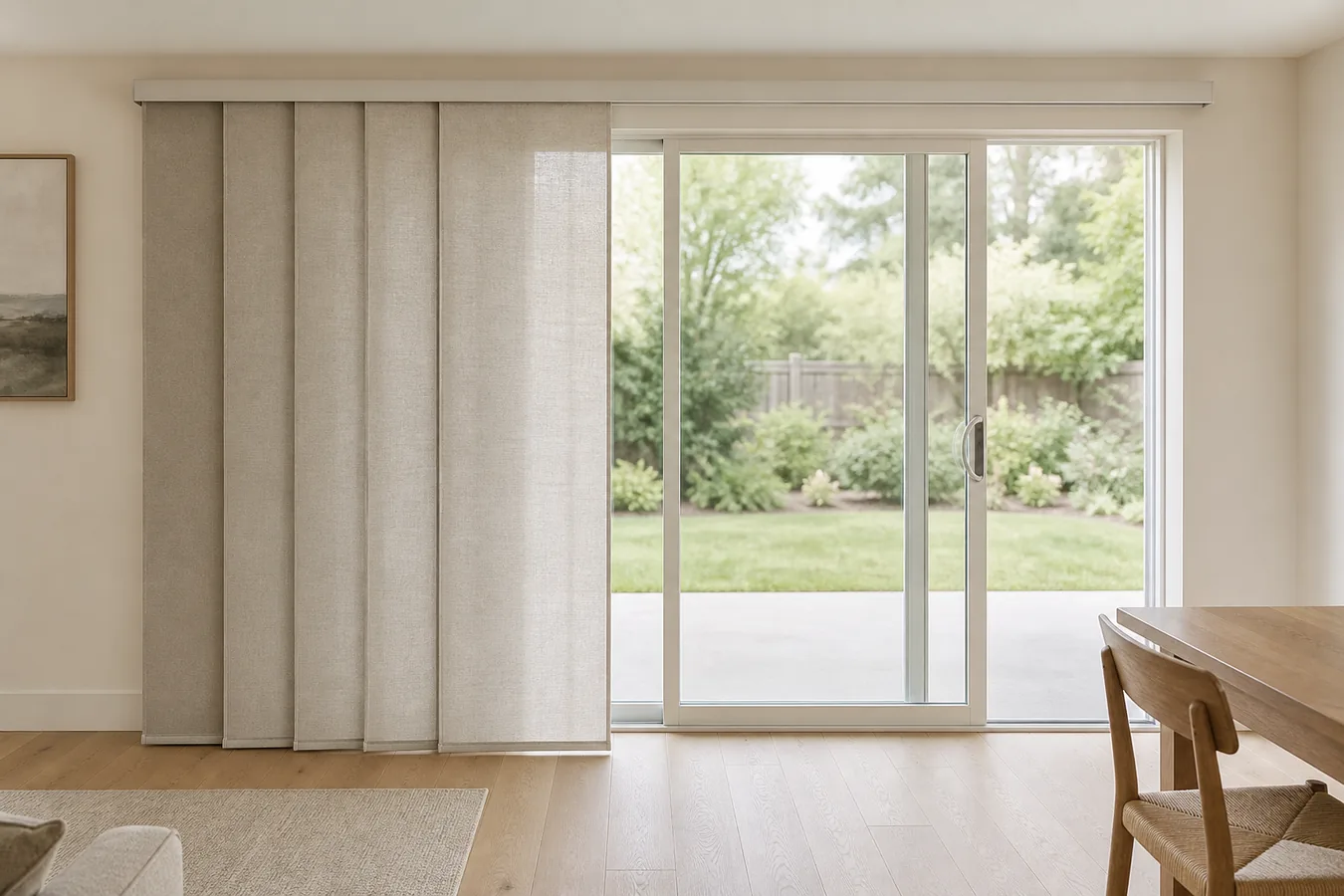
Individual vanes can move aside when a cat passes, which may reduce the need to force through horizontal slats. The same movement can become an attraction, and vanes can detach, crease or be chewed. For a patio door, also protect the human travel path and confirm whether a damaged vane is separately replaceable.
Shutters, privacy film and an uncovered cat window
A framed shutter exposes rigid louvers rather than loose fabric or a lift path, but it still has hinges, finish, controls and custom-fit cost. Privacy film removes a movable covering from the cat’s reach; it also removes adjustable privacy and may block the cat’s view. An uncovered dedicated cat window preserves the view but may not meet the room’s night-privacy or glare requirement. These are valid alternatives when every ordinary blind leaves the same failure point exposed.
Cornell’s feline behavior guidance explains that scratching is innate and recommends observing the cat’s preferred material and orientation, then placing a suitable sturdy scratching surface near the target. That supports redesigning the environment. It does not turn a nearby post into a warranty for the blind.
Pet damage may be your cost even under warranty
Treat pet damage as an ownership cost until the exact warranty says otherwise. LEVOLOR’s current custom blinds and shades warranty lists damage from pets or insects among its exclusions. Another brand, stock product or retailer can use different terms, so read the warranty attached to the exact item on the quote.
Ask what can be replaced separately: one vertical vane, several slats, a fabric panel, bottom rail, bracket or complete covering. Record the product and order identity that support will require. Also ask whether the covering must be removed, shipped or professionally serviced and whether labor, travel or reinstallation is excluded.
Mount stability belongs in this cost discussion. A cat tree, sofa arm or shelf can create a launch point that was not present when the blind was measured. Show that furniture and the planned perch on the elevation. The blind remains a window covering, not a load-bearing shelf; the dedicated perch carries the cat.
Choose the least exposed failure point
For one window, write down the behavior, the access the cat is seeking, the privacy state people need, the proposed covering form, the control path, the component the cat can still reach, the independent perch or scratch route, the mount/service plan and the warranty treatment for pet damage.
Then place that window back into the room-by-room smart-shade planner. A pet route that exposes a street-facing room after dark is incomplete; a private shade that the cat must fight to reach a favorite window is also incomplete.
The strongest shortlist does not promise that the cat will change. It changes the route or removes the tempting failure point while keeping the window useful for light, privacy, operation and service.