When a roller shade won’t stay down, the movement is evidence—not yet a repair instruction. A traditional spring roller may have excess tension or may not be catching at the chosen position. A newer spring-assisted shade can use a different adjustment point, turn direction or stop controller. Chain-driven and motorized shades do not belong on the spring path at all.
Do not begin by removing the shade, winding the tube, spraying lubricant or ordering a spring. First capture the four seconds that produce the fault: the control you touched, the motion under your hand, what happened at release and how the shade answered the next command. That short record preserves the difference between rebound, upward creep, weak lift and physical binding.
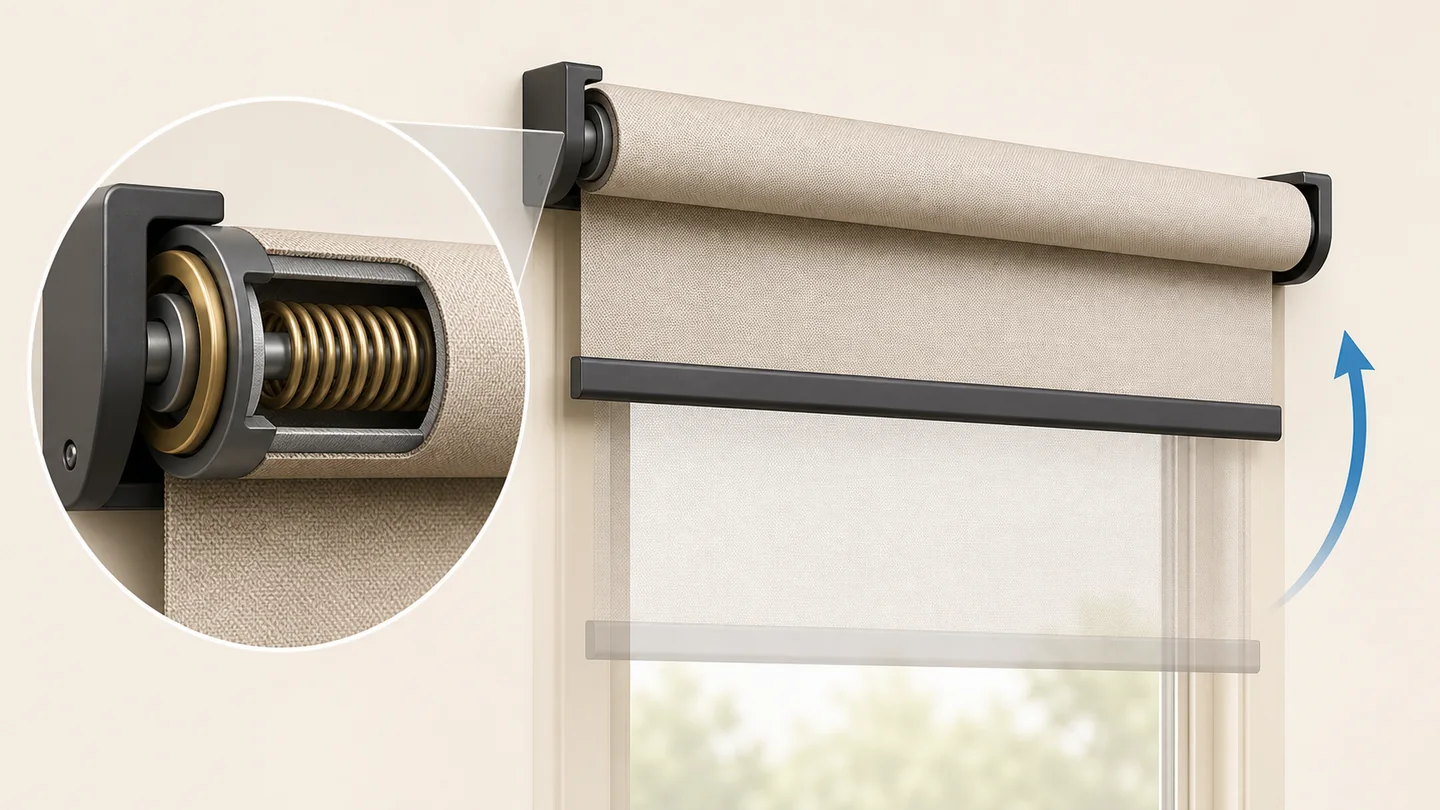
The illustration is generic. It shows why the force can be hidden inside a roller tube; it does not show the mechanism inside your shade or authorize a repair direction.
The fault happens in four seconds
| Moment | Observe without changing the mechanism | What the observation can separate |
|---|---|---|
| Before the touch | Maker label, collection or order number; hem-bar handle, pull, chain, wand, remote or headrail button; documented standard or reverse roll | A chain or powered control exits the simple spring branch; a product name creates a current-manual search target |
| During movement | Did you pull and release, push the rail to position it, turn a chain or press a control? Did the shade move freely, drag, skew or stop on one side? | The intended hand motion distinguishes operating systems; drag and skew can mimic a spring fault |
| At release | Did it snap upward, creep upward, remain where placed, fall lower, or stay fixed while the fabric shifted? | Fast rebound and slow creep are different records; a bracket or fabric problem should not be renamed “bad spring” |
| Next command | Does a small pull release it? Can it be pushed upward? Does the chain rotate? Is there motor sound? | The response routes the case to spring-activated Cordless, position-anywhere lift, clutch, motor or product support |
Use words that describe motion. “It shoots to the top after I let go” is more useful than “the tension is bad.” “It remains at the sill and the control side feels free” is more useful than “the spring is broken.” The cause comes later, after product identity and intended motion agree.
If you are not sure whether the covering is a roller, cellular, Roman or horizontal blind, begin with the broader cordless blind symptom guide. This page starts once the covering is a roller shade.
Name the control before naming the spring
A spring can support more than one user experience. The word “cordless” does not tell you which one you own.
| Control clue | Normal motion to verify | Next evidence owner |
|---|---|---|
| Pull-and-release hem bar | Pull down to lower; another small pull and release may initiate the rise on the named product | Exact spring-activated Cordless operating and stop-height record |
| Position-anywhere hem bar | Directly push or pull the rail and leave it at the intended position | Exact balanced-lift or spring-assist tension record |
| Simple exposed end pins | Traditional pull-down roller with a spring/locking arrangement inside the tube | Maker record when available; otherwise the bounded legacy spring branch below |
| Continuous bead chain | Chain turns the drive while its tension device remains installed | Roller shade clutch identity and repair scope |
| Remote, wand or headrail button | A powered command moves the roller to programmed limits | Motorized blind failure-layer troubleshooting |
The cordless operation guide shows why pull-and-release and direct push/pull are not interchangeable normal motions. Match the intended response before classifying what has failed.
Rebound, creep and weak lift point in different directions
A rapid rebound is the classic complaint: the bottom rail is released and the fabric runs upward immediately. On an identified traditional spring roller, excess spring tension or a locking problem can produce that behavior. The observation does not prove which one. If the shade will not catch at any position, a rewind that changes only tension may not restore the part that holds position.
Slow upward creep is a different event. The rail accepts a position, then rises gradually without a new command. Current Hunter Douglas guidance uses that symptom within a named LiteRise system to route the user toward reducing spring tension. The same source treats its spring-activated Cordless system differently: it has pull-and-release operation and a separate stop-height adjustment. Two products sold under the broad cordless idea therefore turn upward movement into different service questions.
Weak lift or no lift points away from the fast-rebound branch. A spring-assisted shade may need more supported lift force, but a bracket squeeze, skewed fabric, obstruction or failed mechanism can also consume or remove movement. The Fix My Blinds roller troubleshooter separates spring tension from clutch, mounting and fabric faults. It also directs attention to secure, level brackets when the material travels unevenly. That is a reason to record alignment, not permission to dismantle the tube.
Physical resistance changes the order of work. If fabric is telescoping into an end plate, a bracket is loose, the tube is not seated, or an enclosure is trapping the hem bar, do not overcome the resistance by increasing spring force. A new scrape, frayed edge, bent bracket, loose mounting surface or uncontrolled snap belongs with the exact manufacturer or installer before another cycle.
The adjustment point belongs to the product
Two current manufacturer records make the danger of a universal clockwise rule unusually clear.
Hunter Douglas repair guidance updated August 12, 2026 distinguishes Cordless from LiteRise on named Designer Roller and Screen Shades before giving an adjustment. Its LiteRise tension path uses a 3/16-inch Allen interface. For that named system, the direction depends on whether fabric rolls from the back or front, and the page limits the change to one or two turns. It also says supported in-home repairs are limited and routes other issues to a dealer.
The June 2025 LEVOLOR PerfectPlacement Cordless Lift open-roll guide describes another named assembly. It uses a 5 mm Allen wrench at the spring head. In that guide, clockwise adds tension and counterclockwise reduces it, while the spring-head side changes between standard and reverse roll.
Those directions are not a conflict to average out. They prove that “turn the spring clockwise” is incomplete advice. Maker, collection, control, roll direction, access point and current document must all match before the direction has meaning. If the shade is reverse roll, preserve that fact; the reverse-roll guide explains how fabric position changes the physical layout even before service begins.
A manual for a similar-looking shade is not a substitute. Do not translate a 3/16-inch control bracket into a 5 mm spring head, move an instruction from position-anywhere lift to pull-and-release Cordless, or assume a direction survives a reversed roll.
The flat-pin rewind is a legacy branch, not the default
A traditional spring roller can still be a reasonable owner repair when it is positively identified and no current maker instruction says otherwise. The generic path described by Fix My Blinds is conditional: too little lift tension is addressed by lowering the identified spring shade partway, removing it as designed, rolling the fabric evenly by hand and reinstalling it; excessive speed/tension uses the opposite change by manually unrolling the removed rolled shade several turns. The symptoms require opposite changes.
Use that record as a description of the traditional mechanism, not as authority for a concealed modern control. If the shade has a cassette, mounting bar, proprietary end cap, tension-access hole, stop dial or branded lift name, return to its current manual.
Stop the generic branch when the tube no longer develops tension, the end pin spins without documented resistance, the shade cannot be removed safely from its exact brackets, fabric is fraying, or the next step is opening the roller tube. A failed internal mechanism may make the supported repair unit a spring assembly, an entire roller, dealer service or a replacement shade. The search phrase “spring roller shade replacement parts” does not decide which unit is sold or approved.
Buy the repair unit, not a loose spring
Before ordering anything, make one identity line:
maker and collection — order/model or manufacture period — operating-system name — standard/reverse roll — tube or mounting-bar identity — control side — exact symptom — current manual — supported part or service route
A photograph can help a manufacturer recognize the ends and bracket, but appearance alone does not prove a part number. Tube diameter also does not prove the spring, stop controller, bracket interface or supported load. For a chain-driven shade, the clutch, tube interface, bracket, idler, bead chain and tension device form the repair scope. For a powered replacement, the motor and completed drive end require their own compatibility record; the roller shade motor guide owns that decision.
Hunter Douglas’ current page limits the in-home repairs supported for its named products and says other issues can require professional assistance. LEVOLOR keeps replacement parts and repair-center service under its customer-service path. Those are executable outcomes, not failures to find a DIY trick.
A seller’s “universal spring” claim is not enough when shade identity, tube interface, control behavior and bracket retention remain unresolved. Return one of four outcomes: follow the exact documented adjustment; request the exact supported part or service; replace the documented roller or complete shade; or hold the purchase until the system is identified.
Leave support the motion, not a changed mechanism
If the exact document does not close the fault, stop with the before-state intact. Send the maker, dealer or repair shop the identity line plus four observations: motion under your hand, movement at release, response to the next command, and any skew, rubbing or sound. Include label, end-hardware and full-window photos without removing covers the manual does not authorize.
State every change already made. “No adjustment performed” is valuable. So is a precise record of one documented change returned to its original position. A support case becomes harder after repeated winding, moved brackets, lubricant inside the tube or a symptom that can no longer be reproduced.
If repair turns into replacement, carry the operating motion, reach, service access and fallback you learned into the Smart Motorized Blinds Planner. The useful result is not a shade that happened to move once. It is a shade whose control, repair owner and next service step are known.