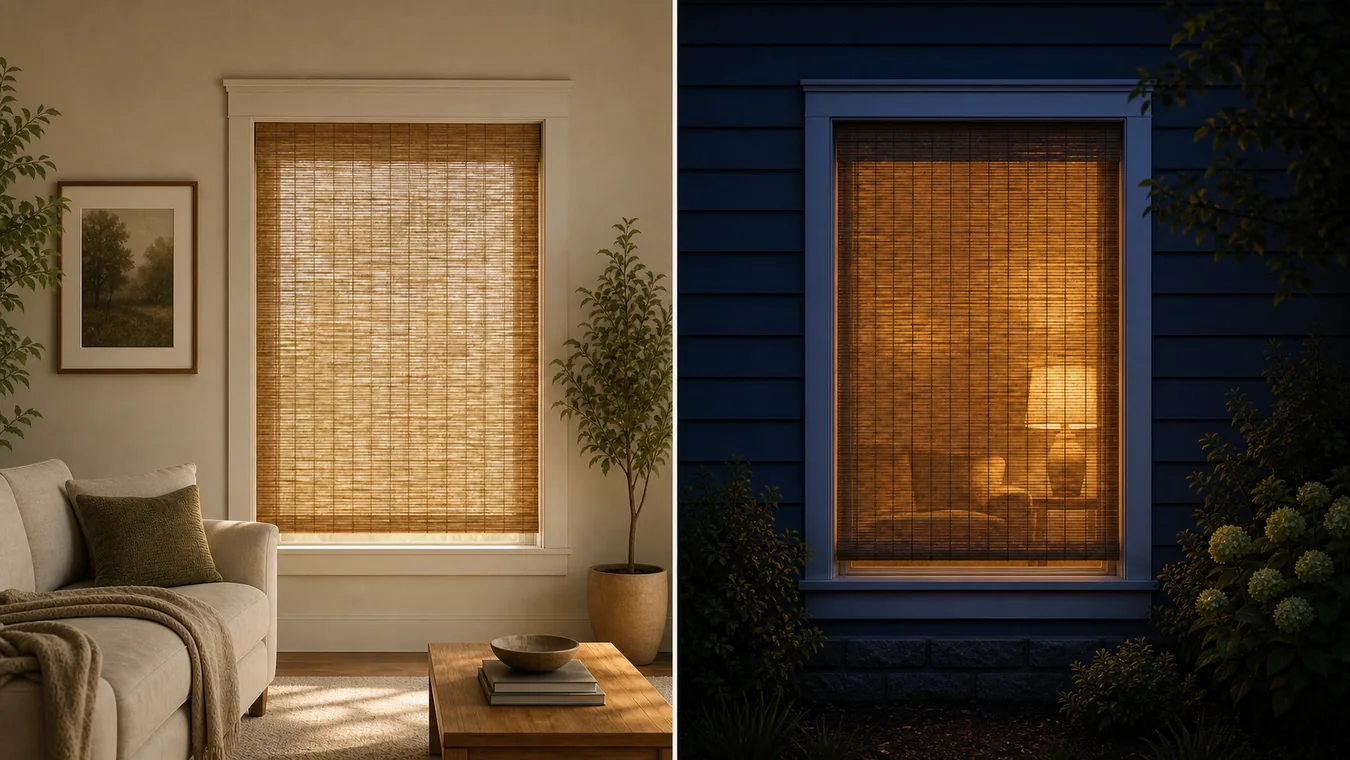
A natural woven shade can look calm and private while afternoon light falls through it. Then the sun goes down, the room lights come on, and the visual balance reverses: the brighter room becomes easier to see from the darker side of the glass.
That is why “bamboo” does not answer the privacy question. The result depends on the exact weave, the named liner, whether that liner moves with the face shade or on its own, and the uncovered space around both layers. Treat an unlined sample as unproven after dark until it is viewed on the real window from the relevant outdoor position.
The practical purchase is a day-and-night configuration, not a material swatch. Keep the texture only if the quote also describes what happens after dark.
Start outdoors, after the room lights come on
Begin at the place where privacy could fail: the sidewalk, neighbor’s window, deck or yard after dark. Turn on the lamps that would normally be used in the room. A daytime inside view cannot substitute for this angle because the relative brightness has changed.
Use the following four states to narrow the order. The liner names are not universal specifications; the seller still has to define the behavior of the exact product.
| Configuration | What it can preserve | What must be proven after dark | Stronger starting use |
|---|---|---|---|
| Unlined open weave | The most visible texture, glow and partial view through the material | Whether people, movement or room details are visible from the real observer position | A room where filtered light and texture matter more than occupied nighttime privacy |
| Named privacy liner | More separation and softer transmitted light than the bare weave | The manufacturer’s exact privacy statement and whether silhouettes remain | A room that needs improved privacy but can accept some glow or shape transmission |
| Named room-darkening liner | Much less transmitted light and a stronger visual barrier through the body | Whether the claim covers silhouettes, seams and the chosen color/configuration | A room where nighttime privacy outranks the unlined appearance |
| Independently operated liner | Woven texture alone by day and a second coverage state when needed | Independent operation, control, stack, size and gap details in the exact system | A room that genuinely needs both an open-weave day state and a covered night state |
Bali’s current Natural Shades page shows why the name must stay attached to the product. It says its privacy liner improves privacy and light control while objects may still appear as silhouettes from outside; its room-darkening liner says those silhouettes are not visible. That is useful evidence for Bali’s named options, not permission to assign the same behavior to every seller’s “privacy” or “room-darkening” liner. See the current Bali liner descriptions.
If the desired night state is “no recognizable person or movement from the sidewalk,” write that observable result into the quote request. “Add privacy liner” is too vague.
A liner can be narrower than the face
The center of a lined shade is only one part of the view. The woven face may be wider than its liner, and the whole assembly may leave another gap between the shade and the window opening. Those are three different widths:
- the ordered or finished width of the woven face;
- the finished width of the liner behind it;
- the covered width after brackets, deductions and operating clearance are applied.
LEVOLOR’s January 2025 Woven Woods reference guide, for example, lists its liner as 1/4 inch narrower than the face fabric—1/8 inch on each side. That is an exact product-guide example, not a universal allowance. It proves why “lined” is not enough information. The LEVOLOR Woven Woods reference guide also needs to be checked for the quoted configuration rather than borrowed for another brand.
Measure the opening and obstructions with the window-shade measurement checker, then decide which plane the covering should occupy with the inside-versus-outside mount guide. An outside mount can increase overlap when trim and wall space allow it; an inside mount can preserve the frame but exposes the manufacturer’s deductions and recess geometry.
Do not convert an opaque center sample into a whole-window blackout promise. Side light, sill light and headrail geometry are separate, and the blackout Roman shade guide owns that stricter room-darkness problem.
The sample is the product you can see
“Bamboo window shades” is a search category, not a reliable bill of materials. Bali describes natural shades made from combinations that can include bamboo, grasses, jute and hardwood. Hunter Douglas describes its Provenance line with natural woods, reeds, grasses and bamboo. The meaningful identity is the exact collection, pattern, color and liner—not the broad bamboo label.
Variation is part of the material. Current Bali and Hunter Douglas pages both describe the changes in color, grain or texture that occur in natural weaves. That can be the reason to choose them, but it also means one small digital image cannot promise identical bands across several windows. Review the largest representative sample available, ask how normal variation is handled, and put adjacent-room or same-room quantities on one documented order when visual continuity matters. The current Provenance product page shows the scope of one named woven-natural family without defining every bamboo shade.
Carry the sample to the actual window twice. In daylight, look at texture, color shift, glare and how much view remains. After dark, light the room normally and view the fully lowered sample from the relevant exterior angle. Record what is visible; do not turn a result from one weave, window or lighting setup into a category-wide claim.
Attached and independent liners create different rooms
A liner can be included yet still fail the daily routine. If it is attached to the woven face, lowering the liner also lowers the decorative shade. You cannot keep the open-weave day state while moving only the liner.
LEVOLOR’s referenced Woven Woods configuration says its attached liner cannot operate separately. Hunter Douglas, by contrast, describes a named independent liner that shares a headrail but operates separately on eligible products. The Hunter Douglas independent-liner page is evidence that this arrangement exists, not evidence that every woven shade supports it.
Choose among these operations before choosing a control:
- One movement is acceptable: an attached liner may be simpler if the woven face and privacy layer should always move together.
- Day and night need separate states: require an independently operated liner and verify its available controls, stack and finished size.
- The texture matters only when raised: a different shade construction may solve the room with less material and fewer moving layers.
The roller, cellular and Roman shade comparison is the required handoff when the woven Roman form is no longer clearly the right one. If separate motor channels or coordinated movement are essential, use the motorized Roman shades guide to define fold, liner, power and control as one finished system.
Humidity can disqualify a beautiful weave
Natural material is not a wet-room approval. LEVOLOR’s current Romans and Naturals technical guide says natural woven fabric can be affected by temperature and humidity and may shrink, stretch or warp slightly. Its listed care is dry: vacuuming, dusting or clean forced air, without water, solvents or abrasive solutions. Hunter Douglas gives similarly specific dry-care directions for Provenance and warns against steam, high moisture and rain exposure.
Those instructions belong to the named products, but the decision rule is broader: obtain the exact care and environmental limits before assigning a woven-natural shade to a humid or splash-prone room. If the glass regularly condenses, the covering enters direct splash, or the room does not dry reliably, pause the style decision and use the bathroom window treatments guide to map water, sightlines and cleaning access first. A liner does not make the front weave moisture-proof.
For an ordinary dry room, ask how both the face and liner should be dusted, whether either layer can be spot-cleaned, and how the shade can be serviced without crushing the weave. The current Hunter Douglas Provenance care instructions illustrate why exact-product care belongs in the purchase record.
The lift belongs in the same quote
The photographed style may be shown with an operating system that is not available at the desired width, liner or material. Current technical guides vary maximum dimensions and control combinations by fabric and configuration. Ask for the finished lift on the exact line item: cordless manual, motorized, or another current compliant system—not “cordless available” copied from a collection page.
For US stock window coverings, CPSC’s current business guidance requires operating cords to be cordless, short or inaccessible, with additional restrictions for inner cords. Where young children are present, CPSC says cordless is the safest option. The cordless and motorized child-safety guide turns that requirement into a finished-product review, while the CPSC consumer guidance gives the current safety direction.
Motorization can make a tall or frequently adjusted shade easier to use, but it does not improve weave opacity or eliminate edge gaps. It also adds power, charging/service access, local control and size limits. Keep those as separate quote fields rather than allowing “smart” to stand in for the night-privacy decision.
Make the quote describe the night view
A usable bamboo-shade quote should make six items unambiguous:
- Face material: exact collection, pattern/color and the seller’s natural-variation policy.
- Liner: exact name plus its stated light and silhouette behavior—not just “privacy included.”
- Operation: attached to the face or independently operated, with the chosen control.
- Finished geometry: face width, liner width, mount, deductions, overlap and expected side/bottom gaps.
- Lift: the exact cordless or motorized system available at this size, with local operation and service access.
- Room fit: the manufacturer’s care method and any humidity, splash or environmental exclusion.
Read that quote from the outside after dark in your mind: what layer is down, which light is on, and what should an observer be unable to recognize? If the paperwork cannot answer that plainly, the bamboo window shade is not ready to order—however good the daytime swatch looks.