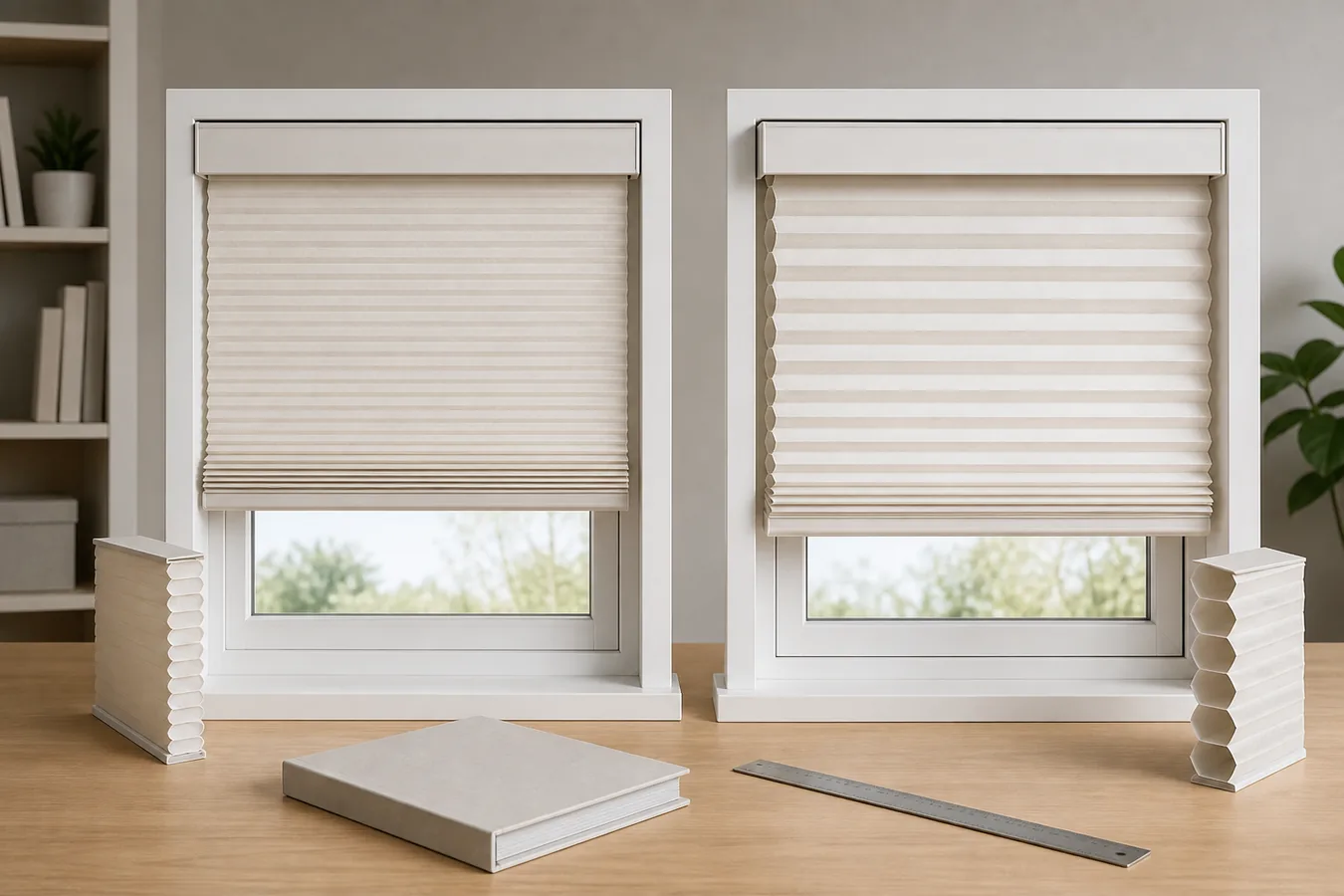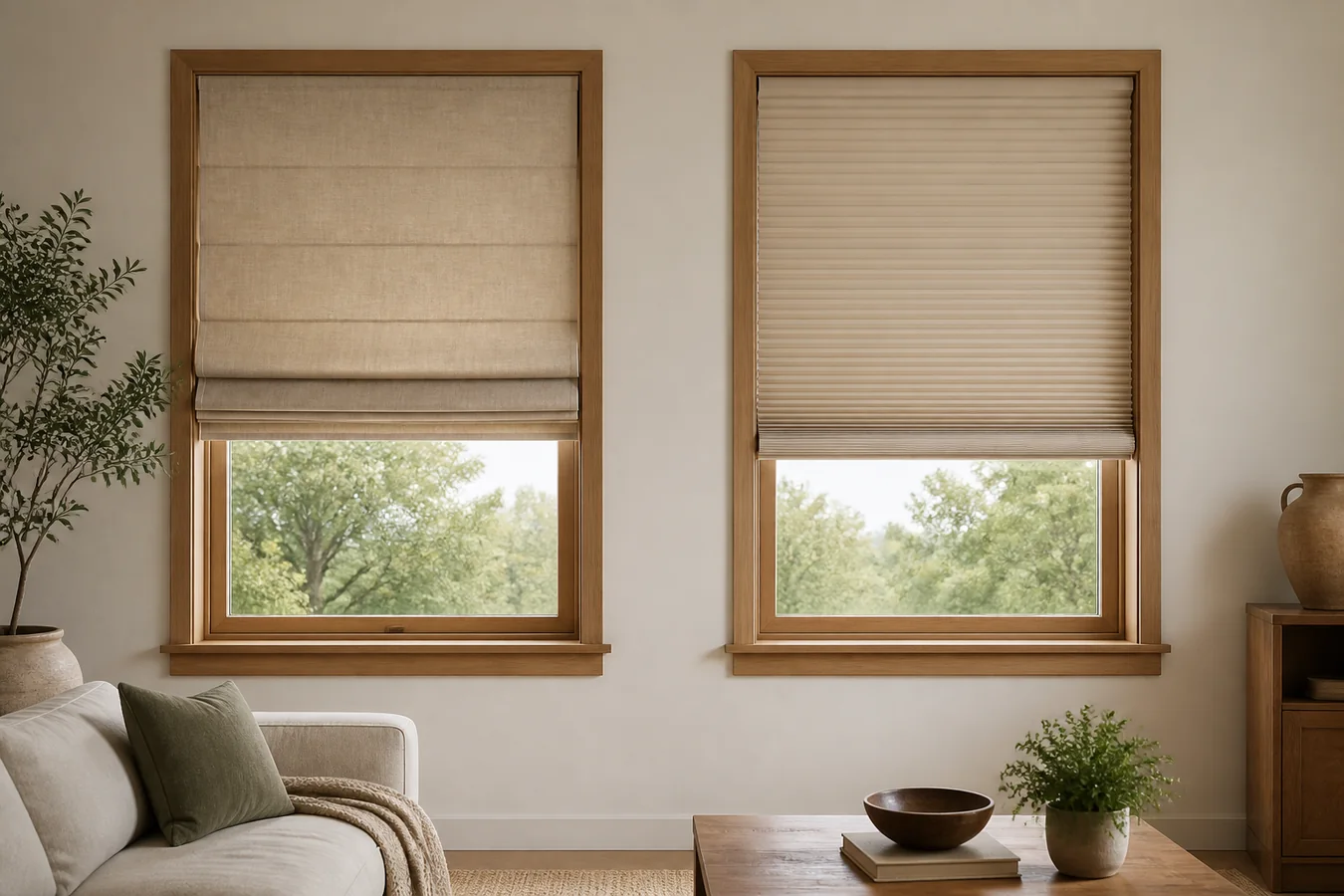
A Roman shade and a cellular shade can both soften a room, cover the glass and use a cordless or motorized lift. They stop being interchangeable when they move. A Roman shade gathers a visible textile into folds; a cellular shade compresses a repeated pleated structure.
Start with Roman when the fabric face and fold are part of the room’s design. Start with cellular when a compact pleated package and product-supported insulation matter more. Neither is the winner until the exact finished shade works while lowered in daylight, lowered after the lights come on, fully raised, and due for cleaning or service.
Choose by the first state that fails
Do not compare one Roman swatch with one cellular swatch on a sales desk. Put both proposed configurations through the same four states. The first unacceptable result is more useful than a long list of category advantages.
| Finished-window state | Roman shade must prove | Cellular shade must prove | Decision if evidence is missing |
|---|---|---|---|
| Lowered in daylight | The chosen fold, face fabric, lining and pattern look deliberate at the finished width and drop. | The pleat size, color and opacity produce the wanted surface instead of reading as a generic office shade. | Request a large sample and a photo or rendering of the named construction; do not approve from a small swatch. |
| Lowered after lights are on | The face, liner, fabrication points and perimeter give the required privacy or darkness. | The exact opacity plus side, top and bottom gaps meet the same requirement. | Treat “privacy,” “room darkening” or “blackout” as unverified until the complete coverage is shown. |
| Fully raised | The accumulated folds leave enough view, clear the handle and preserve access to the headrail. | The compressed pleats, bottom rail and headrail leave the required clear opening. | Require a quoted fully raised dimension; never estimate stack from the category name. |
| Cleaning, charging or service | The specified fabric and liner tolerate the room’s likely soil and the lift components remain accessible. | The cells and fabric have an acceptable care method, while the power source and motor can be reached if fitted. | Hold the order. Ownership begins after the showroom visit. |
The table is intentionally strict. It compares two complete configurations, not the best Roman option with a basic cellular one. If a liner, top-down/bottom-up lift or motor is added to one row, price and fit must be updated for that exact row too.
Lowered, the surface has to earn the room
Roman shades put more visual responsibility on the textile. Fold style, fabric body, seams, liner and pattern placement can remain visible across a large part of the window. That makes Roman a strong candidate when the covering should read as furnishing rather than quiet background. It also means a small sample cannot show how the material will hang, fold or align at full size.
Cellular shades replace broad fabric folds with repeated pleats and internal cells. The effect is usually more regular and architectural. Color, cell size, rail finish and opacity still matter, but the decorative decision is less about drape. If the room already has patterned upholstery or curtains, that restraint may be a benefit rather than a compromise.
Do not let the surface decision absorb the privacy decision. A Roman face fabric may need a named liner. A cellular fabric may be sheer, light filtering or more opaque. In both cases, installed edge gaps can remain visible after the center material is covered. Judge the sample against the glass in daylight, then repeat the observation from outside after dark with the room lights on.
Operating style does not belong exclusively to either category. Current named systems demonstrate that Roman and cellular families can each include multiple opacity, lift and motor choices. For example, Hunter Douglas presents options within its Vignette Roman and Duette cellular lines. Those pages prove availability only for the named configurations, not for every Roman or cellular shade. Put the exact option code on the quote.
Raised, the stack can veto the prettier sample
A shade spends part of its life above the view. Roman fabric forms folds as it rises, so material, lining, fold construction and finished drop influence the raised package. Cellular pleats compress differently, but the headrail, bottom rail, shade size and lift system still occupy space. “Roman stacks larger” is a useful research direction, not a dimension you can order from.
Imagine a short window above a desk. A Roman sample may be the better match for the room, yet a deep fully raised stack can leave too little sky visible or collide visually with the upper sash. On a tall window where the top portion is rarely part of the view, the same stack may be inconsequential. The window, not a generic comparison chart, decides whether the difference matters.
Ask each seller for a front elevation showing the fully lowered finished width and gaps, plus a second elevation showing the fully raised bottom position. Add the headrail projection, handle location and service clearance. Manufacturer technical guides, such as LEVOLOR’s current Roman and cellular guides, illustrate why dimensions, deductions and available configurations belong to named products. Their numbers should not be transferred to another brand or construction.
If the Roman path still leads, the guide to motorized Roman shade fold, stack and motor fit goes deeper into front, rear, moving and fully raised views. If the cellular quote hides its construction behind “premium insulation,” compare the exact evidence in the single-cell versus double-cell guide.
Insulation needs a product record, not a honeycomb slogan
Cellular shades deserve the first look when window insulation is a leading requirement. Their cells create air spaces, and US Department of Energy research on cellular shades found meaningful performance in its defined test and modeling scope. That evidence supports investigating a well-fitted cellular product. It does not promise a particular household saving, make every honeycomb equal, or prove that a category label overcomes a poor fit.
Do not ask, “Is cellular more energy efficient than Roman?” without defining the two products. Ask for the exact manufacturer, collection, fabric or cell construction, operating option, current rating or certified listing if available, and the installed geometry to which the evidence applies. A Roman quote with a liner and an outside mount is not identical to an unlined Roman sample; a cellular quote with different cells, fabric or control is not automatically equivalent to the product in a study.
The broader energy-efficient window-covering guide separates winter heat loss from summer solar gain and explains why rating, perimeter fit and operating schedule travel together. Use that process if energy performance is the deciding job. Keep this comparison focused on whether the Roman or cellular configuration can provide the appearance, stack and ownership result you also need.
Care and operation can reverse the choice
Cleaning advice has to start with the exact material. Roman fabrics and liners differ in whether they tolerate vacuuming, spot treatment or professional cleaning. Cellular materials differ too, and the cell openings or bonded structure can make an improvised wet method a bad experiment. Identify the likely soil—ordinary dust, cooking film, condensation marks, pet contact or fingerprints—then obtain the current care instructions for the exact quoted fabric. If the allowed method does not fit the room, reject the configuration before it becomes a maintenance problem.
Operation is another configuration decision, not a category prize. Standard bottom-up, top-down/bottom-up, cordless manual and motorized paths can change the hardware, available sizes, gaps, stack, price and service access. If lower-window privacy with daylight above is essential, confirm that the exact combination of fabric, size and control supports it. If a high or frequently adjusted window makes a motor useful, specify power, local control, charging or battery access, controller dependencies and the behavior after service.
The terms smart and motorized still do not identify a physical shade construction. Use the smart blinds versus motorized shades guide to freeze the control requirement after the Roman-or-cellular choice has survived the window. For a cellular configuration, the motorized cellular guide keeps fit, power, local fallback and service in the same decision.
Where young children may be present, safety outranks the preferred fold or app. The US Consumer Product Safety Commission advises choosing cordless window coverings in that setting. Inspect the completed product and all accessible cords; a motor label by itself does not describe every component behind the shade.
Make both quotes prove the same finished window
Send both sellers one window record rather than two different shopping questions. Capture the opening, intended mount plane, available depth, trim, handles and other obstructions with the Smart Shade Measurement and Compatibility Checker. Then ask for two complete rows—one Roman and one cellular—with no blank category promises:
| Quote field | Roman row | Cellular row | Reject or hold when |
|---|---|---|---|
| Construction | Fold, face fabric, liner, opacity and window-facing finish | Cell construction, fabric, opacity, rails and window-facing finish | The row uses only “designer,” “thermal” or “blackout.” |
| Finished geometry | Mount, ordered and finished size, deductions, edge gaps, projection and fully raised position | The same dimensions for the cellular configuration | Only opening measurements are shown. |
| Performance evidence | Evidence for any privacy, darkness or thermal claim attached to this construction | Exact current rating/listing plus privacy or darkness evidence for this construction | A category average or unrelated model supplies the claim. |
| Ownership | Care, lift/motor, power, control, safety, service access, warranty and return terms | The same completed ownership fields | The sample is approved but the operating system is still “to be confirmed.” |
Now the choice can be specific. Select Roman if its finished textile and folds create value you can still accept after the night view, raised stack and care burden are visible. Select cellular if the exact pleated product preserves the opening and supplies stronger relevant performance evidence without creating an ownership problem. If neither row survives all four states, change the configuration or choose another shade type; a missing drawing or product record is a reason to wait, not a reason to guess.