Motorize the window you repeatedly avoid—not the room with the longest feature list. A motor earns its premium when it performs a named job often enough to change how the shade is used, and when power, control, fallback and service are all acceptable.
That answer can differ from one window to the next. A frequently adjusted group may earn motors, an easy guest-room shade may stay manual, and a remodel can receive power preparation without committing to the motors yet. “Are motorized blinds worth it?” is a window-allocation question, not a vote on the entire category.
If a quote uses smart, motorized and electric as if they promise the same thing, settle the product and control boundary in the smart-blinds-versus-motorized-shades guide first. This article begins once the proposal names the physical movement and the control that performs it.
Start with two finished quotes, not one upgrade line
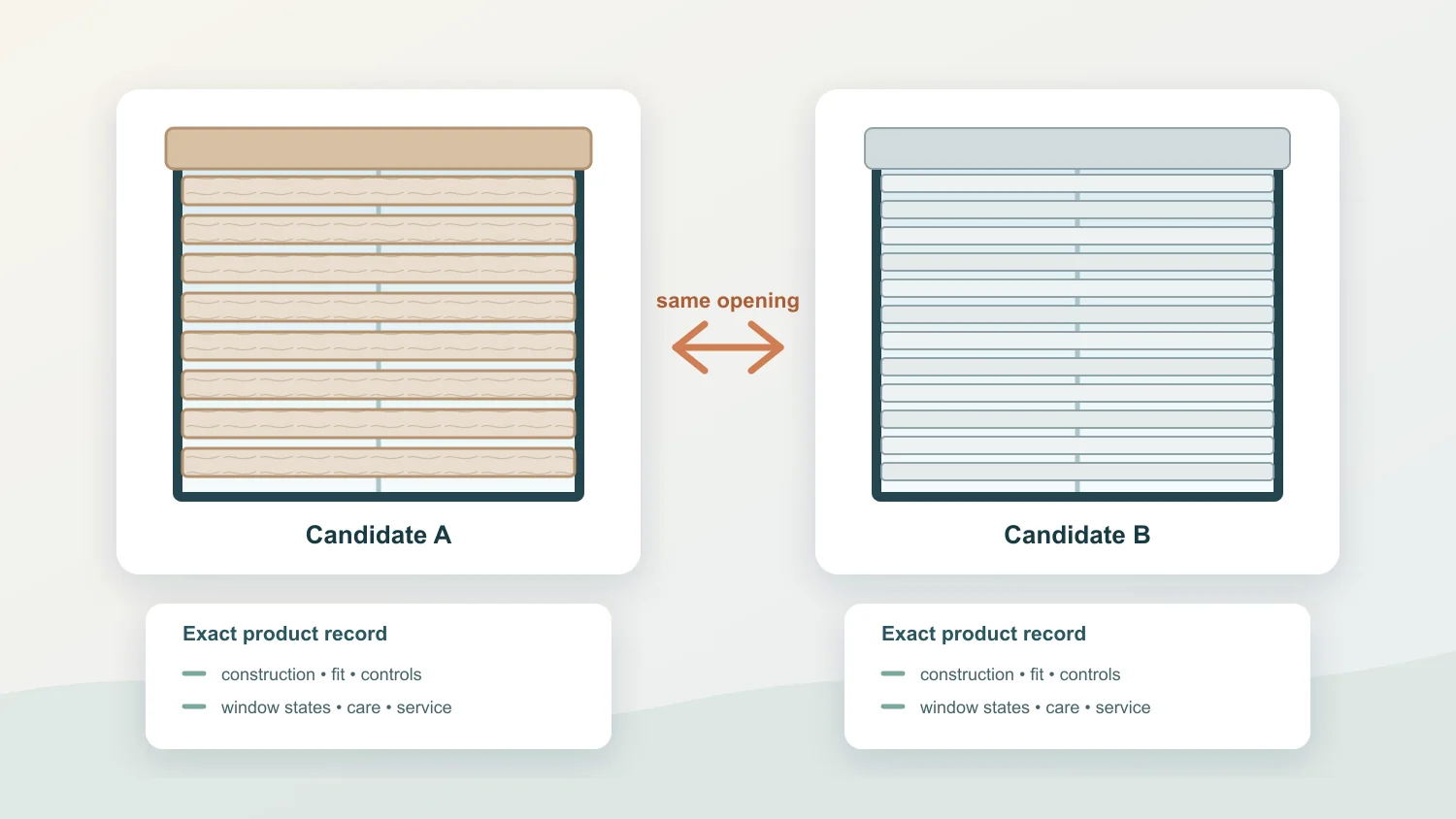
Before ranking any window, make the premium describe one real change. Hold the product family, fabric, opacity, mount, coverage and required positions steady. Then identify what changes when the operating system changes.
A current Lutron Serena and Triathlon roller specification, for example, lists battery-powered, wired and cordless-manual models, then gives configuration-specific controls, dimensions and mounting details. That does not prove another brand’s limits. It proves why “manual version” and “motorized version” can be different builds even when a seller places them under one collection name.
If the motorized option changes the fabric, mount, fascia, maximum width, edge gap or available function, stop calling the price difference a motor premium. You now have two completed window treatments to compare. The site’s cordless-versus-motorized lift comparison handles that deeper single-window eligibility question.
Record the raw opening and obstructions separately in the Smart Shade Measurement and Compatibility Checker. The seller still owns the finished dimensions, deductions and supported options for each quoted build.
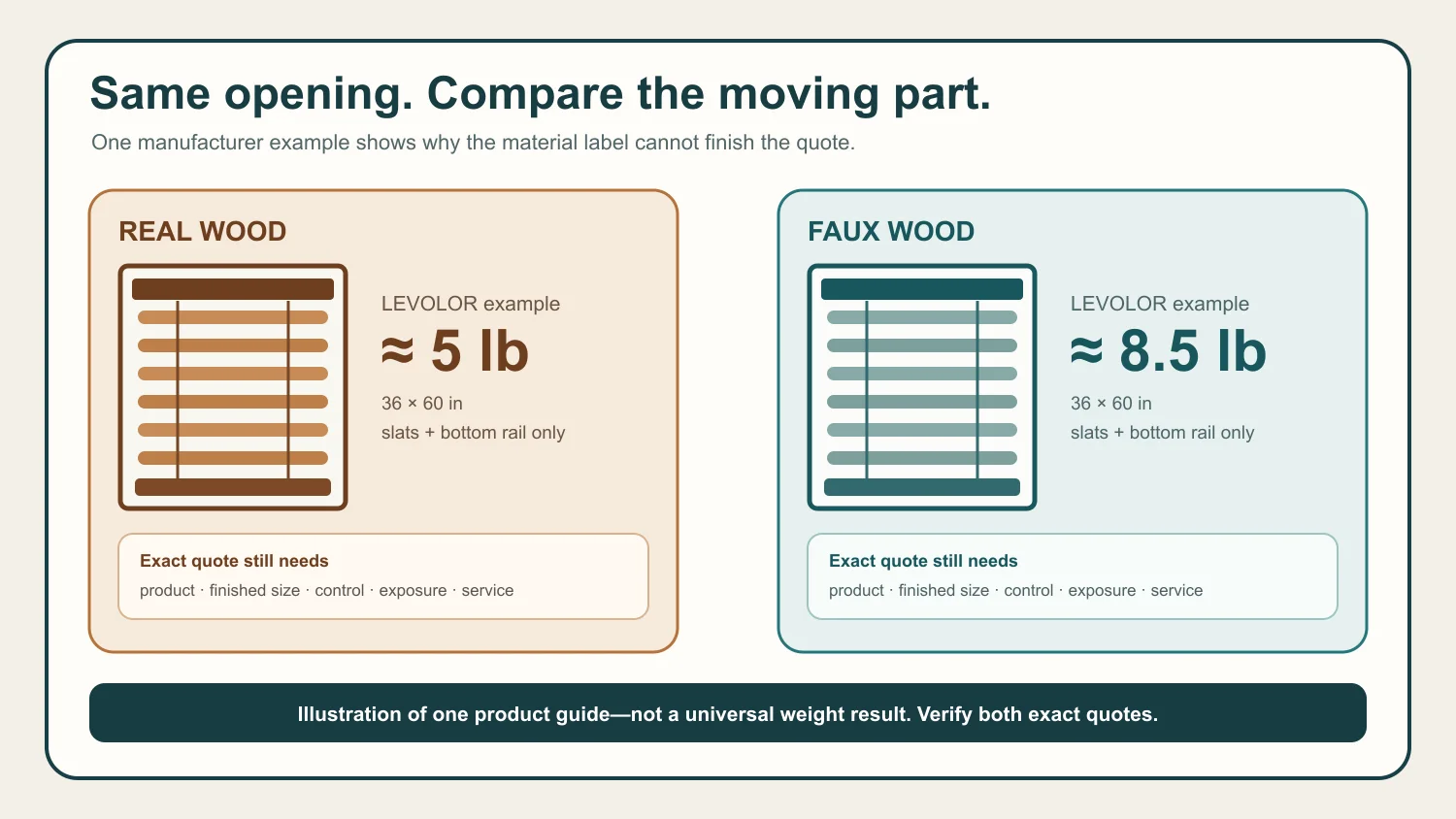
Horizontal blinds need an extra line because motorization may power tilt, lift or both. If the quote is for faux wood, the motorized faux-wood guide keeps those motions separate. Do not award whole-blind convenience to a tilt-only motor when the room also needs the bottom rail raised.
Only windows with a valid manual-versus-motorized pair move to the household board. That sequence prevents a richer fabric, different mount or incomplete control package from masquerading as the value of the motor.
Three windows expose three different verdicts
Now imagine three openings before asking for a whole-home price.
Three west-facing living-room shades are lowered most occupied afternoons for glare and raised again when the sun moves. People regularly miss one or leave the group uneven. A documented group command or schedule could remove a recurring task. That group has a plausible case for motorization.
A stair-landing shade is hard to reach, but it stays in one light-filtering position for most of the year. A motor would make the rare adjustment easier, yet battery, reset and service access would still be difficult. That window may belong in “prepare and defer” or may need a covering that can remain in its useful state without frequent movement.
The guest-room shade is at arm’s reach and moves only before and after a visit. If the manual version already reaches every required position, a motor adds equipment to a task that hardly exists. Keeping it manual is a complete decision, not a lesser one.
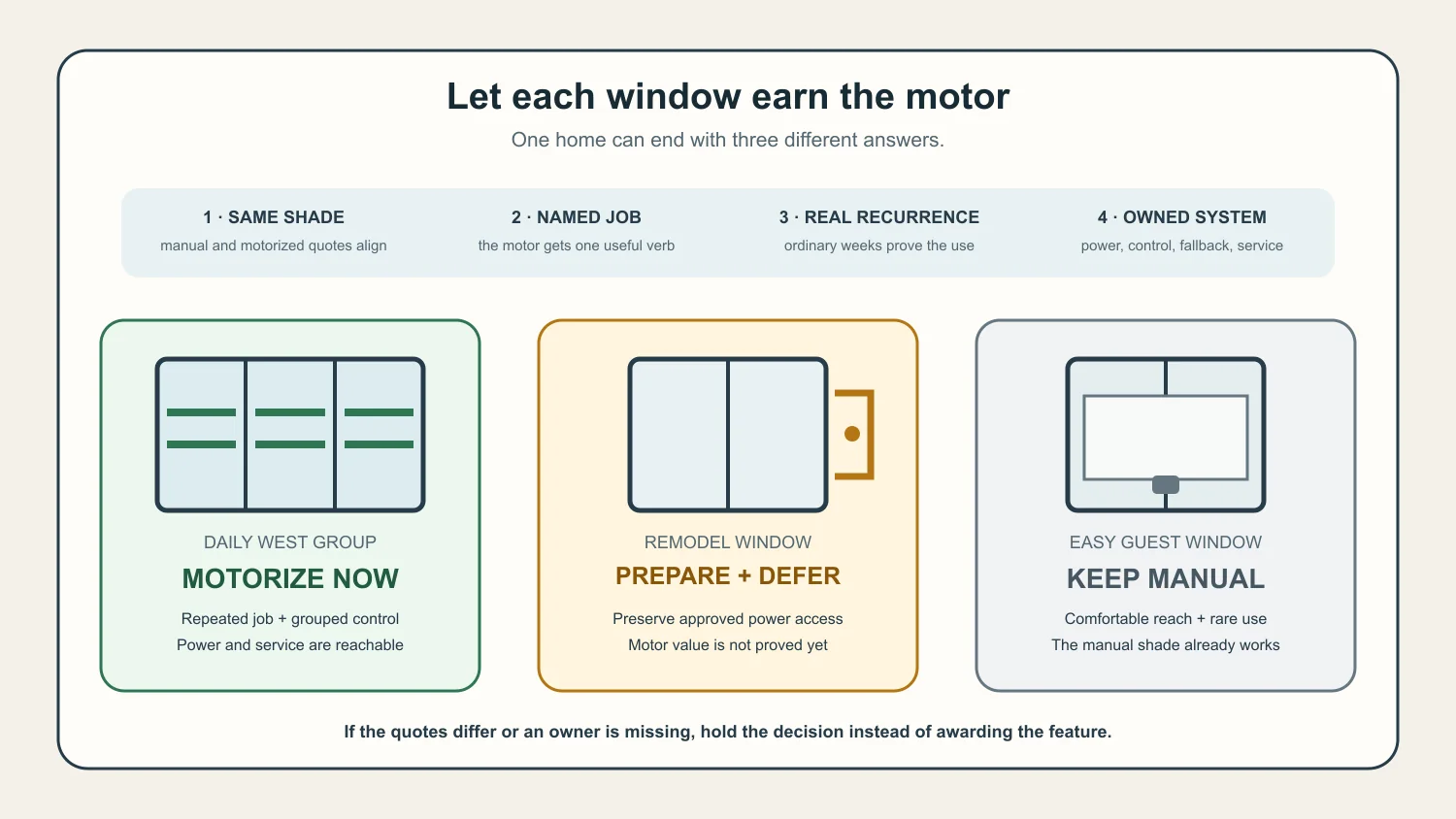
The priority board turns those scenes into a record. It does not score lifestyle in points or claim a financial payback. It asks whether one exact motor has a real assignment and an acceptable owner.
| Window or group | Motor’s named job | Evidence the job will be used | Added ownership work | Current disposition |
|---|---|---|---|---|
| West living-room group | Lower three shades before recurring afternoon glare; reopen after the glare period | Same behavior is wanted on occupied days; group or schedule is documented for the quoted system | Reachable power or charging, local control and group service owner are named | Motorize candidate |
| Stair landing | Change a hard-to-reach shade on occasional seasonal days | Few movements are expected; the useful default state is still under review | Battery, reset and service access may require special reach | Prepare and defer, or choose a stable manual or fixed solution |
| Guest room | Open and close one low shade around visits | Manual operation is comfortable and infrequent | Motor, power and controls create more ownership than the task removes | Keep manual |
Use actual windows, not room labels, as the rows. A bedroom may contain one easy window and two high windows. A living room may need a synchronized street-facing group while a side window remains manual.
Keep a seven-day movement diary
The board shows possible outcomes; an ordinary week supplies the evidence. For seven days, write each wanted movement as a verb, a window group and a moment:
- lower the three west shades before afternoon screen glare;
- raise the two high windows from the floor each morning;
- close the street-facing bedroom shades at the normal privacy hour; or
- tilt the office blinds during the part of the day when glare crosses the desk.
“Use the app,” “add convenience” and “make the room smart” do not describe a completed job. Neither does a voice-assistant logo. If you cannot finish the sentence “the motor will ___ at ___ because ___,” the proposed feature has not earned credit yet.
Record how often the manual action is wanted, how often it is skipped, who finds it difficult and whether several windows need the same state together. Frequency is not converted into dollars here. It simply separates a repeated household job from a feature that will be demonstrated once and forgotten.
Reach deserves the same discipline. An inaccessible window that must change twice a day creates a strong operating problem. A high window that can remain in one useful state may create very little motor value, especially if charging and service are equally inaccessible. The important fact is not height by itself; it is the combination of required movement and practical access.
Motorization can also contribute to a cord-safety plan, but only within the completed product and room. Current CPSC guidance includes motorized operating systems in the cordless option for the stock-covering operating-cord provision while separately retaining requirements for inner cords and product identification. The site’s cordless and motorized child-safety guide carries that full audit. A motor label alone is not a room-safety verdict.
Turn one repeated movement into a reliable routine
Choose one repeatedly missed movement from the diary before considering an app, scene or schedule. Automation is useful when it executes a state the household reliably wants and otherwise misses. Name the covering, position, trigger, season and windows involved. “Close the west group at the start of the glare period” is testable. “Save energy automatically” is not.
The US Department of Energy’s window-attachment program review illustrates the boundary. Its automation analysis used manual operation as the baseline for a specified single-cell cellular shade and evaluated defined thermostat, weather/solar and schedule algorithms. That research supports studying exact shade behavior. It does not establish a universal saving for every motorized blind, fabric, climate or household schedule.
Before giving an energy or comfort benefit to the motor, settle the covering’s required state and the rule that will move it. If the desired position blocks a valued view, conflicts with winter solar gain or is regularly overridden, the theoretical schedule is not the real household behavior.
Controls must exist in the quoted system. A remote-only motor may perform a useful grouped action without being a smart-home device. An app or voice routine may require a specific hub, controller, account or cloud service. Trace that route in the smart-blinds compatibility guide rather than transferring a feature from the brand family to the selected motor.
The best schedule candidate is not the most elaborate one. It is the smallest reliable behavior that removes a repeated miss. Additional scenes can be added later only if the exact system supports them and someone owns them.
Charge the ownership tail to that window
For every routine that survives the diary, charge the added system back to the window or group that receives the benefit. The motor removes hand movement and adds a small system; its future work cannot be spread invisibly across the rest of the house.
Power and access. Name battery, rechargeable, plug-in or professionally planned hardwired power, plus the person and route for charging, replacement or service. In the cited Lutron roller specification, battery requirements vary with shade size and configuration, and a battery-boost option is discussed for larger or high-use applications. Those facts belong only to the named products, but they show why a runtime borrowed from another window cannot close this row. Use the battery, solar and hardwired comparison for the exact power path.
Local control. Record what works from the room without a phone or internet connection. Then add any remote, keypad, hub, app or voice layer. If a household member cannot perform the required action through the available local control, the system has not replaced the manual task for that person.
Failure response. Ask what happens when the remote, hub, household power or shade battery is unavailable. A local button can still depend on the motor and power. Physical hand movement is allowed only where the exact product documentation says so; the manual-fallback guide separates those failure layers.
Warranty and labor. “Motor warranty included” is not a complete ownership answer. One current Lutron shading warranty, as a manufacturer-specific example, distinguishes external controls and accessories from other system components, excludes on-site labor and notes that inaccessible components can affect warranty responsibility. Your quote may have different terms. Record parts, labor, travel, removal, reinstallation, programming and the company that will take the first call.
Occupancy horizon. A long-term homeowner and a short-term renter may value the same recurring task differently. Do not invent resale value to force the answer. Simply record how long the current user expects to own or use the system, along with any permission and removal boundary.
A motor can still win after all five rows are filled. In fact, a closed ownership path makes the decision more credible because the benefit is no longer being compared with invisible work.
Return three lists to the planner
The completed board now returns three lists rather than one category-wide answer. First, circle the windows with a named action that recurs, cannot be handled comfortably or reliably by the intended users, and can be performed by the quoted motor. These are the motorize now candidates—but only after the like-for-like build, power, local control, fallback and service rows close.
Second, mark openings where construction timing matters but the operating value is not yet proved. During a remodel, it may be sensible to preserve an approved power route or service access while leaving the covering and motor undecided. That is prepare and defer, not a purchase recommendation and not proof that every prepared window should later receive a motor.
Third, keep the easy, infrequently moved windows manual when their manual configuration already supplies every required state. Redirecting the motor budget to the high-use group is not inconsistency; it is the result of evaluating the work each motor will actually do.
Any row with different shade configurations, an unnamed smart-home dependency, unreachable charging, unknown outage behavior or no service owner remains on hold. Return the final three lists to the Smart Motorized Blinds Planner: motorize now, prepare and defer, and keep manual. The useful answer is not “yes” for the house. It is a short list of windows whose motors have jobs.