Buying blinds for privacy starts with two pictures of the same window. One is taken during useful daylight. The other is the view toward the room after dark with the indoor lights on. A covering earns the job only if the part of the room you care about disappears in every required picture.
That rule changes the shopping question. “Cellular, roller, sheer or slatted?” comes later. First name who could see in, which part of the room must be hidden and whether you still want sky, garden or daylight through another part of the glass.
Use the room-by-room shade planner to record those room states. Then choose a mechanism that can reproduce them. A privacy label without an observer, light condition and covering position is not an acceptance result.
Name the view that must disappear
Give the privacy problem an address. The observer might be a pedestrian below the sill, a neighbor at the same level or an upper-floor window looking down. The protected zone might be the sofa, bed, bath area, desk screen or the full room. These are different geometries even when the windows are identical.
| Fact | Record | Why it changes the covering |
|---|---|---|
| Observer | Location, height and the usual approach to the window | Sets the inward sightline that must be interrupted. |
| Protected zone | The exact chair, bed, work surface or room area to hide | Determines how much of the opening needs coverage. |
| Useful opening | Sky, garden, daylight or ventilation you want to keep | Prevents privacy from becoming unnecessary full-window closure. |
| Required times | Daylight, dusk, lights-on night and full close as applicable | Separates one optical condition from another. |
If only the lower part of a street-facing room needs protection, a movable rail may preserve daylight above it. If an elevated neighbor can see over that rail, the same idea fails. The top-down/bottom-up shade guide explains that privacy-horizon geometry. Do not choose by feature name alone.
Make daylight and night separate jobs
Daylight privacy and lights-on-night privacy are not two scores on one scale. The light balance changes, and the covering may need a different position or a second material. Keep the observer and protected zone fixed while you record each state.
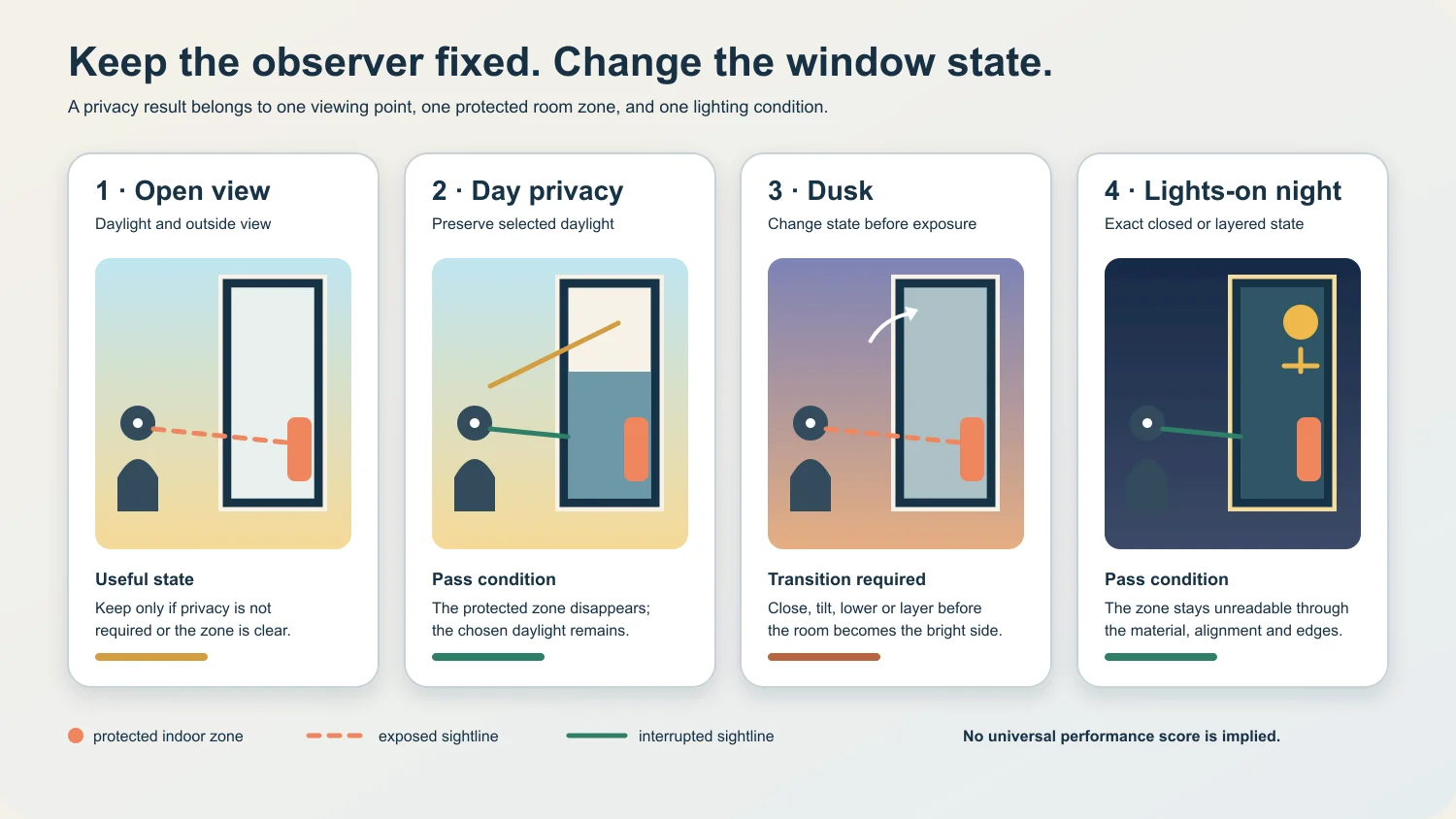
| State | Covering position | View to preserve | Pass condition |
|---|---|---|---|
| Open view | Raised, open or vanes aligned for the desired view | The useful outdoor scene and full daylight | Privacy is not required in this state, or the protected zone remains outside the sightline. |
| Day privacy | Exact fabric, slat, vane or rail position proposed for daytime | The stated daylight or upper-window view | The named observer cannot resolve the protected zone in the actual daylight condition. |
| Dusk transition | The position used before the room becomes brighter than outdoors | Only what remains acceptable during the transition | A repeatable control change happens before the protected zone becomes exposed. |
| Lights-on night | The exact closed or layered position used with normal room lighting | Usually none, unless a verified configuration preserves it | The protected zone stays unreadable from the observer point, including through edges and aligned openings. |
Current LEVOLOR reference guidance uses five product-specific privacy and light-control levels rather than one category-wide promise. It also says adding smart-shade automation does not change that optical level. Automation can recall an accepted position or close before dusk; it cannot make an unsuitable material private.
Lutron’s current fabric specification guidance separates open-weave sheer, privacy and blackout fabrics and asks whether the job is daytime, nighttime or all-hours. It also treats privacy, view and glare as priorities that must be qualified. That is why the record needs the exact fabric and color, not just “light filtering” or an openness number.
Choose the mechanism that can reproduce both states
The exposure map does not crown a universal winner. It tells you which physical change the window must make.
Use a fixed fabric when one view balance works all day
A continuous privacy or translucent fabric can suit a room that accepts a softened outward view in exchange for diffuse daylight and obscured detail. An open-weave screen preserves more view but should not inherit a nighttime-privacy promise from the word “shade.” Compare the exact material in the light-filtering roller-shade guide, then separate fabric class from the finished opening with the light-filtering versus room-darkening guide.
Use adjustable slats or vanes when the view must change
Horizontal slats, sheer vanes and zebra bands create privacy by changing alignment. That makes position part of the product, not a styling detail. Use the slat-direction guide for an existing horizontal blind and the zebra-blind guide for alternating bands. Hunter Douglas also shows adjustable vanes and named two-opacity systems on its current privacy and light-control page; those examples demonstrate mechanism classes, not equal performance across products.
Move the privacy boundary when only one room band needs cover
Top-down/bottom-up shades are useful when the protected zone ends below a practical rail position and the desired daylight begins above it. Draw the observer’s line before choosing the feature. A higher observer can eliminate the open upper band, while a lower observer may allow more glass to remain exposed.
Add a second opacity only when the states truly differ
If daytime requires a light-preserving material and lights-on night requires a more private closure, two fabrics or two independent layers may be coherent. They also add headrail space, controls and service work. Use the dual-shade guide to decide whether two states justify two layers. If the requirement is strict darkness rather than ordinary privacy, edge continuity becomes a separate task covered by the side-track blackout guide.
Approve the finished window, not the swatch
A swatch can identify color, texture and a material family. It cannot show the installed edge, the observer’s angle, the indoor lighting or the position a control will actually recall. Record the maker, collection, fabric, color, mount, finished coverage and operating position beside every required state.
Controls receive their own check. For stock coverings, current U.S. CPSC guidance limits operating cords to cordless designs, short cords or inaccessible cords; it separately covers inner-cord access. Do not choose a harder-to-reach cord routine to preserve a view. For the exact opening, record depth, handles and mount constraints in the measurement checker.
Approve one demanding window before repeating the configuration. The acceptance record is short: observer, protected zone, lighting state, exact covering position and remaining view. A state you did not observe stays unknown. If daylight passes but lights-on night does not, change the state or the mechanism—not the meaning of “privacy.”