Where does the blind go when the sash leaves the frame?
That question matters more than whether a shade is cellular, pleated, roller or motorized. A treatment can look perfectly fitted while the window is closed and still block the handle, fall away from the glass in tilt mode, or strike a wall when the sash swings into the room.
Choose one of two workable arrangements before ordering: a retained blind that mounts to and travels with the sash, or a fixed treatment that parks completely outside the sash’s path. Then verify the exact finished blind—not just the glass size—in closed, tilted and fully turned positions. A missing pose is an unresolved order.
Decide where the blind lives
A sash-mounted blind becomes part of the moving window. Its frame, tracks, clips or other authorized attachments stay on the sash as it tilts and turns. Hunter Douglas describes its named TrackGlide system with Duette shades as staying in place when a tilt-turn window is closed, tilted or turned. Louvolite describes its named Perfect Fit frame as moving with a window or door. Those examples prove that the architecture exists; they do not make every shade or every window profile compatible.
A fixed treatment belongs to the stationary opening, wall or ceiling. It does not follow the sash. Before the window tilts or swings inward, the shade must retract into a documented parking position that leaves the sash, handle and hardware clear. This can be a reasonable choice when you want a treatment independent of the window frame, but the parking step becomes part of every opening cycle.
Do not blur the two arrangements. A standard inside-mount shade is not sash-mounted merely because it sits near the glass. A clip-on product is not proven compatible merely because the listing says “no drill.” If you have not decided the mount plane, use the inside-versus-outside mount guide first. If avoiding holes is the governing constraint, the no-drill fit guide covers the frame and permission questions that this page does not repeat.
Replay the finished blind in three positions
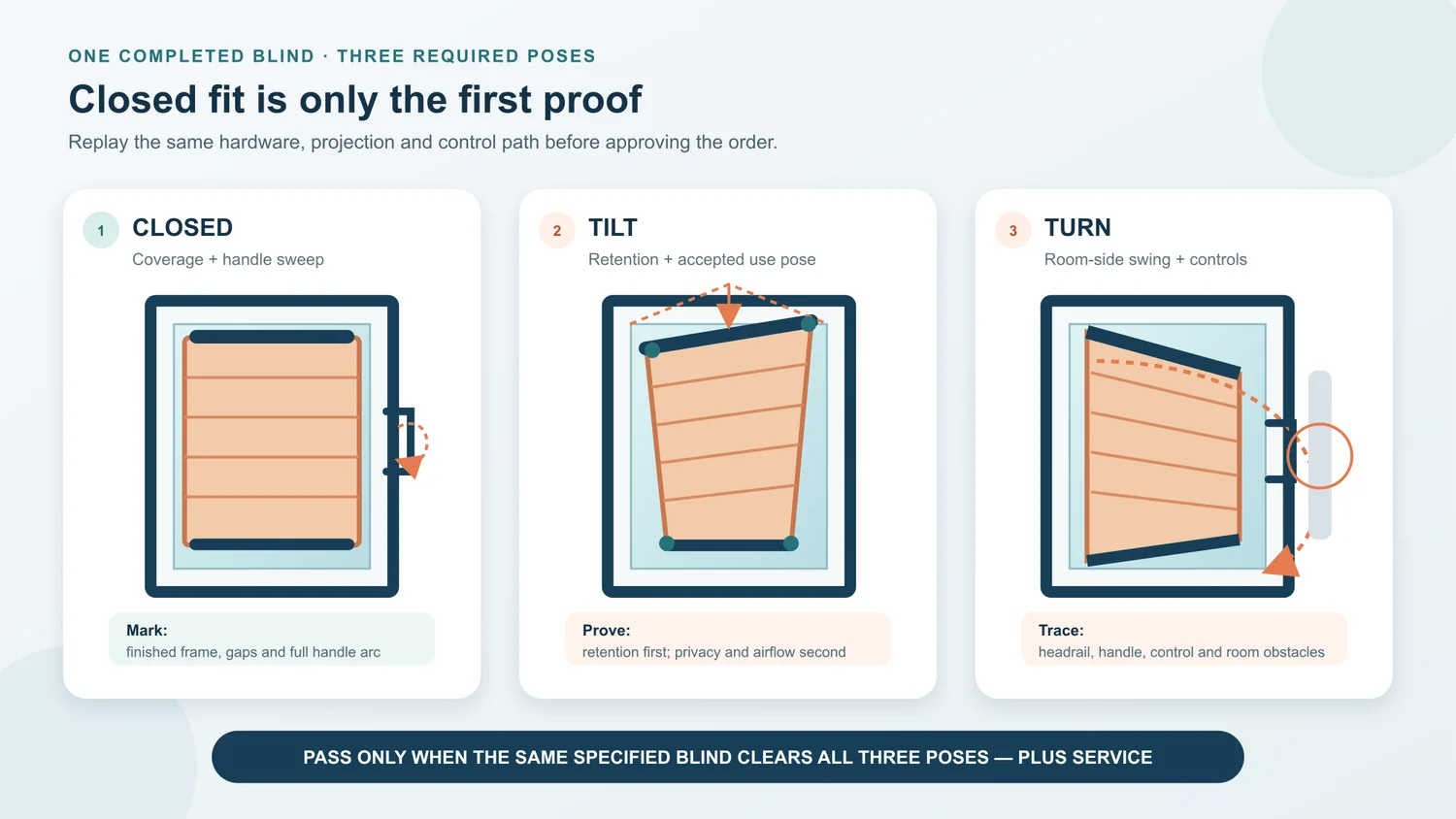
Use one window ID and one completed blind configuration. Keep the maker, collection, control, finished width and height, attachment system and projection unchanged as you replay these positions.
1. Closed: prove coverage without stealing the handle
With the sash latched, mark the blind’s headrail or frame, side tracks or guides, fabric stack, bottom rail and controls. Trace the complete handle sweep rather than checking the handle at only one resting position. A frame that fits the glazing area can still sit in the handle’s path.
Check the visual result here, too, but keep the claim narrow. Note the gaps you can actually see and the privacy position you intend to use. Do not translate “cellular,” “framed” or “custom” into a guaranteed blackout or insulation result.
2. Tilt: prove retention and choose an acceptable use pose
Open the top of the sash to the ventilation position you actually expect to use. A sash-mounted system must keep its headrail, fabric and bottom rail controlled as gravity changes direction. A fixed treatment must already be parked outside the moving sash.
Now separate two decisions that sales pages often combine. First: does the system remain mechanically retained as specified? Second: do you accept the privacy, light and airflow result in that position? A shade may stay attached but need to be raised partly for ventilation. Another may remain lowered along the tilted sash. Neither result is universally better; the quote should show which one you are buying.
Inspect the upper corners and gasket area rather than concentrating only on the center glass. The tilted sash changes the space near the head of the opening. Any track, clip, cable, fabric edge or control that enters that space needs exact product authority, not a hopeful field adjustment.
3. Turn: include the room in the clearance drawing
Swing the sash inward to the angle you expect for cleaning, ventilation or access. The window is no longer just an opening; it is a moving object inside the room.
Trace the outermost path of the handle, blind frame or headrail, bottom rail and any projecting control. Continue the trace until the sash reaches the accepted open angle. Check the recess return, adjacent wall, trim, sill objects, furniture and a neighboring window leaf. For a powered system, include the battery wand, charging connector or cable loop in the finished projection.
A specialist may propose a stop that deliberately limits the turn angle. Treat that as a design choice, not proof of full-swing compatibility. Record the accepted angle and confirm that it still permits the window task you care about. If the sash must open fully for cleaning or egress-related use, do not quietly replace that requirement with a smaller angle based on a blind drawing.
Tilt-and-turn windows are not the same geometry as hinged French doors, even though both move into the room. For paired leaves and door hardware, use the separate motorized blinds for French doors guide. This page’s decision is limited to a tilt-and-turn sash and its completed covering.
Make attachment eligibility an explicit claim
“Mounts to the frame” is a location, not an attachment specification.
Ask the blind supplier to identify the exact clips, tracks, frame or fasteners in the configured order. Ask the window manufacturer or qualified window professional whether those attachments are allowed on the exact window series and profile. The answer may depend on glazing bead shape, gasket position, sash material, surface finish, internal reinforcement or restrictions that cannot be identified from a room-side photo.
US specialists currently market multiple sash-mounted approaches. Ashland Blinds describes a four-corner attachment for its own system. Tilt and Turn Window Blinds USA presents named Perfect Fit and Clic Fit products. Realistic Design NYC offers specialty blinds for inward-opening European windows. These are useful commercial paths, but their claims remain bound to their systems. One seller’s clip eligibility does not authorize another clip on your sash.
Do not choose adhesive, drill points, longer screws or altered clips from generic advice. If the two authorities disagree—or neither will approve the completed attachment—the correct result is manufacturer/installer review or a different architecture. A fixed opening-mounted treatment may avoid sash attachment, but it still has to pass the parking and movement drawing.
Keep the original opening record in the Smart Shade Measurement and Compatibility Checker, then attach it to the quote instead of retyping rounded numbers into separate seller forms. The factory may need its own order measurements and deductions; your field record should remain unchanged so the finished blind can be checked against the same window.
The narrowest clearance is often outside the glass
Tilt-and-turn windows can have generous glazing and still leave very little room around the handle, bead or edge of the sash. That is why glass width alone is a weak buying input.
Mark at least these completed dimensions on the seller’s drawing:
- maximum room-side projection of the headrail or framed blind;
- distance from the blind edge to every part of the handle sweep;
- attachment and guide locations relative to the bead and gasket;
- bottom-rail or frame position when tilted;
- fabric stack or cassette position when a fixed shade is parked;
- the outer swing path at the accepted turn angle.
If a slim sash creates the constraint, the narrow blinds guide helps keep visible coverage, mechanism width and tracking space separate. Do not carry a minimum-width claim from that page or another product into this order; the exact configured system owns its limits.
Controls deserve their own mark. A chain, wand, handle, battery module or charger can pass the closed view and fail during the turn. Motorization removes some manual reach, but it can add power and service geometry. On a tall tilt-turn unit, plan those service moves with the high-window blinds guide rather than assuming remote control removes physical access.
Treat service as the fourth motion
After CLOSED, TILT and TURN pass, ask how the blind leaves the sash for repair.
That is not an abstract maintenance concern. Hunter Douglas’s current repair guidance for its named Duette and Applause shades with TrackGlide says in-home repair is not recommended and directs the customer to the original dealer or installer. Another system may have a user-removable frame or a different service route. The point is not that one policy is preferable; it is that the service owner must be known before an attachment covers clips, glazing access or a power component.
Have the quote name who removes and reinstalls the system, what access is needed, and whether a charger, battery or motor can be reached while the window remains safely controlled. If the blind must be removed before window service, make that handoff explicit. “Removable” without an authorized sequence and responsible party is not a complete service plan.
Ask for one marked configuration, not a compatibility promise
Send the supplier one page containing the window ID, maker and series; blind maker, collection and control; finished dimensions; attachment method; and the three sash drawings. Ask them to mark the blind, hardware, handle, parking position and accepted open angles on that page.
The returned record should lead to one of five outcomes:
- Sash-mounted pass: the exact retained system and attachment are authorized, and all three positions plus service access are marked.
- Fixed-opening pass with a parking rule: the shade clears only when fully retracted, and you accept that operating routine.
- Change configuration: another frame, control, projection or mount can close the failed pose without changing the window requirement.
- Manufacturer or installer review: attachment, collision or service responsibility needs a named professional decision.
- Do not order yet: a pose, authority or completed dimension is still missing.
This is also the right point to place the page in the larger large-window and moving-opening decision hub. The hub helps route other moving-opening tasks; this page’s narrower job is finished only when the same specified blind can be followed from latched window to ventilation tilt to accepted inward swing—and back out again for service.