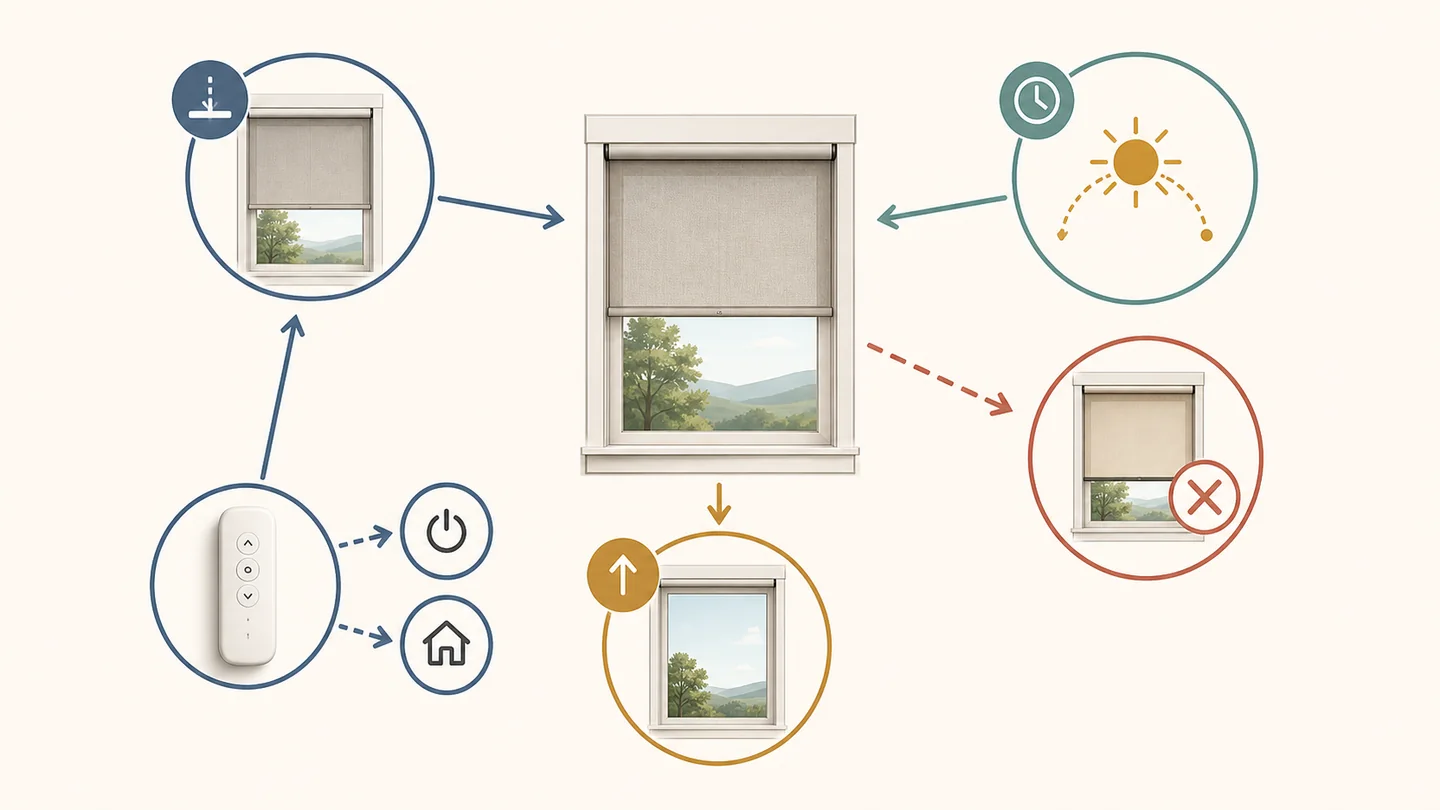
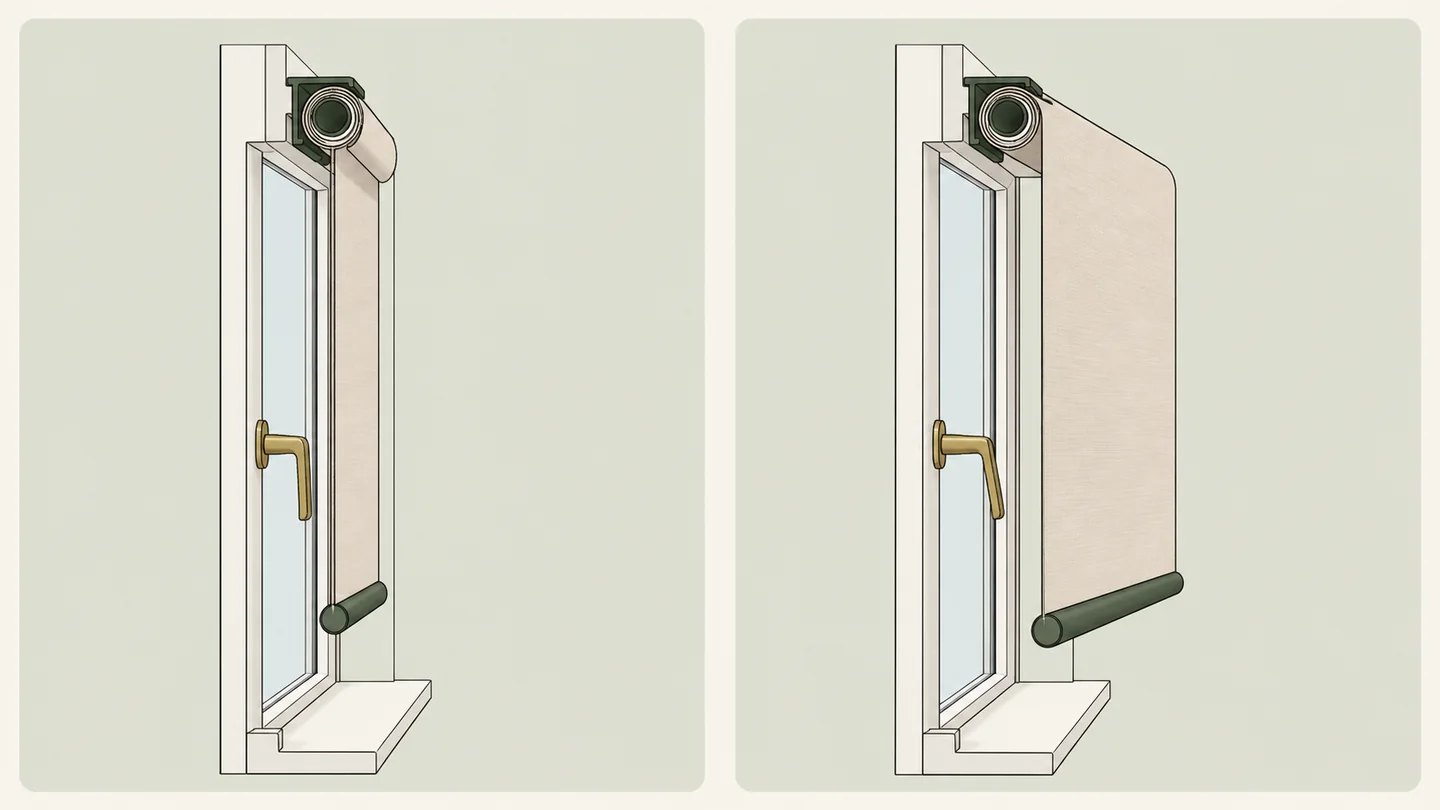
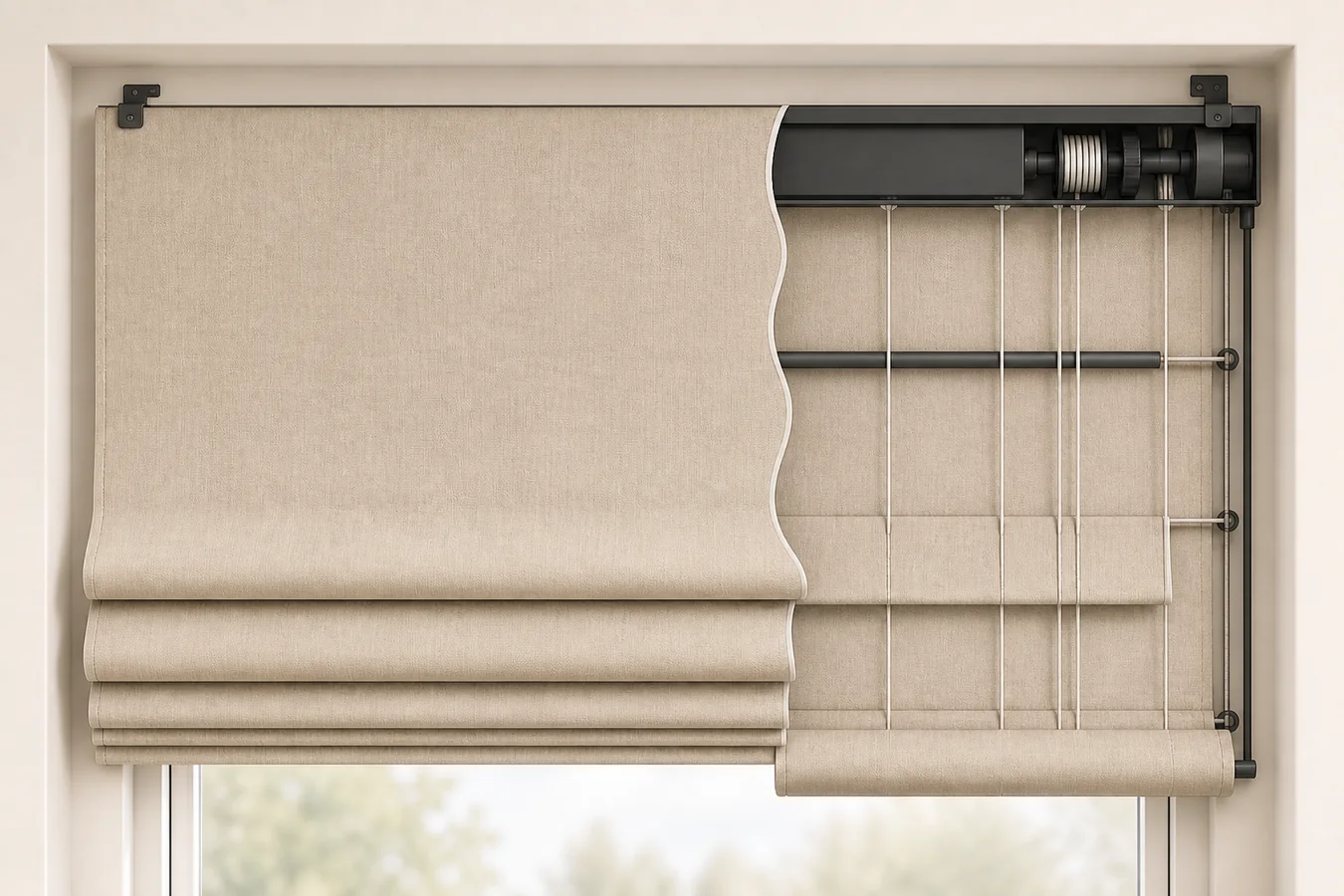
Yes. A manual roller shade can make a light chain, spring, fabric or hembar sound, and a motorized shade adds the drive and tube. “Quiet” should mean that the expected sound is acceptable during the room’s real use—not that the shade is silent.
The buying mistake is listening to a bare motor number or one showroom sample and treating it as the installed result. Ask what the exact finished shade will do in your room, at a stated distance, while raising and lowering, both alone and in its intended group. A new squeak, click, rattle, grind or stalled hum is a different question: preserve the symptom and use exact-product support rather than accepting it as normal shopping noise.
A quiet roller shade still has a sound signature
A manual clutch, chain or spring can be heard while the fabric rolls. Motorization replaces the hand movement with a drive, but the sound does not stop at the motor. It can travel into the tube, brackets, cassette or wall; fabric and the bottom bar also move through the room.
Listen for pattern before volume. Smooth, repeatable sound that begins with movement and ends when the shade stops is an operating signature. A sharp sound at one point in travel, a new rattle, intermittent clicking, rubbing or a motor that sounds loaded without normal movement is a symptom. This page does not diagnose that symptom, because its cause depends on the exact product and installation.
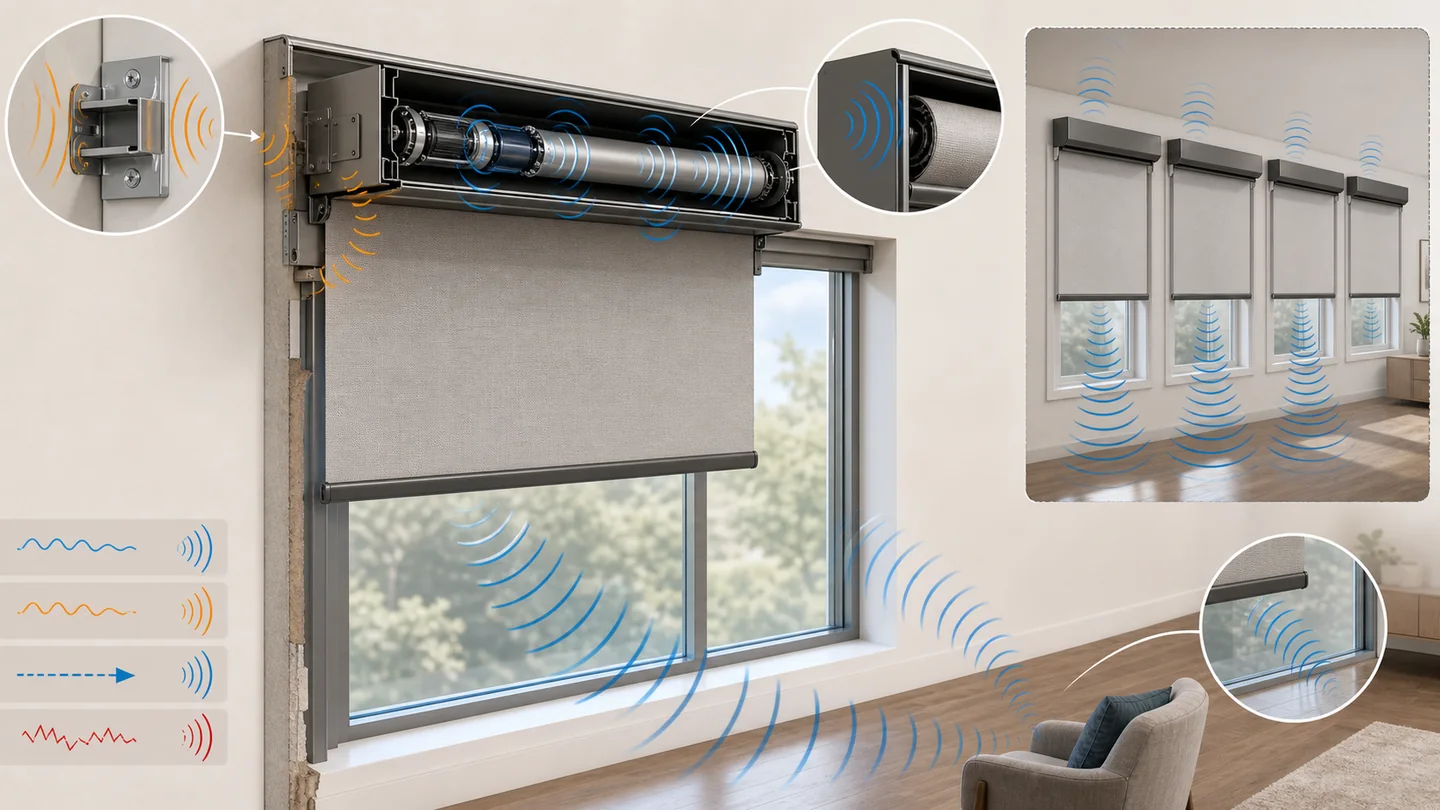
The illustration maps the purchase variables: drive and tube, bracket-to-wall vibration, enclosure response, room reflections and one-shade versus group operation. The waves do not represent a measured level; they show why the completed installation matters.
A motor number is not a finished-shade number
A decibel figure is useful only with its specimen and method. Lutron’s current Sivoia Roller 225 product record states less than 38 dBA at 3 feet for one named shade configuration. Somfy’s Sonesse 510S2 page publishes 47.2 dB for a named motor, but the visible product record does not present the same 3-foot, completed-shade condition. The numbers therefore cannot rank the two purchases.
Pro Design’s motor-decibel FAQ makes the boundary unusually explicit: its decibel tests are performed on the motor, not a motor installed in a finished shade. It also names open roll versus cassette, wood floor versus carpet and raising versus lowering among variables that change the result.
| Claim field | Useful record | Do not infer |
|---|---|---|
| Tested object | Exact motor, bare drive assembly or completed named shade | That a motor-only result predicts its tube, housing and room |
| Configuration | Shade dimensions/load, tube, bracket, enclosure, mount and power | That every size in a collection uses the same drive |
| Operating state | Raise or lower, speed, start/stop behavior and one unit or group | That one direction or one sample represents the intended scene |
| Method | Distance, position, background, room/test space and reported metric | That unlike decibel numbers are directly rankable |
If those fields do not travel with the number, the number is only a reason to ask another question. It is not evidence that the quoted shade will be quieter at your chair.
Size can choose the motor before you do
Two shades from the same collection can sound different because their sizes select different hardware. Hunter Douglas support for named Designer Roller and Screen products says its PowerView Gen 3 and PowerView+ configurations can use 23 mm and 31 mm motors, and describes the 31 mm motor as approximately twice as loud as the 23 mm motor. Motor selection depends on the shade and tube size.
A second Hunter Douglas size-and-sound record gives a useful, tightly bounded example: for most configurations covered by that article, shades wider than 90-1/8 inches use a larger tube and motor, while shades 90 inches or less use a smaller combination. The exact cutoff can vary, so this is not a universal ordering rule.
The transferable question is: Which exact motor and tube will this finished width receive? Ask it after the supplier has your measured opening and fabric selection. A small showroom shade proves little if the quoted window crosses into a different drive. If the shade family itself is still open, use the motorized roller, cellular, Roman and zebra comparison before optimizing one roller configuration.
The cassette and the room join the instrument
A motor inside a tube is mechanically connected to the idle end, brackets and mounting surface. A fascia, cassette or pocket changes the nearby structure. Pro Design says a metal tube and metal cassette can enhance motor noise in its systems; Hunter Douglas says valances, cassettes, hardware and mount type can amplify or dampen sound in its named products. Those statements do not prove that every enclosure is louder. They prove that the enclosure belongs in the evidence.
Coulisse makes a commercial system-level case around motors, brackets, drive plugs, tubes, cassettes and speed control on its Absolute Silence page. Its “up to 15 dB quieter” result comes from its own sound lab and needs the exact comparator, method and purchasable configuration before it can influence an order. The useful idea is narrower: a quiet motor does not rescue a resonant completed assembly.
Room surfaces finish the path. Hard glass, tile, stone and bare walls can make operating sound more noticeable than carpet, upholstered furniture and fabric. An inside mount and an outside mount also place the assembly in different cavities and planes. Do not redesign the room around a shade claim; listen where the shade must work. The cassette roller shade guide owns housing fit and service access, while the reverse-roll guide owns the fabric plane. Keep both decisions attached if the supplier changes the top assembly.
Write one finished-shade sound card
The card below holds the actual purchase still long enough to compare it. Fill it from the quote, current product record and one representative demonstration. “Not supplied” is a useful entry; it prevents an assumption from turning into a product fact.
| Card line | Record before ordering | Decision it controls |
|---|---|---|
| Identity | Manufacturer, collection/revision, motor, tube, power and control | Accept only evidence for the hardware the finished size will receive |
| Assembly | Width, height, fabric/load, open roll/fascia/cassette/pocket, brackets and mount | Require a demonstration or revise the assembly when the sample differs materially |
| Room scene | Room, hard/soft surfaces, quietest intended time, listener position and distance | Accept sound where it matters rather than in a busy showroom |
| Movement | Full raise and lower, speed if adjustable, one shade and intended group | Revise grouping or schedule movement outside a sensitive period |
| Published evidence | Motor or completed shade, value/claim, method, distance, background and source | Compare only matched records; otherwise keep quietness unresolved |
| Symptom boundary | Any squeak, click, rattle, grind, rub or stalled hum | Route an abnormal sound to exact-product support instead of normalizing it |
The possible outcomes are deliberately different. Accept a documented completed-shade condition; require a representative demonstration; revise the motor, tube, enclosure, mount or grouping; schedule movement outside a sensitive period; route an abnormal symptom to support; or hold the quietness claim until comparable evidence exists. Missing sound evidence does not prove a bad shade. It means quietness cannot yet justify the premium.
One shade and a wall of shades are different events
A single shade may be acceptable while a whole room group is distracting. More units occupy more positions, and the event can last longer if the system starts shades in sequence. Even nominally synchronized shades may not have identical motors or loads when window sizes differ.
Write the intended group into the acceptance scene. If a bedroom has four shades that will close together, do not accept a demonstration of one small unit. Ask whether the group starts together or in sequence and listen for the duration from first movement to final stop.
Automation can solve a timing problem only after the behavior is explicit. A movement that is acceptable before occupants enter may be unwelcome during a call or after bedtime. The window-treatment automation guide owns the trigger, exception, exit and recovery contract; this page contributes the sound-sensitive condition.
Listen at the room’s quietest useful moment
A buyer demonstration is not a laboratory test, but it can still be a fair acceptance scene. Use a representative completed shade—or the nearest documented sample with every mismatch listed—in the intended room or a room with similar hard and soft surfaces.
- Fix one normal listening position. Mark the approximate distance to the shade and do not move it between options.
- Use the room’s quietest normal condition. Turn off avoidable temporary noise without creating an artificial silence the room will never have.
- Run both directions. Observe one full raise and one full lower with the same speed and control method.
- Run the intended group. Time the experience from the first shade starting until the last one stops.
- Separate steady sound from a symptom. Do not average a new click, rub, rattle, squeak or stall into an acceptable hum.
Pass when the expected steady movement is acceptable in the quietest real scene and no abnormal intermittent sound appears. Revise or schedule when the sound is acceptable only outside a sensitive period. Hold when the demonstration uses a different motor, tube, enclosure, size or group and the supplier cannot explain the difference.
Do not use a casual phone reading as a substitute for a manufacturer’s scoped acoustic record. Phone hardware, app processing, position and background can vary. Its only defensible role here is helping you repeat your own setup—not producing a transferable product rating.
A new squeak is a service signal, not a buying trait
After installation, compare any new sound with the accepted signature. Preserve the exact position, direction, control path, power state and whether movement changed. Do not keep resetting the shade or apply a generic lubricant because a merchant article names it.
The motorized-blinds troubleshooting guide separates power, local control, remote, app/hub, limits and mechanical symptoms before a reset. Use that path and the current manufacturer record for the exact motor generation. If the shade is overhead, jammed, rubbing, newly loose or requires cover removal, stop at the service boundary.
Operating sound is also different from sound entering through the window. If the actual complaint is traffic, voices or room echo, the soundproof-blinds guide separates absorption inside the room from transmission through glass, sash and gaps.
Make the quote return the evidence
For this exact opening, please identify the finished shade’s motor, tube, enclosure and mount; provide any sound claim with the tested object, direction, distance and method; and demonstrate one full raise/lower plus the intended group from the marked listening position during the room’s quietest normal use.
Read the response as a completed configuration. If the supplier changes the motor, tube, top treatment, mount, size or grouping, update the card and repeat only the affected acceptance scene.
Roller shades make noise. The purchasing standard is not silence; it is an expected, repeatable sound that remains acceptable in the exact room and a service path for anything new or irregular. When the quote can prove that scene, “quiet” has become a condition you can accept rather than an adjective you have to trust.