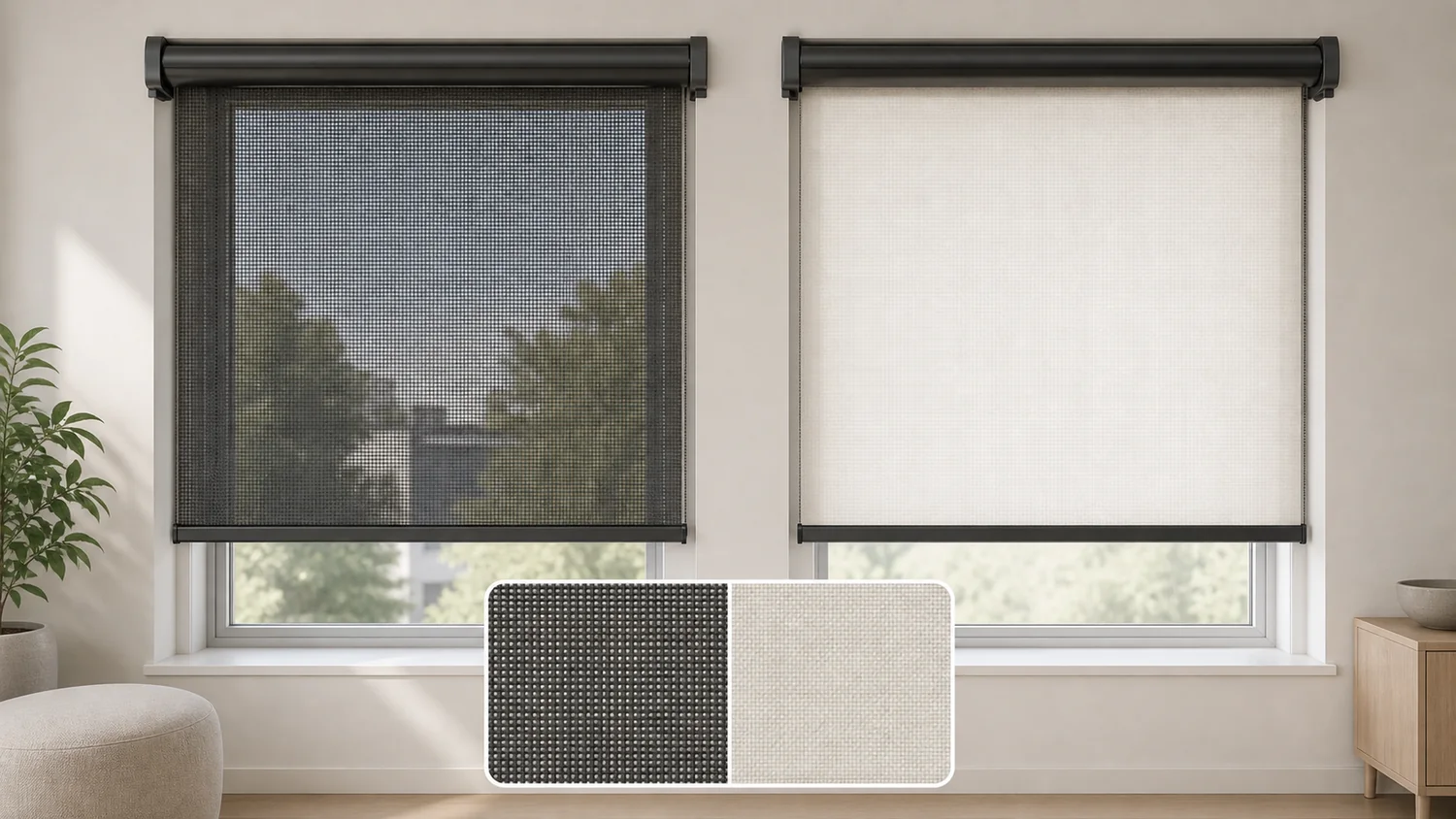
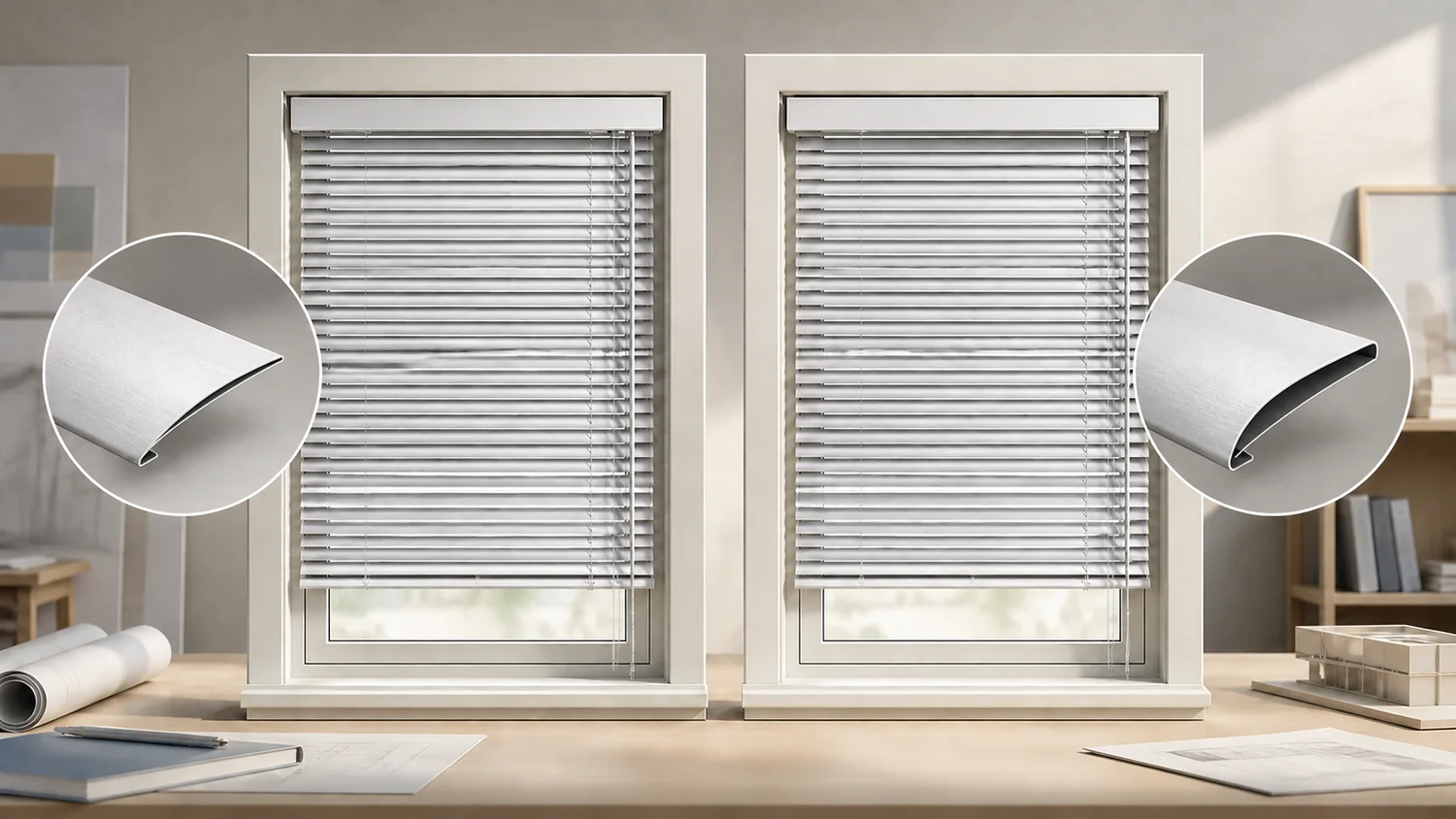
Two samples on a counter can make vinyl vs aluminum blinds look like a simple material contest. The comparison stops being simple when the vinyl candidate has two-inch slats and no lift while the aluminum candidate has one-inch slats, a different headrail and cordless lift. Any difference at the window could come from material, geometry, control, product tier—or all four.
There is no useful universal winner. Put one exact vinyl blind and one exact aluminum blind on the same measured opening. If slat width, headrail, mount, control or warranty changes, name that change instead of crediting the material. Review both blinds lowered and tilted, lowered and closed, and fully raised. Choose only after both complete configurations can perform the window’s required jobs.
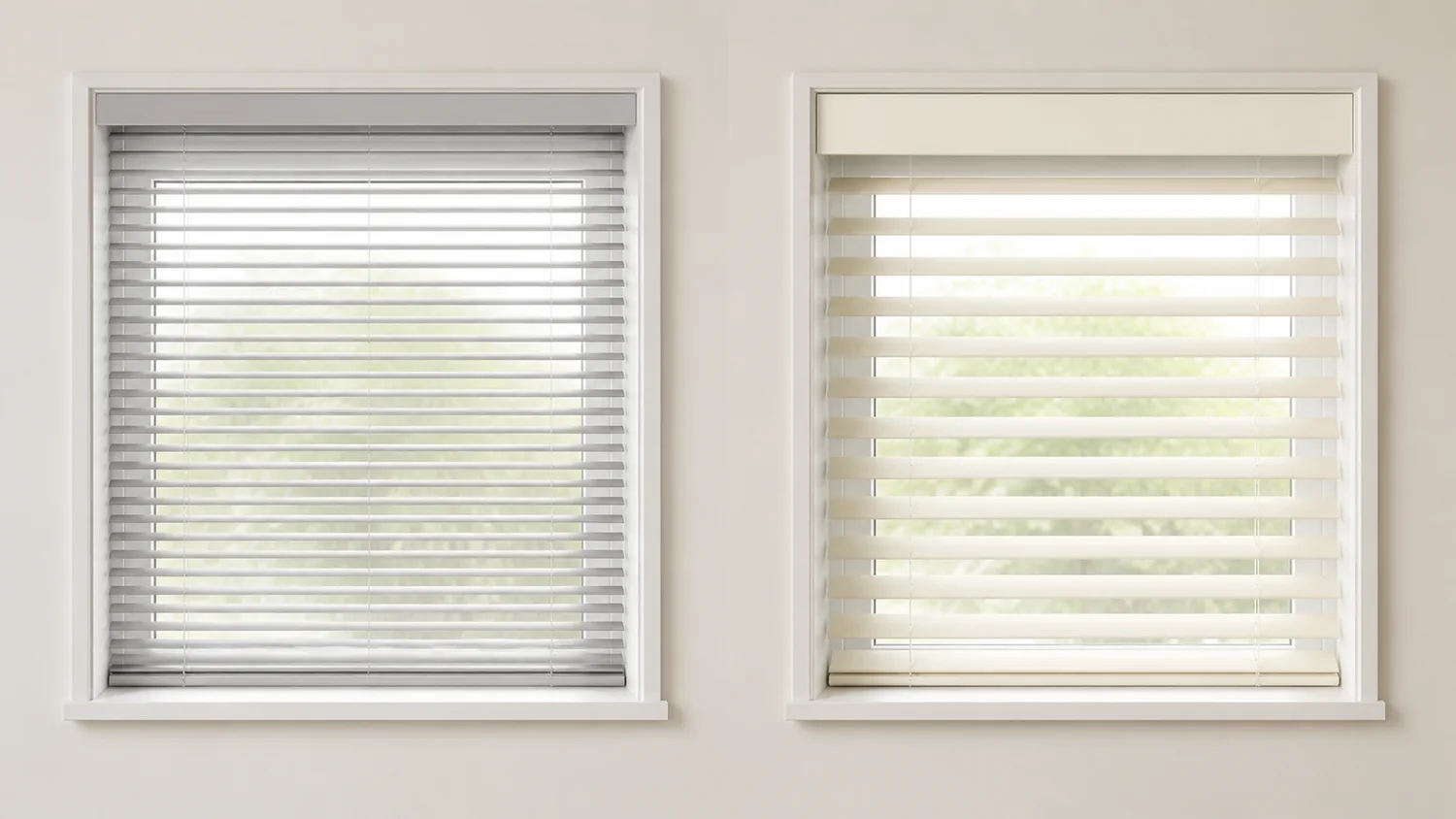
The conceptual samples use identical openings. Narrow aluminum slats appear on one side and wider vinyl slats on the other. The image shows how the complete configuration can change; it does not identify a performance winner or a product that will fit another window.
A false comparison can look perfectly reasonable
Current product ranges show why the first task is not scoring materials. Bali’s current horizontal-blind page presents aluminum in one-half, one and two-inch slats, while its vinyl horizontal description is for two-inch slats. Graber’s current pages also present multiple aluminum slat sizes and a two-inch vinyl line with separate no-lift and cordless-lift configurations.
Those are current examples from two manufacturers, not market-wide rules. They show that selecting a material can move the buyer into a different product configuration. A one-inch aluminum blind and a two-inch vinyl blind may both be valid candidates, but they cannot isolate what the material changed.
A pair is comparable only when both rows identify the same window opening and mount plane, intended finished coverage, slat width or an explicitly accepted difference, lift and tilt functions, required clear/filtered/private states, and source date or quote revision.
If you are still choosing between a tilting blind and a fabric shade, settle that broader format choice with the smart blinds versus motorized shades comparison before narrowing this decision to two slat materials. If both candidates are horizontal blinds, continue even when a perfect pair is unavailable. The task is then to compare two different finished systems honestly, not to invent a controlled material test.
Build the finished-blind card before choosing a material
Use one row per candidate. Copy fields from a current manufacturer page, technical guide, written quote or returned drawing. A store filter or loose sample is not enough to identify a finished blind.
| Field | Vinyl candidate | Aluminum candidate | What closes the field |
|---|---|---|---|
| Product identity | Maker, collection, product code, source date | Maker, collection, product code, source date | Current product record or written quote |
| Opening and mount | Raw opening, inside/outside mount, mounting surface | The same opening and mount | One field record; no guessed order deduction |
| Slat package | Material wording, slat width, disclosed thickness, finish, route holes or tapes | The same fields | Exact sample label and current specification |
| Headrail and bracket | Headrail size, minimum/flush depth, bracket and valance | The same fields | Side section or installation record |
| Controls | Lift, tilt, control side, reach and restrictions | The same fields | Exact option row and operating instruction |
| Window states | Lowered/tilted, lowered/closed, fully raised | The same three states | Finished elevation, exact sample or documented rendering |
| Care and exposure | Approved cleaning, excluded cleaners, room limits | The same fields | Current care owner for the exact finish/product |
| Warranty and service | Covered components, term, exclusions, replacement unit and labor | The same fields | Current warranty plus the seller’s service answer |
Start with raw opening facts in the Smart Shade Measurement and Compatibility Checker. Keep the order size separate. Bali’s horizontal-blind measuring guide covers aluminum and vinyl, yet it still makes product-dependent deductions, depth, stack and option clearances part of the finished result. The selected manufacturer’s current instructions—not a general material article—own those values.
Read the card horizontally. A blank product code makes every downstream claim unstable. A known slat cannot compensate for an unknown headrail. A favorable warranty phrase cannot compensate for a control that is unsuitable for the room. Do not add up “wins”; eliminate configurations that fail a required field.
If the seller uses overlapping synthetic labels such as vinyl, PVC, composite or faux wood, identify the actual named construction before continuing. The composite-versus-faux-wood guide handles that label problem. This page begins after both candidates are real horizontal-blind products.
Read both blinds in three positions
Loose slats reveal color, texture and flexibility. They cannot show side gaps, route-hole light, headrail depth, raised stack or the hand movement required at the installed height. Put both finished candidates through the same three positions.
Lowered and tilted is the ordinary daylight state. Use the same tilt direction and viewing position. Note what happens to the view, glare line and privacy sightline. Do not transfer a result from a close-up photograph to the whole window; slat spacing, route holes, ladder placement, finished width and the light around the edges all contribute.
Lowered and closed is a different geometry. Ask for both tilt directions if the product allows them. View the exact sample or rendering with the brighter side of the window reversed, especially when nighttime privacy matters. “Room darkening,” “privacy” and “tight closure” remain exact-product claims. Neither the word vinyl nor aluminum proves the finished perimeter or the overlap between slats.
Fully raised brings the headrail and lift into the decision. Record the raised package, the glass left open, the control reach and the force or action described by the current instructions. A no-lift product cannot be treated like a blind that clears the glass. A cordless option on one candidate is not a minor convenience if the other row stays permanently lowered.
Slat width can change view, stack and hardware before material has any chance to decide the outcome. If the pair shifts between two-inch and a larger nominal slat, use the 2-inch versus 2.5-inch blind comparison to rerun the complete headrail and state record. For this comparison, a slat-width mismatch should stay visible on the card.
Stress the weak points your room actually creates
SERP comparisons often assign one material to bathrooms, another to sunny windows and a third answer to busy rooms. That sounds decisive because the room names are familiar. It is not enough evidence for an order.
For handling and impact, describe the real contact. Is a pet pushing through the lower slats, a chair touching the blind, or an adult operating it several times a day? A sample may show how one exact slat flexes or marks under gentle handling. Do not turn that into an improvised damage test or a lifespan forecast. Ask what component can be replaced and whether the finish and slat are still available for the named collection.
For sun and heat, record orientation, exposed hours, glass conditions and the exact finish. Request any product-specific placement limits, discoloration exclusions or comparable test basis the seller relies on. Do not convert a reflective color, a metal label or a plastic label into an energy-saving promise. Window geometry, glazing, edge gaps, slat angle and operating schedule remain part of the result.
For humidity, condensation and cleaning, trace what reaches the slats, ladders/tapes, rails, controls and brackets. A wipeable face is not the whole blind. The waterproof-blind claim guide separates humidity from direct splash, while the easy-to-clean blind comparison matches the actual mess to the permitted care method. Use those branches when the exposure, not material aesthetics, is likely to decide the order.
This exposure record may leave both candidates eligible. That is useful. It means appearance, sample quality and the verified quote can break the tie without pretending that one material wins every room.
The control and warranty belong in the material decision
A blind is operated through its completed headrail and control system, not through the slat material. Graber currently lists cordless lift for both named aluminum and vinyl lines, but its vinyl page also shows a no-lift configuration. The exact option row therefore belongs on the card; “available cordless” does not prove the quote includes lift or that the chosen size supports it.
Where young children are present, the U.S. Consumer Product Safety Commission recommends cordless window coverings. Current CPSC business guidance also applies operating-cord and inner-cord requirements to finished stock and custom coverings. Treat that as a completed-product gate. A preferred slat material cannot compensate for an unresolved control or accessible-cord hazard.
Warranty language can expose another hidden difference. Bali’s current warranty assigns a specific three-year period to two-inch horizontal vinyl slats while other components use different coverage language and exclusions. That is a fact about the named current warranty, not proof of a universal material lifespan. Read both candidates at component level: which slat, mechanism, bracket or control is covered; whether the remedy is repair, a like-or-similar part or product replacement; who pays removal, shipping, remeasurement and reinstallation; and what happens if the color or exact slat is discontinued.
Save the receipt, quote revision, product code, finish code and a photo of the finished-product label. Service becomes much harder when “white vinyl blind” or “silver aluminum blind” is the only identity left.
Approve the side view, not the adjective
Return one page to the seller with both candidate rows and the same window ID. Ask for a side view or section of each accepted configuration. It should show the recess, glass, headrail, bracket, slat path, bottom rail, valance if any, control and the most projecting part. Add the factory deduction and raised package from the current order record.
The returned page should also identify the exact maker, collection, product and finish; raw field measurements versus final order size; slat width and any disclosed thickness or gauge; lift and tilt controls including the no-lift case; lowered/tilted, lowered/closed and fully raised states; approved cleaning and exposure limits; and the warranty owner, covered replacement unit and service contact.
Now make the choice in two passes. First eliminate either configuration that fails the mount, control, required window state, care boundary or service path. Then compare the surviving appearance, verified options and ownership burden. Material can be part of that choice, but it no longer carries claims that belong to the headrail, geometry or fine print.
If a seller cannot return a complete row, that is not evidence against vinyl or aluminum. It is evidence that this particular finished blind is not yet defined well enough to order.