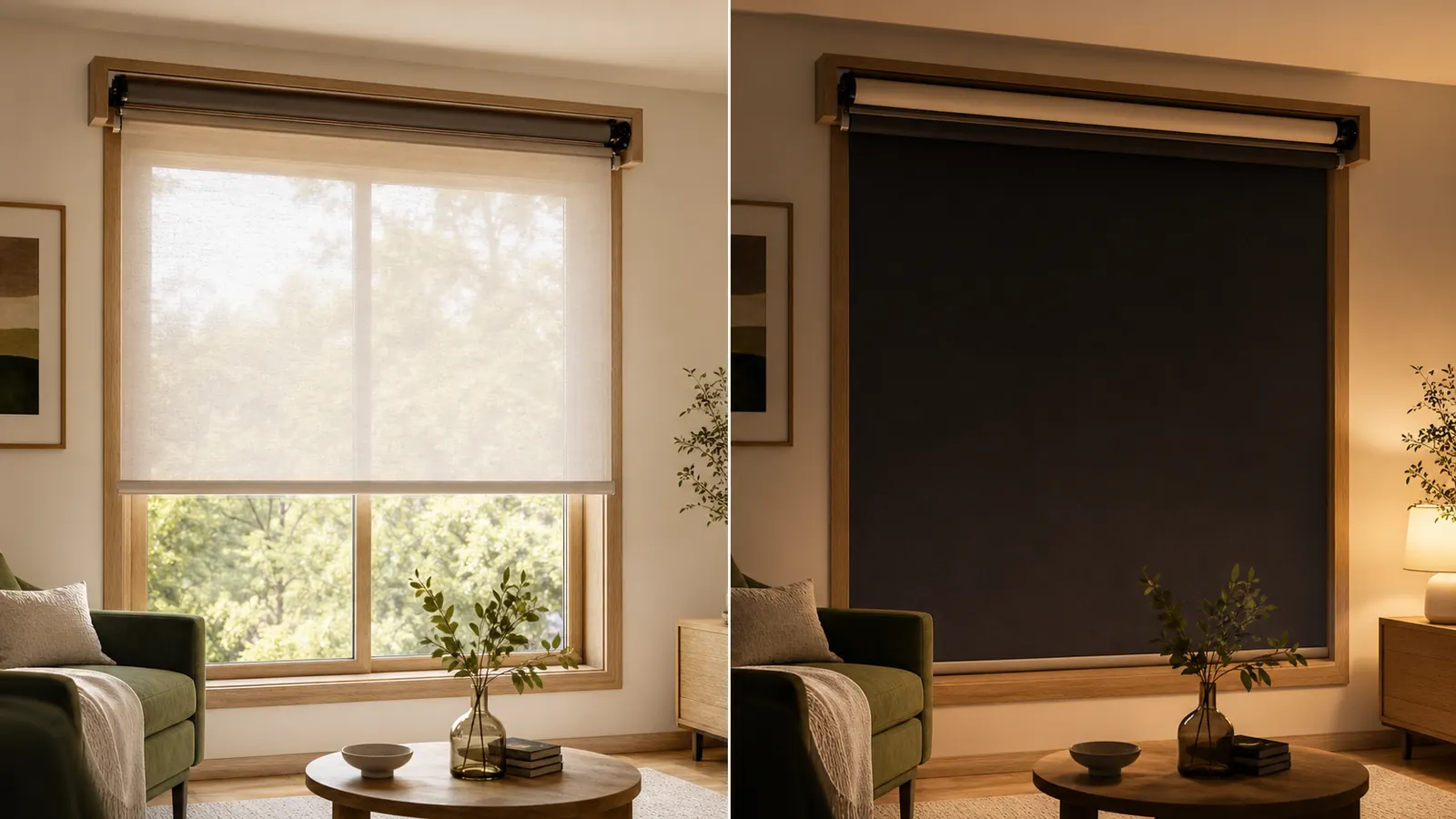
A dual shade is easy to want and surprisingly easy to waste. The sales pitch is tidy: lower a translucent layer for daylight, then lower an opaque layer for privacy or sleep. In a room that genuinely uses both states, that can be much cleaner than changing curtains or living with one compromise fabric.
But two rolls also need more room above the glass. A motorized version may bring two drives, two limits and two things to charge or service. And “blackout” fabric does not make the side gaps disappear. Before paying for the second layer, prove that it will have a real job on an ordinary day—and that the finished hardware fits the window.
Start with three window states
Ignore fabric names for a moment. Stand at the window and describe the three positions you would actually use:
| Window state | What should the room be able to do? | What that means for the shade |
|---|---|---|
| Fully open | Keep the best view and maximum daylight | Both layers must retract far enough that the headrail, rolls and bottom bars do not spoil the opening you wanted to preserve |
| Filtered day | Soften glare or add daytime screening without turning the room dark | One exact light-filtering, solar or sheer layer has to pass the real seat, screen and street-view test |
| Private or dark | Block the nighttime view in, darken a bedroom or calm a media room | The opaque layer and the finished mount must provide enough coverage for that room; fabric opacity alone is not the result |
If filtered day and private or dark are both recurring states, a dual shade deserves a quote. If one row is hypothetical—perhaps the “day layer” would stay rolled up because the window faces a private yard—the second roll is mostly expensive storage.
This is also where a single shade can win. A room that only needs glare control may be better served by one proven light-filtering roller shade. A bedroom that stays dark until morning may need one well-covered blackout treatment rather than two coordinated fabrics. The goal is not to use every position a product offers; it is to make the positions you already need easy to repeat.
“Dual shade” is not one mechanism
Ask what is inside the headrail before comparing prices. “Dual” is used for several constructions that do not move the same way.
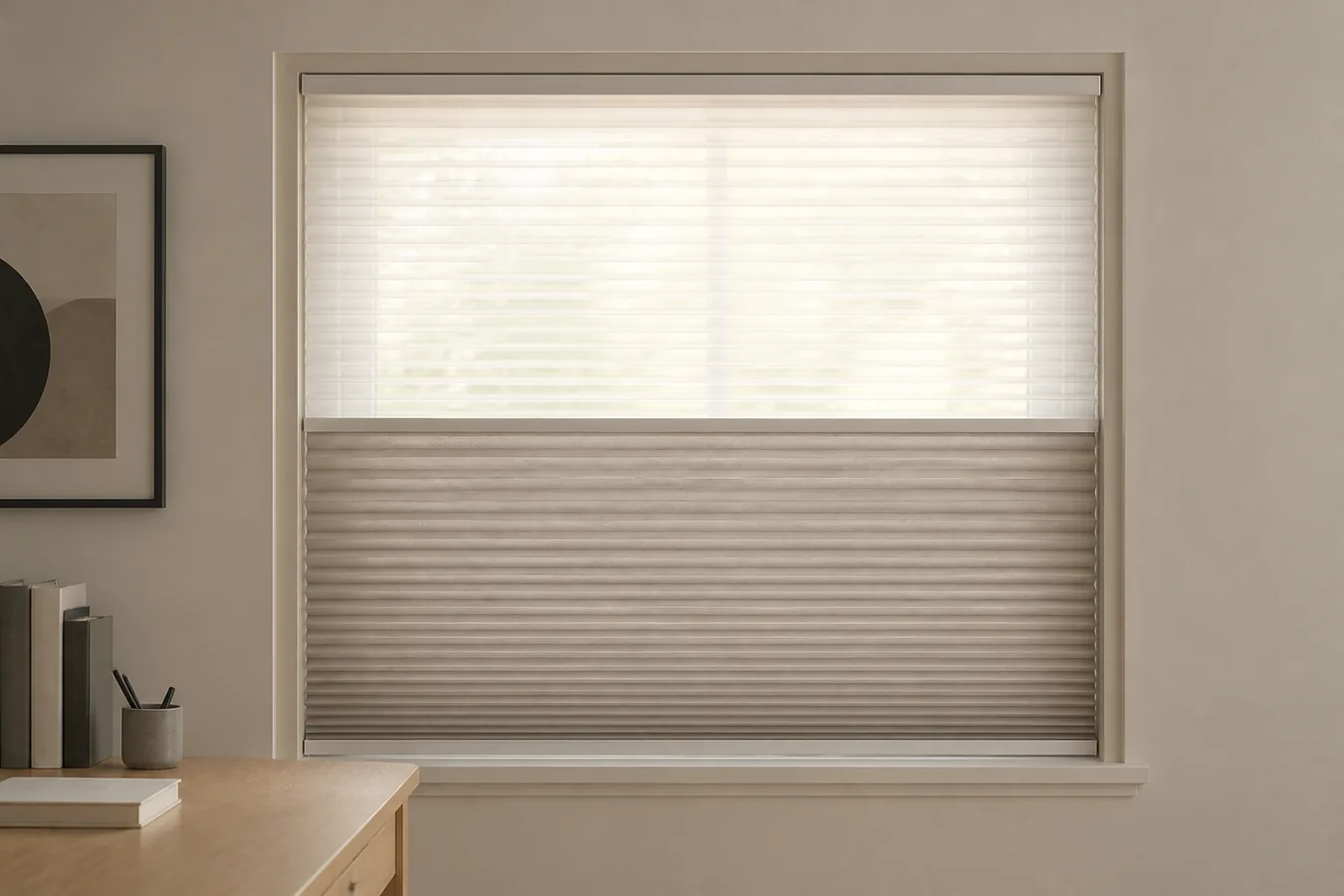
A true dual roller places two separate roller shades at one opening, commonly a filtering or solar fabric and an opaque fabric. Each roll can move independently. That is different from a zebra shade, where alternating sheer and solid bands move past one another, and from a day-night cellular shade, where two fabric sections share a different lifting architecture.
There are branded systems that pair opacity in still other ways. Hunter Douglas describes several Duolite constructions, including two fabrics on one roller in named roller products, fused light-filtering and room-darkening cellular fabrics, and a front shading paired with an opaque rear layer. Those are useful examples of why the product name is not enough. Ask the supplier to draw the actual rolls, fabric paths and moving sections for the exact configuration.
| Construction named on the quote | The useful question |
|---|---|
| Two separate roller tubes | Can either layer move without moving the other, and where do both rolls sit when fully raised? |
| Two opacities joined within one shade | Which section can cover the full window, and in what order do the sections move? |
| Zebra or layered-vane shade | Does band alignment give the nighttime privacy and darkness you expect, or only a different level of filtering? |
| Cellular day-night shade | Do the two fabric sections, rails and lift limits create the top and bottom positions the room needs? |
The site’s motorized shade-type comparison is the right place to compare those mechanisms. Use “dual roller” only when the quote really contains two roller layers.
Give each layer one job
Once the construction is clear, assign each layer a sentence. “Front: soften 2 p.m. screen glare while preserving daylight.” “Rear: stop the lights-on view from the sidewalk and make the room dark enough for sleep.” If both sentences say “add privacy,” the fabrics may be duplicating each other.
Sample the actual fabric and color. A pale filtering fabric can look private from the room in daylight while revealing silhouettes after dark when the lighting reverses. A solar fabric’s openness, color and view-through can change the result. Test the proposed day layer from the normal seat, then go outside after dark with the room lights on. The existing light-filtering guide explains that trial in detail.
Treat the dark layer separately. Check the fabric, then the edges. Inside-mounted roller fabric is narrower than the hardware and has operating clearance at the sides. Outside mounting or a purpose-built channel can change coverage, but the answer belongs to the exact product and wall. The motorized blackout room guide helps match that remaining light to the room rather than treating the word “blackout” as a guarantee.
Do not assume which layer belongs nearest the glass. Roll direction, fascia and product design can change the approved order. One current Bali dual-roller listing, for example, specifies different front and rear roll rules depending on whether its cassette is used. That is evidence that layer order matters—not a rule to copy to another brand.
Measure the box above the glass
The second roll lives somewhere. On a deep, square recess it may disappear neatly. On a shallow jamb it can project into the room, collide with trim or a handle, or require an outside mount that changes coverage and appearance.
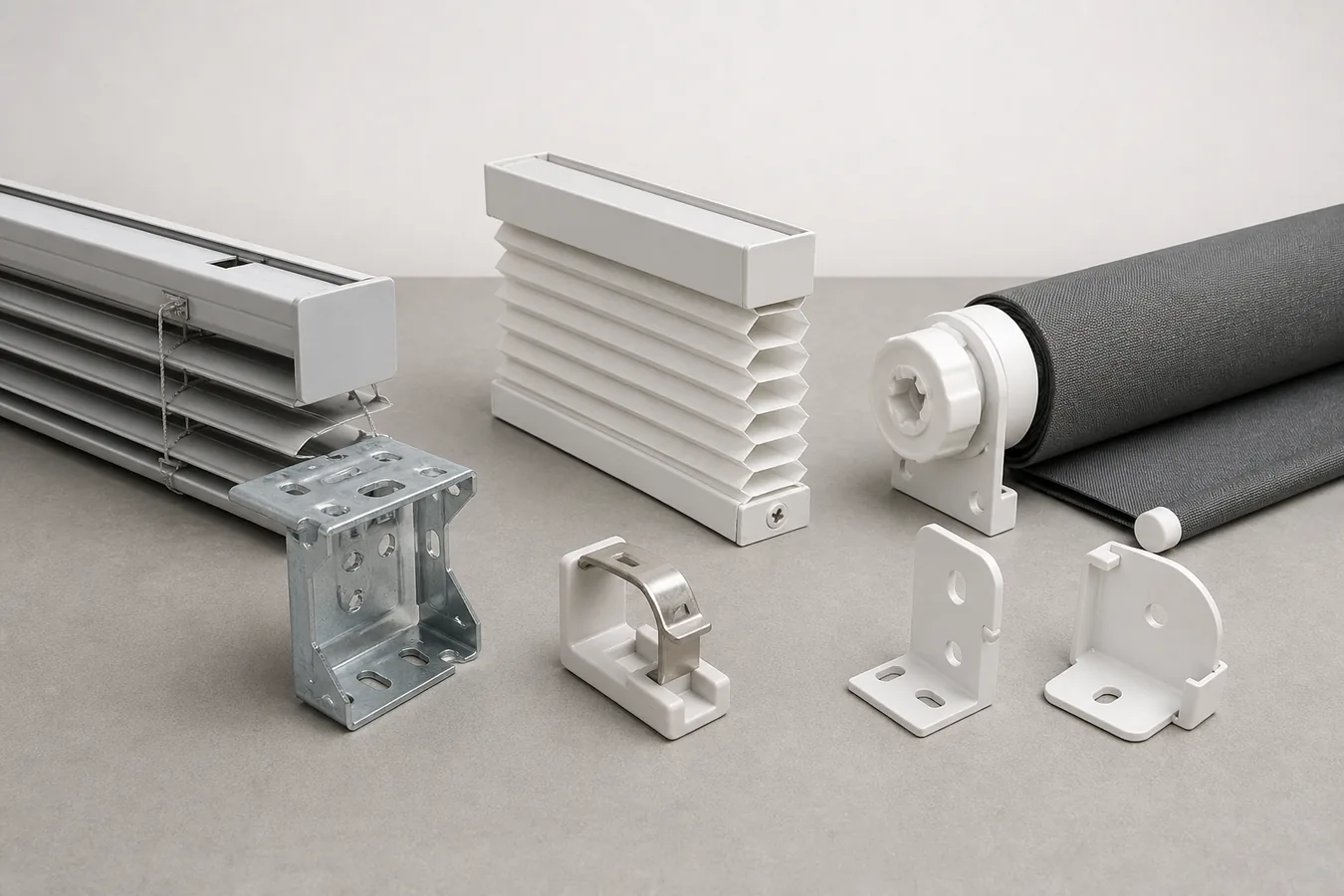
Measure the opening at the plane where the brackets will sit, not only at the glass. Record usable depth after screens, locks, crank handles, tile, casing and uneven returns. Then ask for a side section that shows both full rolls, brackets, cassette or fascia, fabric paths, bottom bars and the nearest obstruction.
Technical drawings show why a single universal depth is unsafe. A current Lutron installation guide shows both vertical and parallel dual-mount arrangements and says the pocket depends on the final window height and fabric type; its examples also call for suitable blocking or structural support. Those drawings describe Lutron systems, not the dimensions your residential shade will use. Their value is the habit they enforce: the final roll size and support condition belong on the exact drawing.
Start with the Smart Shade Measurement and Compatibility Checker to record the opening, mounting surface and obstructions. Then settle inside versus outside mount with the dual headrail in mind. An inside mount that was generous for one roller can be too shallow for two; an outside mount that clears the hardware can change the light gap, trim coverage and visual height.
The drawing should show the fully raised state too. Two rolled fabrics and two bottom bars can create a larger bundle than the product photo suggests. If that bundle hangs over a view, transom or door, the “fully open” row in the first table has failed.
Two layers can mean two service paths
For a manual dual roller, confirm how each layer is operated and where its control sits. Two chain loops on the same side may be awkward; opposite sides may conflict with furniture, a wall or a door. Child-safety hardware and tension devices have to fit the actual mounting surface.
For a motorized system, ask whether each layer has its own motor, identity and limit positions. Then write down:
- which remote channel or app tile moves the day layer and which moves the dark layer;
- whether one scene can raise one layer before lowering the other;
- what still works locally if a hub, bridge, internet connection or voice service is unavailable;
- where each power lead, battery, charging point, reset control and removable component sits;
- whether ordinary charging or reset can be done without moving furniture or bringing out a ladder.
One current SmartWings dual-shade category lists selected rechargeable, hardwired and PoE power options and several ecosystem choices. That establishes options for that family, not compatibility for a quote. Freeze the exact motor and protocol for each layer, then carry both through the site’s power-path selector and compatibility check.
Schedules should describe a room result, not a gadget demo. “Lower the filtering layer at afternoon glare; raise it before lowering blackout at bedtime” is testable. “Automate the shades” is not. If two layers cannot be named clearly in the remote, grouped separately and recovered locally, they will be harder to live with than one good shade.
Know when a simpler shade wins
Dual rollers earn their bulk when the room repeatedly needs both a soft daytime layer and a genuinely more private or darker nighttime layer. Street-facing living rooms, bedrooms used in daylight and media rooms that are not always dark are plausible cases. Even there, the samples, gaps and controls still decide the answer.
Choose a simpler path when the second layer has no regular job:
- one light-filtering roller for a room that only needs glare softening;
- one blackout treatment when the shade stays open by day and closed for sleep;
- motorized zebra blinds when adjustable band overlap solves the light task and its closed state passes the privacy test;
- a cellular construction when insulation and a different day-night movement matter more than two roller fabrics;
- one everyday shade plus curtains when darkness is occasional and the extra headrail would spoil the opening.
The cheapest second layer is the one you do not buy. The most expensive is the one that fits on paper, blocks the view when raised and still fails the night task around its edges.
Ask for one labeled cross-section
Before approving a dual-shade order, have the supplier return one side-view drawing for each different opening. It should label:
- the window ID, bracket plane, usable depth and mounting surface;
- both roller tubes or the exact alternative construction;
- front and rear fabric, opacity, color and roll direction;
- cassette, fascia, bottom bars, fully raised bundle and finished projection;
- anticipated fabric edges and coverage at the top, sides, center and sill;
- each layer’s control, motor, power, charging, reset, local override and service access;
- the three promised states: fully open, filtered day and private or dark.
A useful approval sentence is: “For window L2, the front filtering layer and rear opaque layer move independently, both raised rolls and bottom bars fit inside the shown envelope, and the drawing identifies the finished gaps and service points for each drive.”
If the quote cannot support that sentence, you do not yet have a dual-shade configuration. You have two fabric swatches and a product name.