A continuous beaded chain is not merely a different way to move a roller shade. It adds a fixed operating path beside the window: the clutch, loop, tension device, anchor surface and the room area around them all become part of the order.
Approve that control only after the exact shade, chain side, loop drop, permanent anchor, adult reach and nearby furniture describe one workable installed system. If young children live in or visit the home, the U.S. Consumer Product Safety Commission says cordless is the safest option. A tension device can reduce risk; it does not make a loop equivalent to cordless.
A chain option changes the installed window
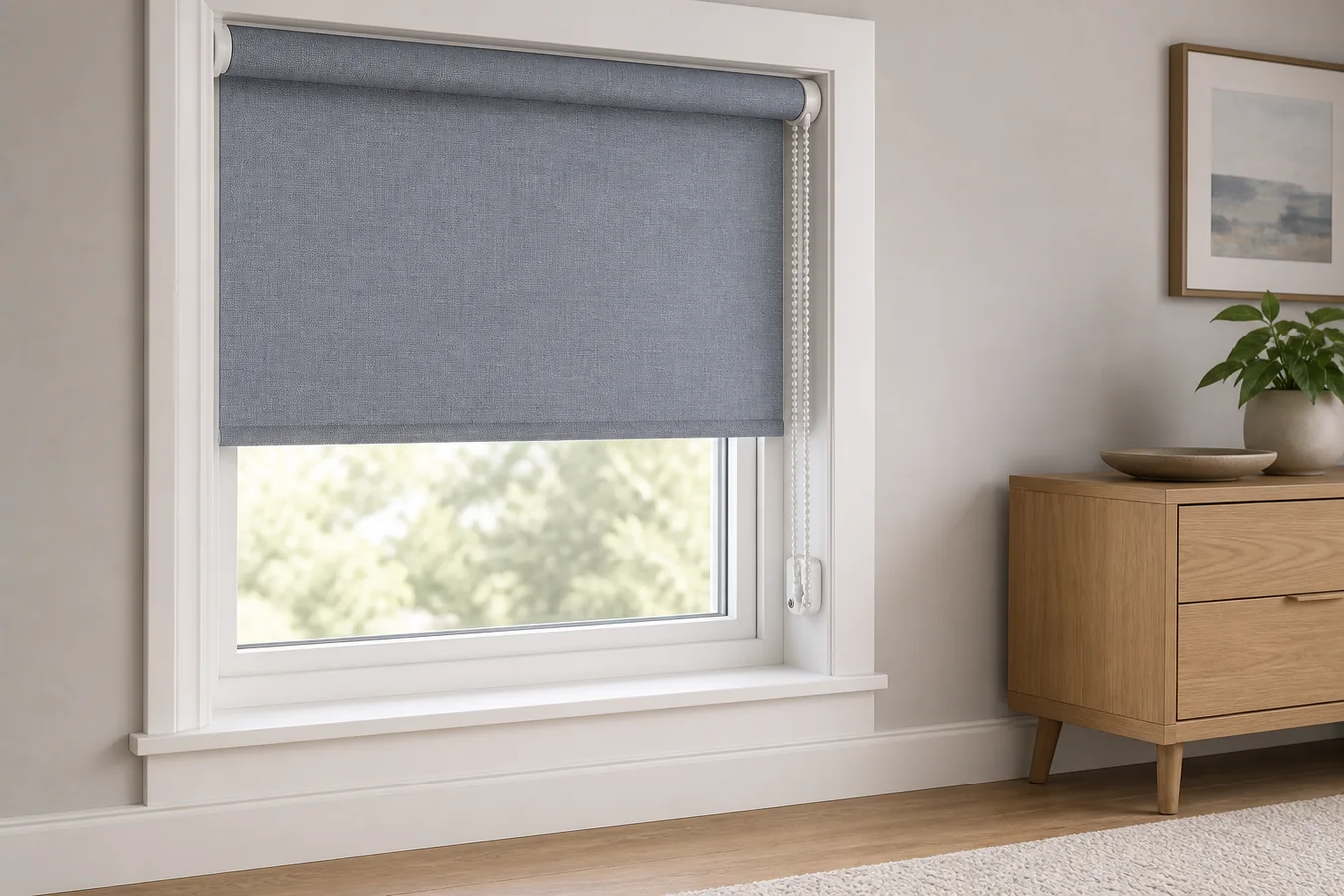
Product pages often place continuous loop beside cordless and motorized as three buttons. That presentation hides the practical difference. Cordless operation usually follows a moving rail or product-specific handle. A motorized shade moves through a powered system. A continuous-loop shade keeps the operating chain in one fixed place while the shade moves.
That fixed place matters. The chain needs a side, a stated drop and an uninterrupted path through its tension device. The device needs an approved surface and fastener. The adult operator needs a comfortable position that does not put a crib, bed, toy chest, chair or other climbable object in the same zone.
The current WCSC explanation of ANSI/WCMA A100.1-2022 says the revised standard eliminated free-hanging cords, prohibits continuous loops and bead chains on horizontal slatted custom products, and adds enhanced requirements for permitted product categories using continuous loops with tension devices. The effective date it gives is June 1, 2024 for products manufactured on or after that date. That is a reason to demand exact product evidence, not to infer that every chain option shown online is interchangeable.
Mark the side before the quote is priced
Stand in front of the real opening before choosing a control side. Trace the left and right edges from the clutch height down to the sill and below it. Look for a crank, lock, deep trim step, tile edge, fragile finish, narrow return, radiator, desk, bed or cabinet. Then mark where an adult would stand and pull without leaning across the shade.
Do not stop at “right control” on a configurator. Ask where the loop ends and where the tension device must be fixed. A control can clear the fabric yet still land over a handle, beside a furniture corner or on a surface the installer will not accept. If the window is part of a pair, note whether two adjacent loops would occupy the center or outer edges.
Save the opening, mount plane and obstructions in the Smart Shade Measurement and Compatibility Checker. Add the chain information to the seller’s quote, because loop drop and tension-device rules belong to the exact operating system rather than the raw window measurement.
Put six fields on the order
Use one row set for the actual candidate. A product-family page can start the record, but only the exact quote, current technical guide and named installer can complete it.
| Field | What to record | Result that closes the row | Result that changes the order |
|---|---|---|---|
| Product and control identity | Maker, collection, fabric, finished size, clutch/control name and document date | Every source names the same continuous-loop build | A generic “chain available” badge or a guide for another system keeps the order open |
| Chain side and loop drop | Left/right side, stated drop, path past trim and hardware, upper/lower stops | The loop is reachable by the intended adult and clears the entire window cycle | Move the side, change the mount or choose another control |
| Tension device and anchor | Supplied device, approved surface, correct fastener, installer and finished position | The installer can anchor it as the exact instructions require and keep the chain taut but operable | No suitable surface, no device or an improvised attachment keeps the order open |
| Reachable room zone | Children who live in or visit, furniture, beds, cribs, toys, shelves and future room use | The zone remains clear under the real furniture plan | Choose cordless or redesign the room; tying or lifting the loop out of sight is not closure |
| Operation and size | Accepted width/height, expected pull force, full travel, roll direction and daily reach | The exact build moves through required positions without an unresolved burden | A heavy, awkward or out-of-range build moves to a documented alternative |
| Service and alternative | Warranty owner, installer, tensioner/chain service, cordless/wand/motorized version and completed prices | One control has a complete ownership path and no failed row | Keep the order open until the seller can bind the missing part |
Do not average these rows. A beautiful fabric cannot compensate for an unknown anchor. A convenient chain position cannot compensate for a child-reachable loop. The useful output is a completed installed state, not a feature score.
The tensioner needs a real home
CPSC guidance says that a continuous-loop cord should be anchored to the floor or wall with fasteners appropriate for that surface and kept taut but operable. The same page tells households to move cribs, beds, furniture and toys away from window-covering cords. CPSC also states that these steps reduce rather than eliminate the hazard.
Its window-blind cord standards activity page explains why the device cannot be treated as optional packaging. CPSC notes that consumers may fail to install a tension device, remove it or install it incorrectly, compromising the system’s effectiveness. So “tensioner included” is only half an answer. The quote needs to identify where it will go and who is responsible for installing it according to the exact instructions.
Photograph the proposed anchor area straight on and from the side. Record whether it is painted wood, masonry, drywall over an unknown cavity, tile, metal or another surface. Do not choose a fastener from a generic article. Ask the maker or installer to identify the approved relationship. If a lease, finish warranty or inaccessible cavity prevents the required attachment, that is a control-selection problem before purchase.
The broader cordless and motorized child-safety audit is the right place to review inner cords, labels and every covering layer in the room. This page has a narrower job: it refuses to let one visible loop enter an order without a real anchor and room plan.
Reach and furniture can veto the chain
A loop can be convenient for the adult who priced the shade and still be wrong for the room. Check the window with its normal furniture, not an empty sales photo. Open drawers and doors. Move the window handle. Sit at the desk or on the sofa. Confirm that the operator can pull in a natural direction without dragging the chain across trim or reaching over furniture.
Then check how the room might change. A guest room may later hold a crib. A low cabinet can become a climbing step. A desk chair rolls. A toy bin moves. CPSC’s preference for cordless when young children are present is clearer than a plan to keep tying up or hiding the chain.
Do not call the system safe because the loop looks short, high or tight in a rendering. The exact product evidence and installed device matter, and the full room remains part of the decision. If keeping the chain zone clear depends on a fragile household rule, the stronger answer is a different control. The room-by-room shade planner can keep that room constraint attached to the rest of the opening decision.
Let the exact shade decide whether the chain earns its place
Continuous loop can remain a legitimate candidate when it solves a real operating problem and the complete installation closes. It may keep the control at a fixed height while a tall shade moves, and a clutch can change the effort needed to raise a larger roller shade. Those benefits still belong to the exact system.
LEVOLOR’s roller-shade technical guide effective June 5, 2025 illustrates the specificity. For the products in that guide, the continuous-loop system includes a bead chain, clutch, tensioner and bead stops. The guide maps default loop drop to shade height, changes chain guidance at some larger sizes and points shoppers toward its InMotion option where pull force would be heavy. It also presents cordless, wand and motorized systems with their own size and control limits.
Do not borrow LEVOLOR’s loop lengths, chain recommendation or alternative eligibility for another collection. Use the example to improve the question you ask: “For this finished shade, what loop drop, chain material, clutch, tensioner, limits and pull behavior will appear on my order?”
If the chain record fails, compare complete alternatives rather than switching one word. The cordless-lift versus motorized-lift guide keeps the shade, window and required positions constant while checking eligibility, reach, power, recovery and service. A wand can be another exact-product option where offered. The winning alternative is the one the manufacturer can actually build for this opening.
Keep the order open until every field names one system
Before payment, place the quote, current technical guide, window photo and installer confirmation together. They should agree on the product, finished size, control, chain side, loop drop, tension device, anchor, limits and service owner. Write the document dates beside them.
If the chain side is unresolved, move it on the quote. If the anchor is unresolved, ask the maker or installer to close it. If the room zone is not durable, choose an exact cordless, wand or motorized configuration. If the seller cannot name the clutch or supplied device, leave the order open.
Once the shade exists, a failure becomes a different task. The roller-shade clutch guide can help identify the drive end and repair scope without treating a replacement clutch or chain as universal. Before purchase, however, the simpler rule holds: the beaded chain earns its place only when the complete installed control is already visible on paper.