The folds can look raised while nothing in the treatment moves. A faux Roman shade is a stationary valance made to resemble a Roman shade. It does not travel down the glass for privacy, rise for a view, or change position for glare control.
That can be exactly right when the fabric has one decorative job. It is the wrong single treatment when the window must behave differently at noon, after dark, or at bedtime. In that case, either put a working layer behind the faux Roman or buy an operable Roman shade instead.
Before comparing fabrics, decide which noun is being sold. Current Blinds Chalet guidance calls a faux Roman a stationary decorative treatment, and specialist workroom Indigo & Luxe sells the category as fixed valances. “Mock Roman” and “stationary Roman” can describe the same idea, but only the exact listing can confirm that it does not move.
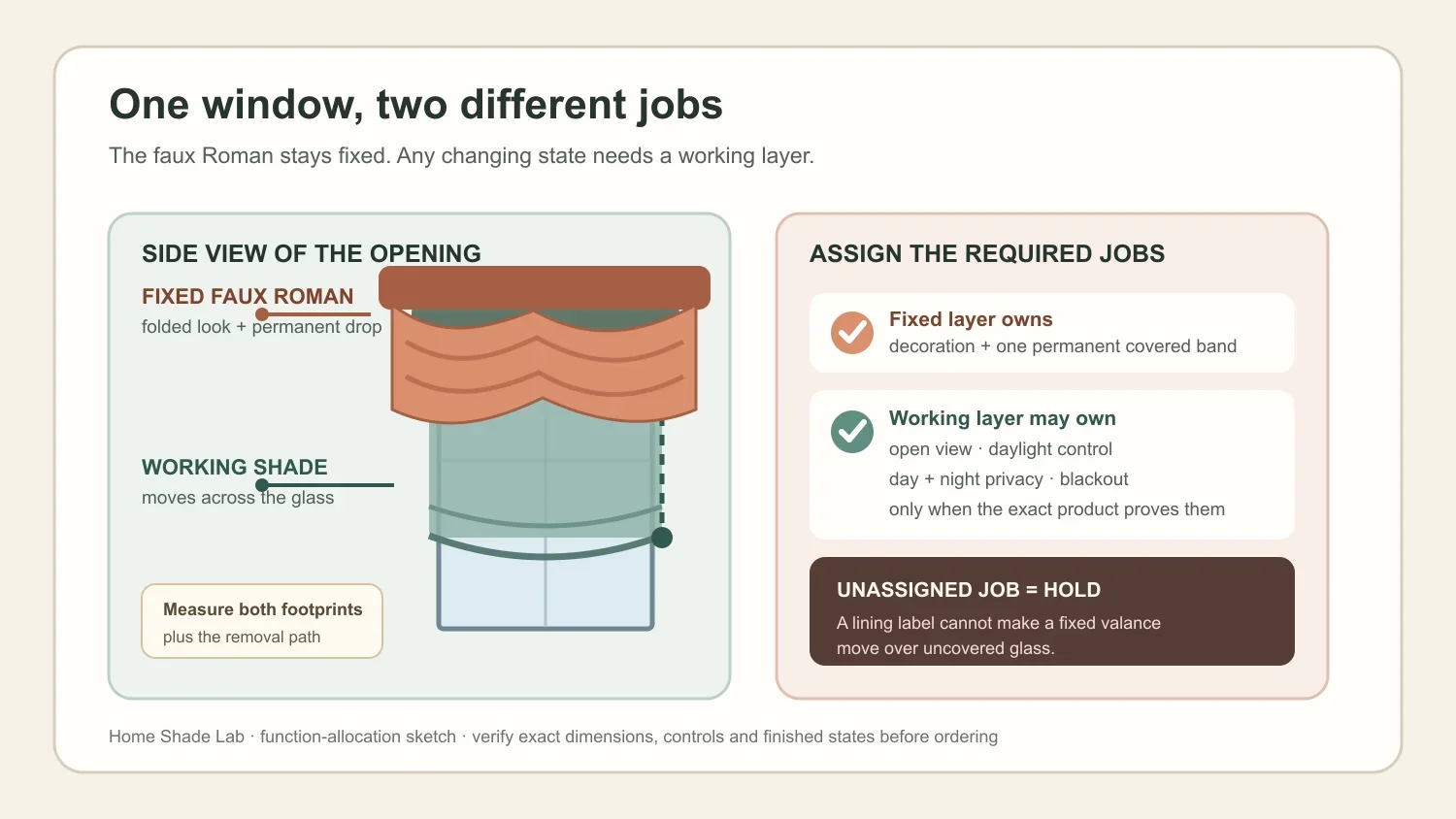
Give every window job a physical owner
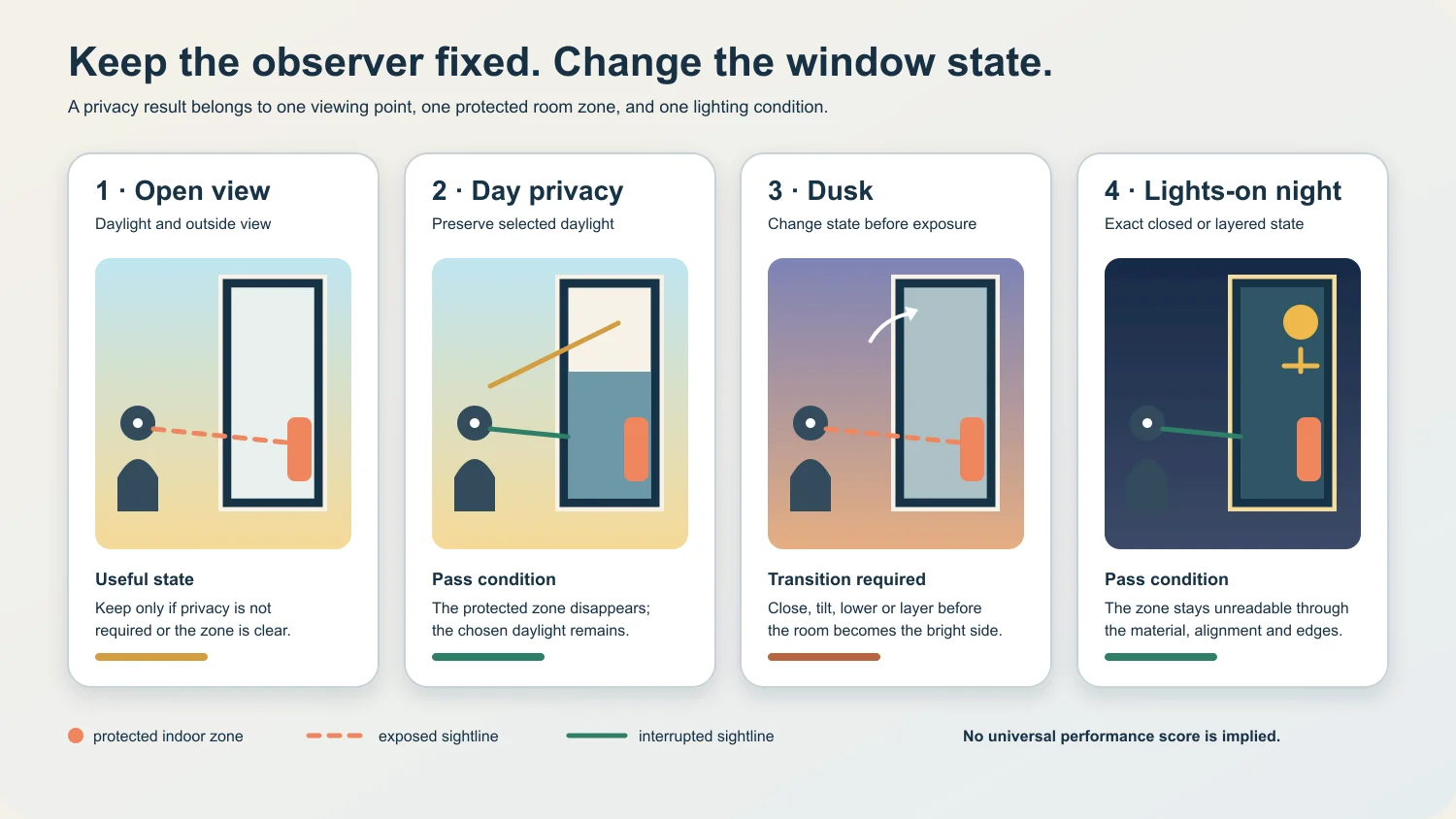
Write the required jobs down the left side of one page: the Roman-fold look, an open view, softened daylight, daytime privacy, lights-on-night privacy, blackout, and any daily movement. Across the top, write “fixed faux Roman” and “working layer.” Put each job in one column.
The fixed face can own decoration and a permanent amount of upper-window coverage. It cannot own a position that changes. A separate roller, cellular, sheer, blind, shutter, or drapery layer may own the changing jobs, but only if the exact product can produce the required state.
| Required result | Fixed faux Roman can own it when… | A working layer is needed when… |
|---|---|---|
| Roman-fold appearance | The visible folds and fixed drop are the whole decorative goal. | The same fabric must also raise or lower. |
| Open view | The permanent drop leaves enough useful glass. | More glass must open during part of the day. |
| Daylight control | One constant covered band is sufficient. | Glare or light must change by time or activity. |
| Privacy | The covered band alone blocks the only relevant sightline. | Privacy must extend lower or change after dark. |
| Blackout | It is not assigned from the product name alone. | The room needs documented fabric and edge coverage. |
| Daily movement | Never. | Any required state depends on repositioning the covering. |
A blank cell is not a minor specification. It is an unowned room requirement. If a seller describes the faux Roman as “light filtering” or offers blackout lining, that still does not make the fixed valance travel over uncovered glass. Material and movement are different facts.
The current Hartmann & Forbes faux-Roman style page, for example, describes three fixed folds. That is a useful description of one named product, not a universal fold count or functional-shade promise. Keep every claim attached to the exact seller and construction.
The fixed drop uses real glass and real depth
A faux Roman may be decorative, but it occupies physical space. Record the finished drop from its mounting point to the lowest fold. That number is the permanent visual stack: it tells you how much glass the valance covers even on the brightest day.
Now draw a side view. Add the rod, board, brackets, returns, projecting folds, trim, handles, and the headrail or roll of any working shade behind it. If the second layer moves, draw its full path rather than only its closed position. Leave a removal route for whichever piece must come down first for cleaning or service.
Inside and outside mounting change the drawing. Current Hunter Douglas mount guidance notes that an inside-mounted treatment needs enough recess depth to sit as intended; exact minimums remain product-specific. An outside-mounted faux Roman can free the recess for a working shade, but it also changes wall projection, visible side returns, and the apparent height of the window. The separate guide to outside-mount Roman shades owns that broader mount comparison.
Use the measurement checker to keep opening dimensions, depth, trim, handles, and mount plane together. Add two values that generic shade forms may not request: the faux Roman’s fixed drop and the working layer’s complete moving envelope.
Three coherent window plans
Let the faux Roman stand alone when the window has no moving job
This is the cleanest case: the window already has acceptable privacy, does not need variable light control, and can surrender the same upper band of glass all day. The faux Roman supplies softness, pattern, and a tailored top treatment. A current workroom listing should still provide finished width, drop, mounting method, lining, pattern placement, and care terms.
Do not manufacture a functional claim to justify the purchase. A decorative object can be worthwhile because it looks right. It simply should not inherit privacy, blackout, or insulation duties that the quote never proves.
Layer it when decoration and function belong to different objects
Layering is coherent when the fixed face owns appearance and one documented covering owns all changing states. The Pinched Pleat’s current Roman-shade guide describes this use: a faux Roman can add polish while another treatment handles light control.
The word “behind” is not enough. Name the second product, mount plane, roll or stack direction, control side, hem-bar path, edge coverage, and removal order. A roller shade might disappear neatly behind the fixed folds; a bulky headrail or projecting handle might not. If the plan uses two independently moving shade layers rather than one fixed and one moving layer, the dual-shade guide owns that different decision.
If nighttime privacy or darkness matters, approve that state on the working layer. The light-filtering versus room-darkening guide separates material labels, while the blackout Roman shade guide follows seams, liner, and edge light. The faux Roman can conceal hardware or soften the composition; it does not erase an untested gap.
Choose an operable Roman when the Roman fabric itself must move
If you want the patterned face lowered for privacy and raised for the view, the requirement already describes a working Roman shade. Start in the site’s shade-family comparison and keep the Roman route only if its raised stack, fold behavior, care, and controls suit the window.
An operable Roman is not automatically better. It has more mechanism, fabric movement, and service detail. It is simply the honest match when one fabric panel is expected to change state. For a powered version, use the motorized Roman shade guide to inspect the fold, stack, and motor fit as one product.
Make the quote match the window
A useful quote should let you rebuild the layer drawing without guessing. For the faux Roman, capture the seller’s exact term, finished width and drop, mount method, projection or return, fold style, lining, rod or board, and removal method. For a working layer, add product family, fabric or slat construction, headrail dimensions, movement, controls, edge coverage, power if any, and service access.
| Quote wording | Translate it into a physical fact |
|---|---|
| Faux, mock, or stationary Roman | Fixed or operable; get that answer in writing. |
| Inside or outside mount | Exact mounting surface and projection. |
| Custom length | Finished fixed drop, not the window height. |
| Lined or blackout lined | Material construction only; no whole-window blackout promise. |
| Layered over a shade | Exact second product, headrail, controls, moving path, and removal order. |
| Cordless | Exact operating method and reachable moving rail or handle. |
Controls remain part of the layer plan. For rooms young children can enter, current U.S. CPSC guidance directs buyers toward cordless coverings. An accessible cord must not disappear behind the decorative folds, and any required tension device must remain inspectable.
The order is ready when every required room state has one physical owner, every object appears on the same measured section, and the quote identifies those objects precisely. If the folds are fixed but your privacy plan depends on their moving, stop shopping the fabric. You need another layer or a different kind of Roman shade.