A roller shade motor is not compatible because it has the right-looking diameter, an attractive torque number or the wireless protocol you want. It is compatible when the motor, tube, crown and drive, brackets, opposite idler, finished shade load, power, controls and limit-setting method belong to one supported assembly.
If a listing cannot name those interfaces, it has described a motor—not a motor that fits your shade. Decide first whether you need an exact replacement, an approved retrofit kit or a newly specified motorized shade. Each route needs different proof.
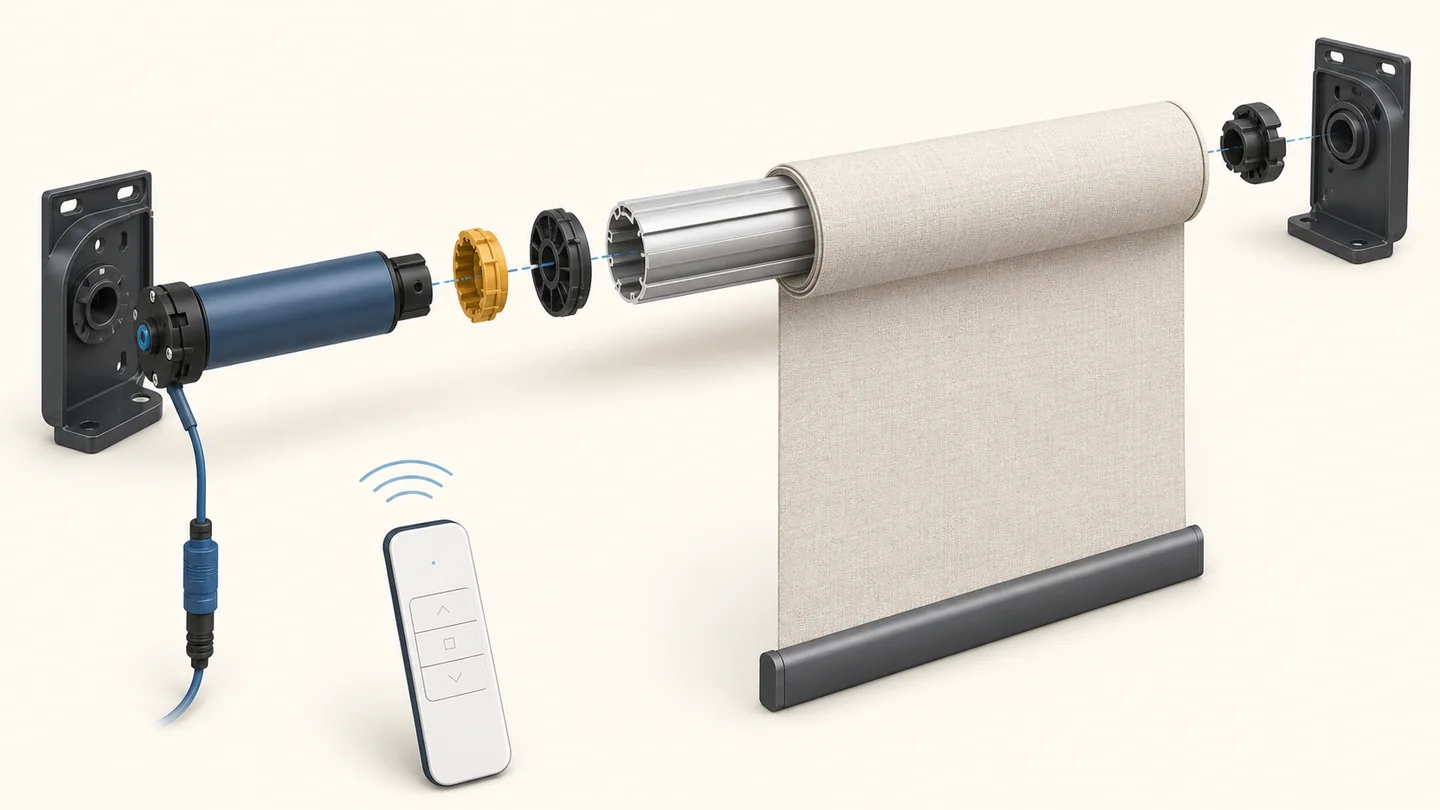
The exploded illustration shows the unit of decision. The tubular motor enters one end of a profiled tube through a matching crown and drive wheel. Its head locks into one bracket; an idler/end plug supports the opposite side. Fabric, bottom bar and roll diameter supply the moving load. Power and controls only become useful after that mechanical chain is real.
First decide what kind of purchase this is
Three shopping situations can produce the same search, but their evidence is not interchangeable.
| Purchase lane | What must already be known | Evidence that closes it | Stop condition |
|---|---|---|---|
| Exact replacement | Manufacturer, collection, model, region, motor reference and existing completed assembly | Current replacement or supersession record, including any changed adapter, bracket, power or programming requirement | The old motor cannot be identified or the proposed part is only “similar” |
| Approved retrofit | Existing shade condition, tube dimensions/profile, usable width, load and mounting space | A named kit or system whose current compatibility record covers the measured shade and supplies/specifies the required interfaces | The kit fits only by removing, machining or inventing an unsupported interface |
| New completed shade | Opening, mount, fabric/light task, finished dimensions, power and control requirements | One completed specification with its selected drive, tube, brackets, idler, enclosure, power, controls and warranty owner | The quote names a motor but leaves the finished shade hardware unresolved |
An old motor failure does not automatically make the job an exact replacement. Part numbers can be obsolete, and a replacement may have a different head, connector or programming path. Likewise, “retrofit” is not a universal promise. Eve’s current MotionBlinds Upgrade Kit record, for example, has separate versions for tube outside diameters of 25–30 mm and 38–51 mm, with different minimum blind widths and torque. The kit includes a crown, drive plug, end plug and bracket set. That is what a compatibility claim looks like: it names the lane and carries the interfaces with it.
If the basic question is whether the existing covering should be automated at all, settle that in the existing-blind retrofit guide before selecting a motor. This page starts after the scope is legitimate.
The motor touches more than the tube
A tubular motor has two mechanical jobs. The drive wheel transfers rotation into the tube, while the crown supports and senses the tube’s rotation around the motor body. Both must match the tube’s actual profile—not merely a rounded diameter from a seller title.
At the exposed end, the motor head must seat in a compatible bracket or adapter plate without defeating its designed retention, clearance or cable exit. Across the shade, the idler/end plug and its bracket set the opposite support. Together, those ends determine tube length, side gaps and whether the assembled shade can enter and remain in its brackets.
Somfy’s current Sonesse 30 Zigbee product record makes the variety visible. Alongside one named 2 Nm, 24 V DC Zigbee motor, it lists multiple named crown-and-drive sets, tubes, motor plates, idlers, brackets and power accessories for particular systems. The page is not a recipe for mixing them. It is evidence that “Sonesse 30” or “30 mm motor” alone does not finish the drive end.
The same boundary appears on Somfy’s Sonesse 28 WireFree RTS record. The motor uses a rechargeable power path and RTS control, while the accessory list distinguishes specific crown/drive sets, tubes, idlers, motor plates and charging pieces. A visually plausible adapter from another shade family is not a verified substitute.
This is why a loose motor should be treated more like one component in a bill of materials than a plug-in appliance. The shade’s current system identity is the shortest path to a real answer. When that identity is missing, photographs and dimensions can help a manufacturer or fabricator investigate, but they do not become authority on their own.
Build the whole-drive-end record
Use one record for one exact opening. Do not combine the tube from one shade, the load estimate from another and the controls from a third into a synthetic “match.”
| Record line | What to capture | What a complete response proves |
|---|---|---|
| Scope and identity | Exact replacement, approved retrofit or new shade; maker, collection, model, generation, region and document date | The evidence belongs to this job rather than a look-alike assembly |
| Finished shade | Ordered width/drop, fabric, bottom bar, roll direction, top treatment and completed moving load | Motor capacity is checked against the object it must move |
| Tube interface | Tube maker/system, material, named profile, maker-defined dimensions, crown, drive wheel and adapters | The motor transfers torque without an improvised coupling |
| Motor-side end | Motor reference/body length, motor head, bracket or plate, cable/charging exit and clearance | The drive end seats in the intended mount and remains serviceable |
| Opposite end | Idler/end plug, idler bracket, extension range and required retention parts | The non-motor end belongs to the same supported construction |
| Finished geometry | Tube deduction, side gaps, minimum width, maximum roll/enclosure clearance and fabric plane | “Fits the tube” also fits the brackets, housing and window |
| Power layer | Voltage, supply/battery, connector, charger/solar accessory, cable path and service access | The named motor has its supported power path |
| Control layer | Protocol, remote/channel, hub, local control, limit method, direction and favorite-position behavior | The motor can be commissioned and operated in the intended system |
| Ownership | Who fabricates, programs, installs, warrants and services the completed result | A named party owns the interfaces instead of the buyer owning the gaps |
The record can close in five ways. Exact replacement requires a current replacement or supersession record and every changed interface. Approved kit requires the measured shade to sit inside the kit’s current physical and load limits. Complete shade makes the seller own the finished configuration. Professional specification keeps a plausible existing shade while an authorized fabricator resolves parts, deductions or capacity. Hold applies when the tube, load, bracket, idler, power or support owner remains unknown.
A hold is not a claim that the project cannot work. It means a loose-part order would transfer unpriced compatibility risk to you.
Torque answers one load question, not the purchase
Torque matters because the motor must turn the loaded tube. It does not tell you whether the crown engages the tube, whether the head fits the bracket, whether the tube is stiff enough, whether the shade tracks correctly or whether the completed width leaves room for both ends.
Rollease Acmeda’s current Automate FAQ gives a load formula based on torque and tube diameter, then separately directs users to its range overview for system and motor compatibility. Keep those ideas together. A calculated load is not a compatibility certificate.
Its current S45 35 mm quick-reference record is an even clearer example. The document binds named motors and torque values to S45 tube variants, brackets, lifting data, minimum widths, maximum drop, roll limits and deductions. The figures are useful inside that construction. Moving one number into an unknown tube with a different profile, bottom bar, fabric or end hardware breaks the evidence.
A seller’s “handles up to” claim therefore needs four attachments: the tested or calculated system, the tube, the finished-shade assumptions and the limits used by the manufacturer. Without them, a larger torque number may simply move the unresolved risk elsewhere. It can change motor size, power demand, head geometry or speed/noise characteristics while leaving the actual tube and brackets unsupported.
If quiet operation matters, keep it as a separate completed-shade decision. The roller-shade sound guide explains why a motor-only number cannot predict the installed shade.
Width changes the drive end
The fabric width is not automatically the tube width, and the tube width is not automatically the ordered shade width. Motor head, brackets, end plug, covers and side clearances occupy real space. A motor can slide into a tube on a workbench and still make the completed shade too wide—or leave too little tube—for the opening.
Technical system records call this out with deductions and minimum widths. The Rollease S45 document calculates tube deduction from the control-end and pin-end gaps and gives different minimum shade widths for named motors. Eve’s retrofit kits also publish different minimum roller-blind widths for the small- and large-tube versions. Those values do not transfer to other brands; they show why motor length and end hardware must be checked against the complete blind.
Roll diameter adds another constraint. Fabric thickness, drop, bottom-bar arrangement and roll direction affect the maximum roll and cassette or pocket clearance. A motor with adequate nominal torque does not prove that the finished roll clears its enclosure or that the tube resists deflection and tracking problems at the required span.
Record dimensions before disassembly or ordering. The site’s measurement checker can preserve the opening, mount plane and obstructions, but it does not choose a motor. The motor system’s current technical record must supply the drive-end deductions and capacity rules.
Physical fit does not close power and control
A motor can be mechanically plausible and still be unusable. Power and control need their own evidence columns.
On power, freeze the exact voltage, supply type, connector, charging accessory and access path. Somfy’s named Sonesse 30 Zigbee example is low-voltage 24 V DC; the named Sonesse 28 WireFree RTS has a rechargeable battery path. Eve’s current upgrade kit uses a built-in rechargeable USB-C battery. Those are three different ownership and service arrangements even before controls are considered.
On control, distinguish the embedded protocol from the app or voice assistant shown in marketing. RTS, Zigbee and Thread are not interchangeable. A system may also require a specific remote, channel, hub, Matter controller, Thread border router or manufacturer bridge. Limits and direction may be programmed at the motor, remote, app or installer tool depending on the exact generation.
Use the motorized-shade power guide when the power architecture is still open. Use the smart-blinds compatibility guide for ecosystem and hub decisions. Neither page can turn a mechanically unknown motor into a physical match.
Keep local operation and recovery visible too. If the hub is unavailable, what exact control still moves the shade? If the battery is empty, can the charging connection be reached without removing the assembly? If a limit must be reset, who owns the current procedure? These are not bonus features; they decide whether the completed shade remains operable and serviceable.
Let the evidence choose the buying lane
For a known failed motor, start with the shade manufacturer or fabricator and request the current replacement or supersession record. Preserve the old label, complete shade model, region and control generation. Do not assume that a matching voltage and body diameter preserve the head, adapter, connector or programming.
For a retrofit, prefer a named kit or documented system over an improvised bundle. A legitimate kit narrows the supported tube range, width and load; supplies or identifies the crown, drive, end plug and brackets; and states its power/control requirements. If the shade falls outside one of those conditions, return to the retrofit-versus-replacement decision rather than machining a new compatibility claim.
For a new shade, buy the completed result. Lutron’s current commercial roller shade selection guide moves through fabric, drive/top treatment, power and controls as linked choices, and its drive units, tube sizes and brackets change with window size. The transferable lesson is not to use Lutron’s table for another brand. It is to require your seller to own the same completeness.
If the existing system cannot be identified, a complete replacement or professional specification can be the lower-risk route even when a loose motor is cheaper. The smart motorized blinds planner keeps the broader window, power, control and room decision attached. If the actual drive is manual and chain-operated, use the roller-shade clutch guide instead; a clutch and a tubular motor are different repair scopes.
Ask for one bill of interfaces
Send the supplier a request they can complete without guessing:
For this exact roller shade, please confirm whether the job is a documented replacement, an approved retrofit or a new completed shade. Return the current motor reference and region; finished shade width, drop and supported load; tube profile and dimensions; crown, drive and adapters; motor head and bracket; opposite idler and bracket; tube/side deductions and enclosure clearance; power supply and connector; control protocol, required hub/remote and limit-setting method; plus the party that warrants and services the completed assembly.
A complete reply should form one compatible bill of interfaces. If the answer changes the tube, motor head, bracket, idler, power or controls, recheck only the affected rows—but do recheck them. If the supplier answers only with “same diameter,” “more torque” or “works with Alexa,” the drive end is still unresolved.
The motor is not the whole shade. Buy the supported assembly, approved kit or documented replacement that makes every interface someone else’s verified responsibility—not a collection of plausible parts that makes the risk yours.