The dining chair with the worst window usually tells you more than the room’s best photograph. Sit there at the time you normally eat. If direct sun reaches a face, a bright window silhouettes the person opposite, or an outside sightline reaches the table after dark, you have found a job the treatment must solve.
Do not choose among Roman shades, woven wood, roller shades, blinds and curtains yet. First mark the seats, meal times, view, glare and privacy zones. A treatment earns its place only if its finished fabric, gaps, raised position and controls solve those states without obstructing the room.
Start with the chair that has the worst window
Sketch the table as a rectangle and number only the chairs people actually use. Add each window, door, radiator or floor register, serving route and the side from which someone outside can approach. For every occupied chair, look toward the window and back toward the room.
| Observation | What to record | Treatment consequence | Hold when |
|---|---|---|---|
| Direct sun reaches a face or place setting | Seat, time, window and height of the bright band | That zone needs adjustable diffusion or coverage during the meal | The sample was judged only under showroom light |
| A bright opening silhouettes the person opposite | Viewer and viewed seats | Reduce contrast without necessarily closing the whole view | The proposed fabric is described only as “light filtering” |
| The outside view matters | The exact seated eye line | Preserve an open or transparent zone when glare and privacy allow | Raised stack or fabric edge crosses the focal view |
| A lit table is visible from outside | Observer path and exposed height | Cover the relevant night sightline, not automatically every inch of glass | Privacy was checked only in daylight |
| A door, heater or serving route is nearby | Swing, heat source, handle and walking clearance | Change mount, hem, stack or control position | Finished hardware dimensions are absent |
| Food, fingers or a pet reach the lower edge | Soil location and cleaning access | Require a documented care method and reachable edge | Care guidance for the exact material is missing |
The map is deliberately about occupied positions. An empty corner does not get equal authority with the chair used every night. If a rarely used seat is the only problem, changing that chair or the meal-time position may be more sensible than darkening the whole room.
Watch one bright meal and one lights-on dinner
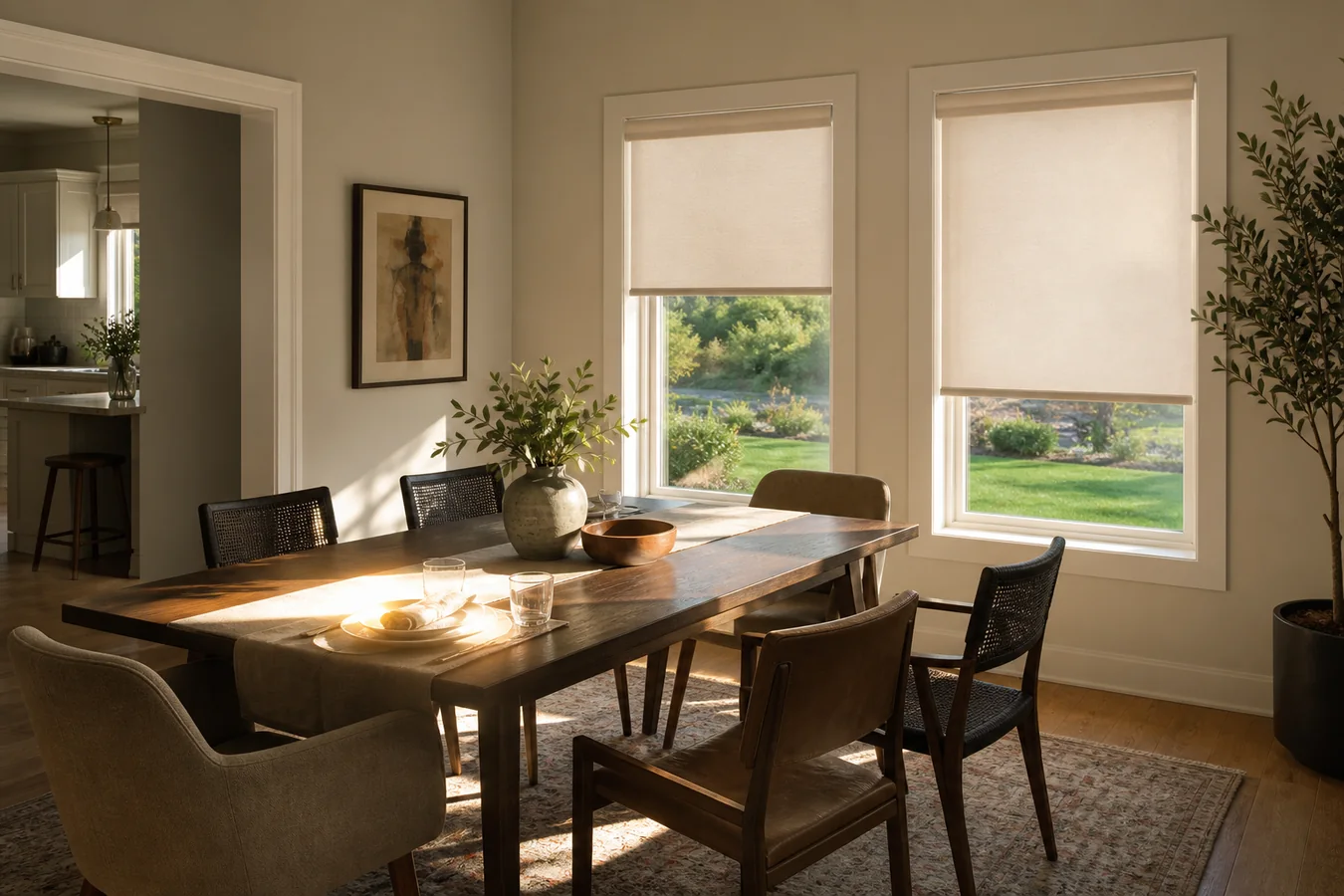
One observation is not enough because dining rooms reverse after sunset. During a bright meal, note direct beams, reflections on glossy tables, the view and how much of the window can remain open. Do not infer a whole season from one afternoon; record the date and revisit if the low sun is already near the edge of the glass.
After dark, turn on the lights you actually use and go outside to the relevant sidewalk, path or neighboring sightline. A pale fabric that appears private by day can reveal shapes when the bright side moves indoors. Test the exact sample against the glass rather than trusting a color name or an online swatch.
The U.S. Department of Energy’s current window-covering guidance treats performance as a combination of covering type and operation. For this room, that means the useful answer may be a shade closed only during a narrow glare period, not a permanently covered window. This article does not estimate energy savings from the dining-room map.
Write one sentence for each failed state: “At 5:30 p.m., the west window puts direct sun across seats 2 and 3,” or “After dark, the table is visible from the front walk from sill height to the top of the chair backs.” Those sentences are specifications. “Needs cozy blinds” is not.
Let the problem choose how the treatment moves
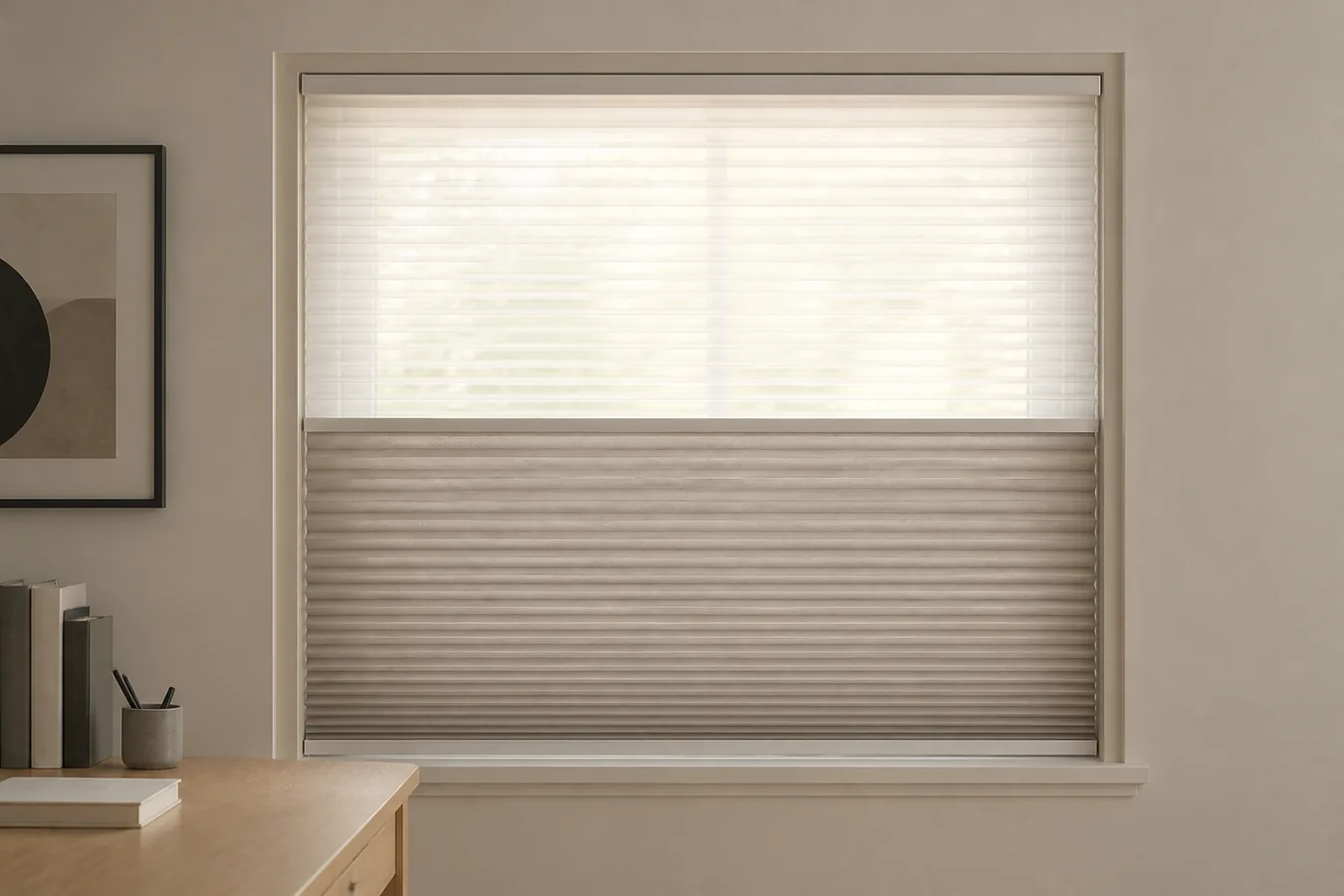
When the problem occupies a changing band, a treatment with continuous height adjustment can follow it. A roller or cellular shade may be useful when the top or bottom edge can be placed precisely, but the exact fabric, finished side gaps and raised stack still decide the result. A top-down/bottom-up configuration can preserve high daylight while covering a lower sightline only if the exact product supports the required size and control.
Slatted blinds can redirect light and view, but their privacy changes with the viewer’s angle and the direction of the slats. Judge the actual outside sightline, not a universal “up” or “down” rule. The site’s privacy sightline test covers that geometry in detail.
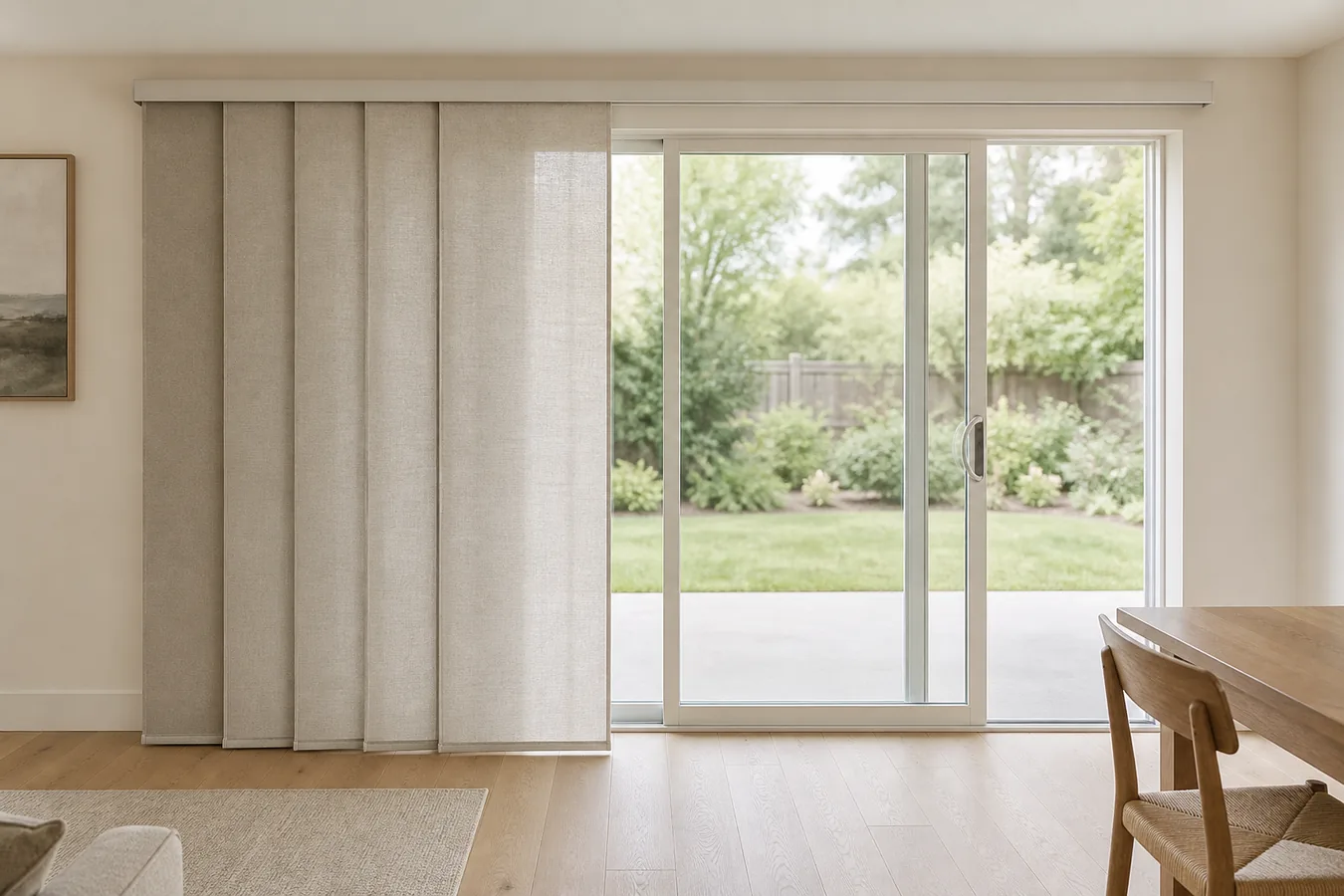
Roman shades and woven treatments can contribute a softer finished look, yet the lowered sample, liner and raised stack must still pass the seat map. A generous fold that looks attractive in a close-up can remove more of a seated view when raised. Curtains can move the stack off the glass if wall space exists, while center overlap and side return determine the night-privacy result.
If the table needs daylight at noon, glare control at 5 p.m. and privacy at 8 p.m., one fixed material may be the wrong brief. Separate the jobs before adding layers.
The room already belongs to doors, heat and people carrying plates
A treatment does not get the whole wall. Open every nearby door fully. Pull out each chair. Carry a serving dish along the normal route. Mark a radiator, baseboard heater, floor register, deep sill, crank, trim projection and any furniture that prevents a hand from reaching the control.
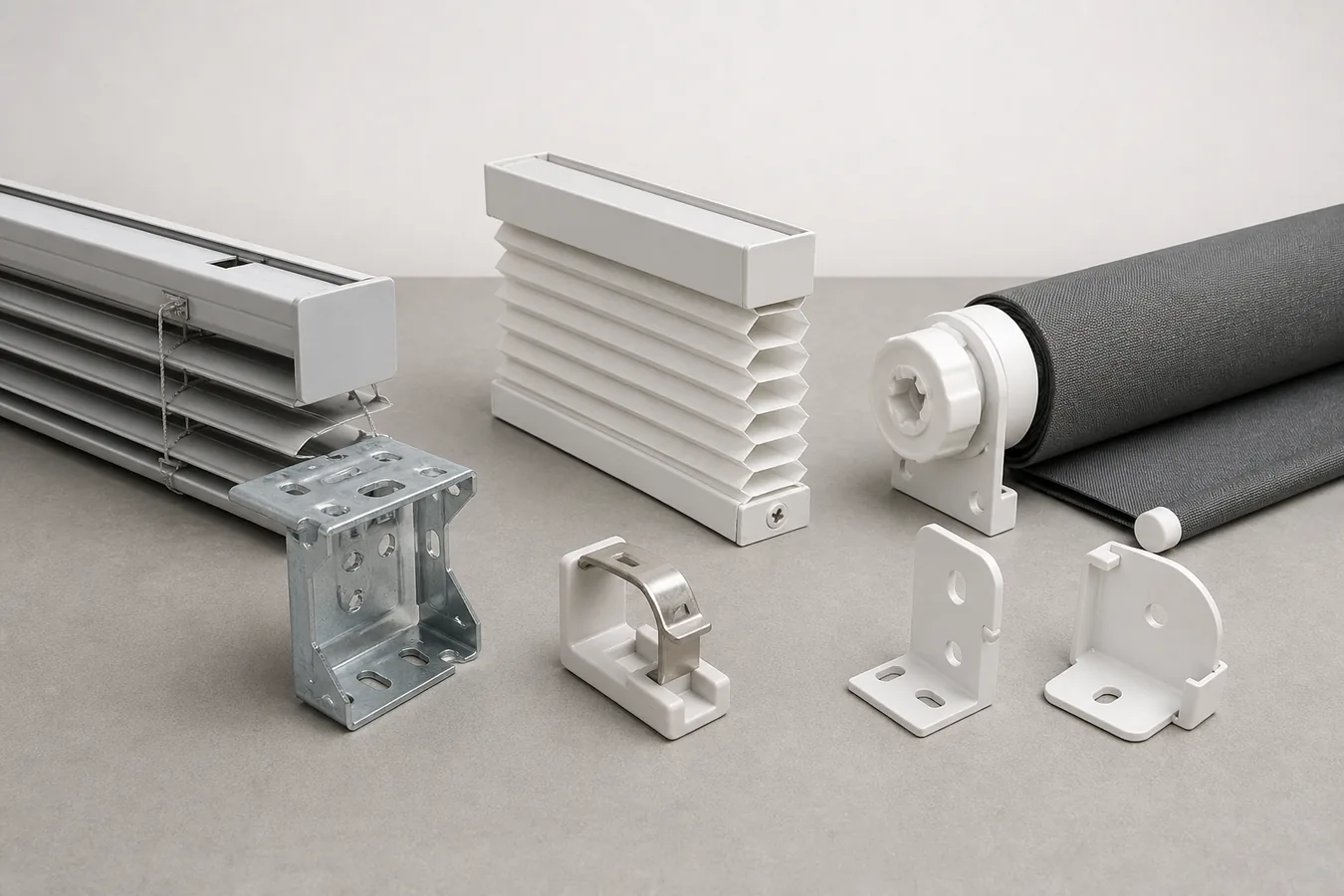
Do not let fabric rest on a heat source or place hardware where the door can strike it. The exact clearance belongs to the product instructions, heat-source guidance and responsible installer; a photograph cannot establish it. If an outside mount overlaps trim, draw the finished hardware envelope rather than measuring only the cloth.
Controls also belong in the occupied room. A chain or cord beside a child’s chair is not an acceptable afterthought. For current US stock window coverings, the CPSC operating-cord rule requires operating cords to be cordless, short or inaccessible under its stated conditions. Ask the seller to name the exact compliant operating system instead of treating “cordless” as a styling option.
Cleaning deserves equal specificity. A dining-room lower edge may meet food splashes or hands even when the upper fabric remains clean. Obtain the care instructions for the exact material, liner and hardware. If normal cleaning requires removing a large or delicate treatment that no one can safely reach, the room plan is unfinished.
A layered answer works only when each layer owns one job
Layering is useful when the roles remain separate. A translucent shade might control a defined bright period while side panels soften the wall and close the evening return. A woven face can provide texture while a named liner owns night privacy. An adjustable blind can redirect daytime light while a second layer closes a known side gap.
Do not buy two products that both “sort of” promise privacy. Write the role beside each layer: glare band, full night sightline, decorative frame, thermal schedule or view preservation. Then test the layers together in their fully open, working and fully closed positions. The combined stack must not block a door, bury a control or turn a small window into hardware.
If one simple shade passes every required state, complexity has no reward. If two states genuinely conflict, the layered drawing should make the conflict disappear without vague claims. The room-by-room smart-shade planner can help separate the dining task from needs elsewhere in the home.
Make the quote return your dining-room plan
Give the supplier the seat-and-time map, straight-on window photographs and the sentences describing each failure. Ask for the exact product, fabric and color sample; liner; mount; finished hardware and fabric widths; expected side and center gaps; fully raised stack; control side; operating system; clearance; power or charging access when motorized; and product-specific care instructions.
The returned proposal should show which layer or movement solves each marked state. If it merely adds a product name to an overall width, it has not answered the dining room. Test the physical sample in the bright meal and lights-on evening before accepting opacity or privacy language.
Use the Smart Shade Measurement and Compatibility Checker to record opening dimensions, depth and obstructions after the room behavior is known. It preserves site facts; it does not turn them into a manufacturer’s order size.
Approve the treatment when every occupied seat has an acceptable bright and dark state, the desired view survives, hardware clears the room, and the exact operating and care details appear on the quote. Otherwise, hold at the failed seat. That is the place where a different movement, layer or mount can still improve the room before the fabric is made.