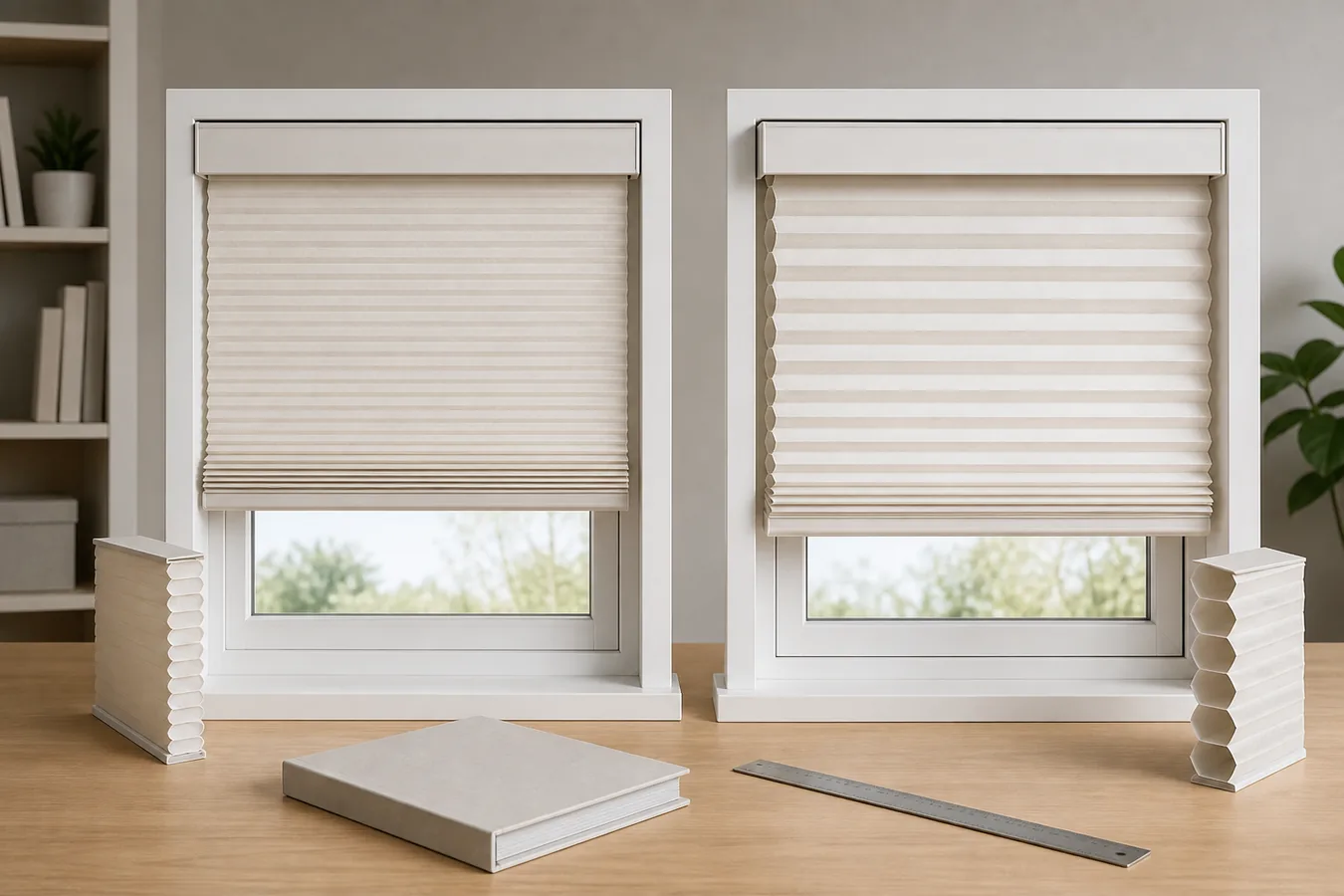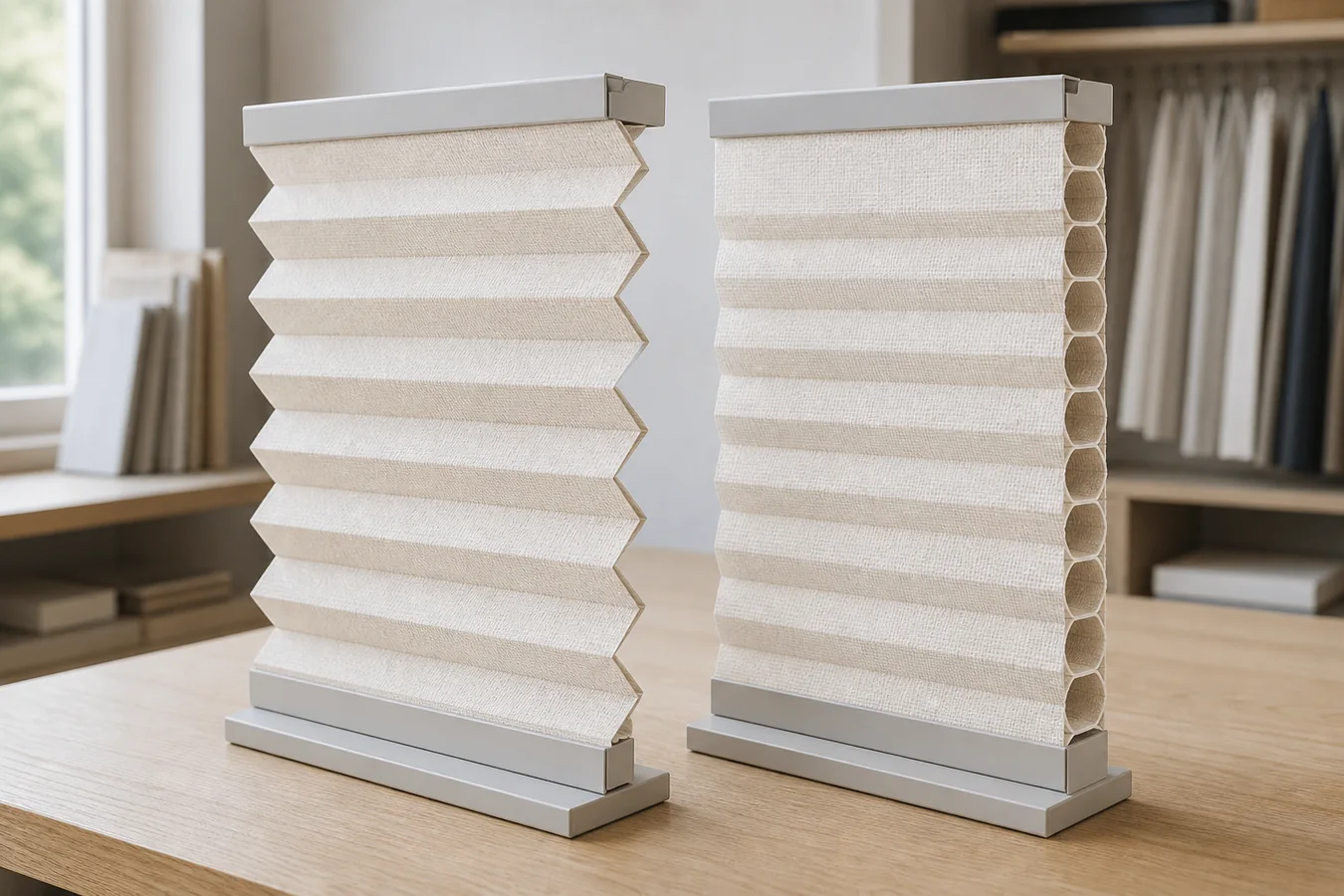
Two showroom samples can present the same horizontal rhythm from straight on. Turn them ninety degrees and the decision changes: a pleated shade exposes a folded sheet, while a cellular shade encloses rows of honeycomb-shaped cells between joined layers.
If verified thermal performance is a priority, cellular is the construction worth investigating first—but the exact product rating, fit and operation still have to prove the benefit. A pleated shade can be the better fit when its exact fabric, liner and light result suit the room and a rated thermal result is not a purchase condition. Neither category name, on its own, proves price, privacy, blackout, cleaning effort or durability.
The front view is the least useful angle
Do not begin with a catalog description of advantages. Begin with the sample edge. Then keep that same sample identity through the light test, performance evidence and order line.
| Proof | What to inspect | What it can establish | When to hold the decision |
|---|---|---|---|
| Edge | One continuous zigzag sheet, or joined layers that enclose visible cells | Whether the sample is pleated or cellular construction | The seller shows only a front swatch or a generic room photo |
| Backlight | The exact fabric, liner or opacity option with a light source behind it | The sample’s actual light diffusion and privacy result under that condition | The quoted liner or fabric is different from the tested sample |
| Label | A current product-specific AERC record or label when energy performance matters | A comparable Warm Climate or Cool Climate rating for that listed product | The claim stops at “energy efficient” or “honeycomb” with no exact rated product |
| Order line | Collection, fabric or liner, control, mount, finished size and quoted total | That the sample and the price belong to the same purchasable configuration | The comparison changes the control, mount, liner or finished dimensions |
The four rows answer different questions. The edge names the construction. Backlighting tests the selected material. The label supplies product-level performance evidence. The order line prevents the evidence from drifting onto a different configuration. A missing row is not an invitation to fill the gap with a category assumption.
A liner can make a pleated shade look like a different product
“Pleated” describes the folded construction, not one fixed level of privacy or darkness. On its current pleated-shade page, Graber shows named fabric and liner combinations that include sheer, light-filtering, privacy-liner and blackout-liner paths. That demonstrates how much an exact configuration can vary; it does not establish that every brand offers the same choices or that a liner will eliminate every perimeter light gap.
Take the quoted sample to the window if the seller permits it, or ask for an exact sample with the same product code, color and liner. Look at it in daylight, then place a bright light behind it to represent the more demanding privacy condition. The result belongs to that sample. If the order later substitutes an unlined fabric, a different color or another collection, repeat the decision instead of carrying the old result forward.
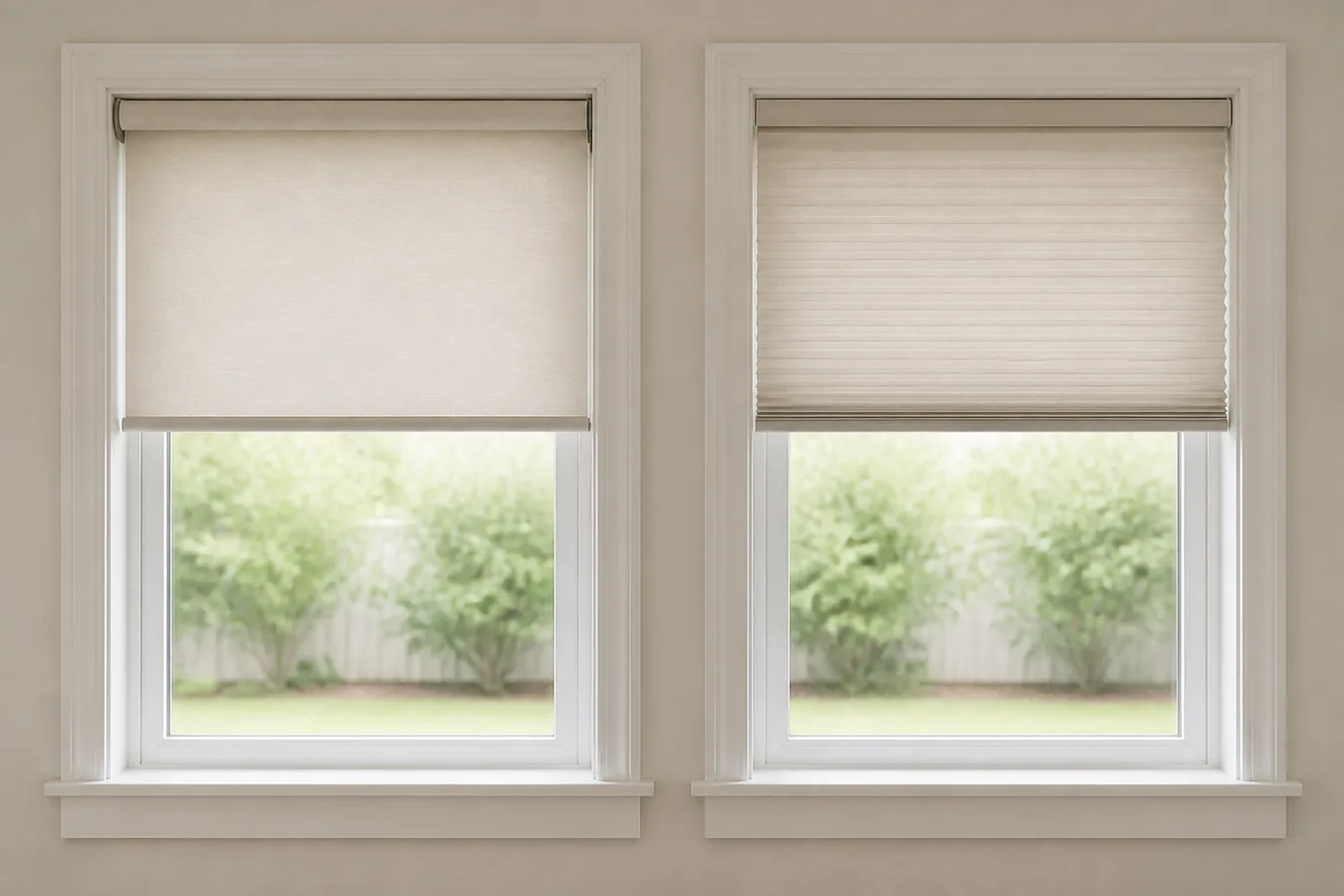
Apply the same discipline to cellular shades. A honeycomb edge identifies the construction, but the exact fabric and opacity still decide what comes through the face. Cellular does not automatically mean blackout, and pleated does not automatically mean poor privacy.
Honeycomb geometry earns an energy question—not a savings promise
The enclosed cells give cellular shades a credible thermal mechanism: the US Department of Energy’s cellular-shade factsheet describes honeycomb cells that trap air. The same evidence should make the comparison more precise, not more dramatic. Study results with particular products, windows, climates and operating schedules do not predict a universal bill reduction for every household.
When thermal performance could change the purchase, ask whether the exact product is currently rated. DOE’s explanation of the AERC certification program describes a product-label route for comparing window attachments, and AERC’s residential-label guide separates Warm Climate and Cool Climate ratings. Record the exact product entry and the rating relevant to the room’s problem. Do not replace that record with a dealer’s category adjective.
A cellular option with a current rating may therefore defeat an unrated pleated option when verified thermal performance is a hard requirement. If neither quote supplies product-level evidence, the honest outcome is “thermal advantage not yet proven,” not an estimated payback. The energy-efficient window-covering guide handles the deeper winter, summer and operating questions after this construction choice.
Do not let the cellular quote change three variables at once
A total-price comparison can look precise while answering the wrong question. Imagine a pleated quote for a privacy-lined cordless outside-mount shade beside a cellular quote for a room-darkening motorized inside-mount shade. The second total does not reveal a “cellular premium.” It combines a different material result, control system and mount plan.
Ask both sellers to solve the same room task at the same measured opening. Keep the required privacy or light outcome, operating method, mount direction and finished coverage visible on both quote records. The exact fabrics will differ, and some configurations may not be available in both constructions; that absence is decision information. It should not be hidden by comparing a basic option in one category with an upgraded option in the other.
If motorization is part of the choice, first use the smart blinds versus motorized shades guide to confirm whether each line is a complete new covering, a powered shade or a retrofit component. Then compare the same control job. A remote-only cordless pleated shade and an app-connected cellular shade are not equivalent merely because both raise without a pull cord.
Do not force a price winner when no comparable pair exists. Choose the only configuration that meets the required task, or hold the purchase until the missing option and total are documented.
Pleat support and cell size affect the finished surface
A small swatch does not show how repeated folds will read across the whole opening. Current named product lines illustrate the variables: Graber lists pleated options with different pleat sizes and an EvenPleat support path, while its cellular-shade range includes different cell constructions and opacity choices. These are examples from one manufacturer, not universal statements about what every brand stocks or which construction lasts longer.
Ask the quote to identify the pleat or cell option, finished shade dimensions and any support feature. View the actual sample from the room’s normal distance, not only close to the fabric rack. A broad pattern that looks calm in a hand sample may create a different rhythm across a wide shade; a compact cell pattern may read differently when the covering is fully lowered. The correct judgment is visual and product-specific.
For cellular candidates, the number of cell layers is a separate decision from pleated versus cellular. The single-cell versus double-cell guide shows why cell count still needs exact rating, fit, fabric and control evidence. If neither surface gives the room the look and finished geometry it needs, compare another construction instead of assigning a reluctant winner; the Roman-versus-cellular comparison is one relevant branch when a broader folded textile surface is under consideration.
Cleaning is an instruction-sheet decision
Do not choose pleated because a comparison page calls it easier to clean, or reject cellular because debris could enter a cell. Fabric, backing, adhesive, rail and motor details can change what the maker permits. Obtain the care instructions for each exact product before ordering and look for methods the document excludes as well as methods it allows.
If the window collects kitchen film, pet hair, condensation or frequent dust, make that condition part of the decision now. A construction that meets the light task but requires a care method the household cannot reasonably follow is not the practical winner. The cellular-shade cleaning guide separates surface dust, trapped debris, spots and recurring moisture without turning one fabric’s instructions into a rule for every honeycomb shade.
Choose the sample you can identify after it leaves the showroom
Before approving the order, make one record that can travel with it: a photo of the sample edge; manufacturer, collection, fabric and color; liner or opacity; pleat or cell construction; current AERC product and rating when required; control; mount; finished dimensions; care-document link; and the quote line that contains the same identifiers. The purpose is traceability, not paperwork. If the delivered order cannot be matched to the evidence that won the comparison, that evidence did not close the purchase.
Once the construction and exact configuration survive that match, enter the opening, mount depth and obstructions in the Smart Shade Measurement and Compatibility Checker. Choose pleated when its verified sample and available configuration best solve the room without a missing thermal requirement. Choose cellular when its exact fabric, finished fit and product-level evidence justify the cell construction. Hold when the seller can prove only a front-view swatch or a category slogan.