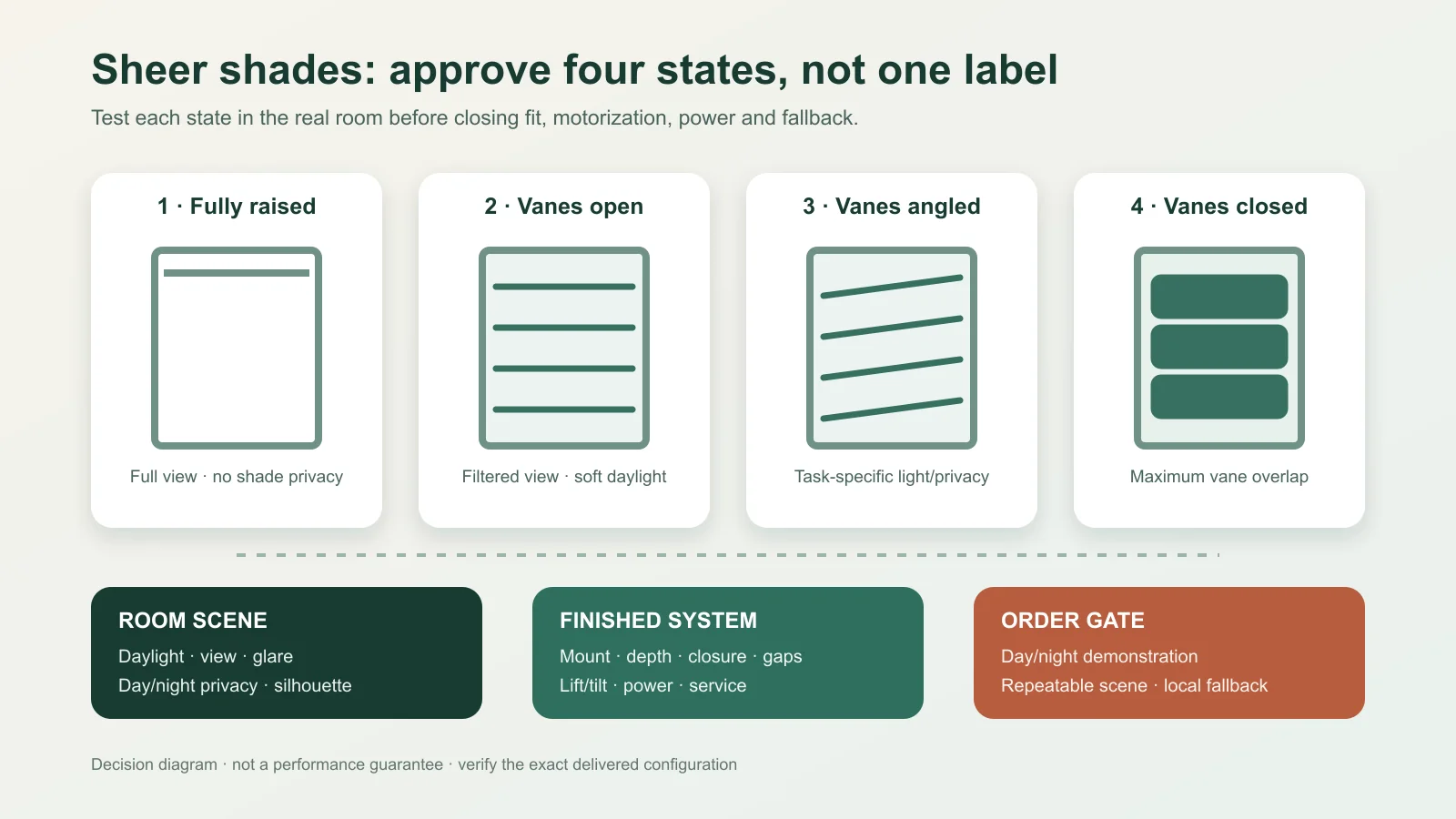
Sheer shades make sense when you will actually use their adjustable vanes. With the shade lowered, you can rotate the fabric vanes to trade view and daylight for more visual screening. That is a different purchase from a flat roller that simply moves up and down. Before ordering, inspect four distinct positions—raised, lowered with vanes open, vanes angled, and vanes closed—and decide whether each position does a useful job in your room.
Do not let one bright showroom photo stand in for the whole system. The buying decision includes the transitions between positions, the completed headrail and edges, and—if powered—the ability to reproduce lift and tilt states without losing local control.
First identify what is moving
Horizontal sheer shadings commonly suspend adjustable fabric vanes between sheer facings. The shade lowers to cover the glass, then the vanes rotate. Hunter Douglas’ current sheer-shade overview distinguishes horizontal vane products, differently contoured constructions and vertical sheer panels. Graber likewise describes fabric vanes between sheer layers whose position changes light and privacy.
That mechanism is easy to confuse with neighboring products. Zebra or layered rollers align alternating bands as one continuous fabric travels. A flat light-filtering roller has no vane tilt. Vertical sheer panels travel across a door and rotate on a vertical axis. Write down the exact product line and whether it lifts, traverses, tilts, or combines those actions. The product photograph is not a mechanical specification.
Make four position cards
Use the same window, interior lighting and exterior observation points for every card. A position is useful only if you can describe why someone would choose it during a normal day.
| Position card | Potential job | What must be observed | Failure signal |
|---|---|---|---|
| Fully raised | Maximum open glass, view and door/window access | Stack or headrail exposure, clear opening and symmetry | The raised package blocks a required view or opening |
| Lowered, vanes open | Filtered daylight with the strongest available view | View clarity, haze, direct sightlines and glare | The sheer layers remove the desired view but do not solve glare |
| Vanes angled | Redirected view or glare control while retaining light | The exact angle that protects the task and whether it is repeatable | A tiny angle change reopens the sightline or bright reflection |
| Vanes closed | Maximum screening available from the sheer system | Closure, overlap, silhouettes, edge views and darkness | Night privacy or room-darkness needs still fail |
Photograph or note each state from the normal chair, screen and doorway, then repeat from outside after dark with the usual room lights on. The four cards make clear whether the vane adjustment adds real decision value or merely creates several inadequate versions of the same result.
Open vanes are about view; closed vanes are not a blackout promise
With vanes open, the sheer facings can soften the view and diffuse incoming light, but the degree varies by fabric and lighting. With vanes angled, they may interrupt a direct sightline or bright angle. With vanes closed, overlap and fabric density can increase screening. None of these descriptions proves a fixed privacy, UV, glare or energy result across brands.
Graber notes that sheer shades are not the first choice for a very dark room. Treat that as a useful category boundary, then test the exact product. After sunset, look from the sidewalk, driveway or neighboring sightline and record whether an observer sees glow, silhouettes, clothing details, faces or activities. If closed vanes do not meet the household’s stated limit, plan a separate opaque layer or another treatment.
The angled card is where the product earns its complexity
An angled vane position should solve a problem that fully open or fully closed cannot. In an office, it might block the sun’s line to a monitor while retaining diffuse light above. In a street-facing room, it might interrupt a lower sightline while preserving a higher view. In a dining room, it might soften a low evening angle without making the room feel shut.
Mark the useful angle on the position card and approach it from both directions. If it is difficult to find manually or cannot be recalled consistently by the proposed motor, the theoretical flexibility has little practical value. Also watch for reflections on the sheer layers themselves; a bright fabric field can remain distracting even after a direct ray is blocked.
Pick the architecture before the color
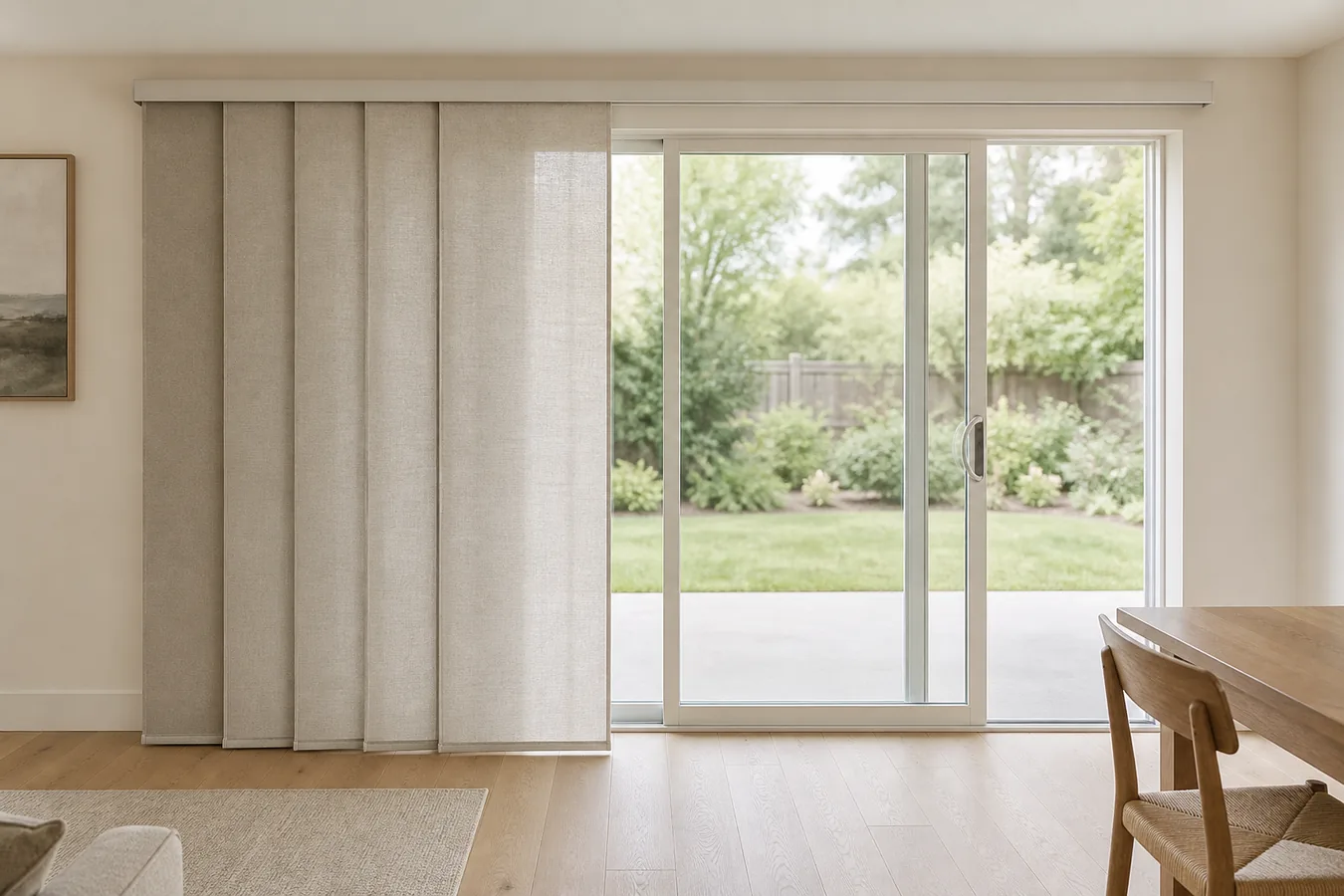
A conventional horizontal sheer is usually the starting point for a window where lift and vane rotation are valuable. A vertical sheer may better match a sliding door because it can traverse sideways while the vanes rotate, but stack, passage clearance and floor interaction become central. For door and wide-opening constraints, use the large-opening shade planning guide.
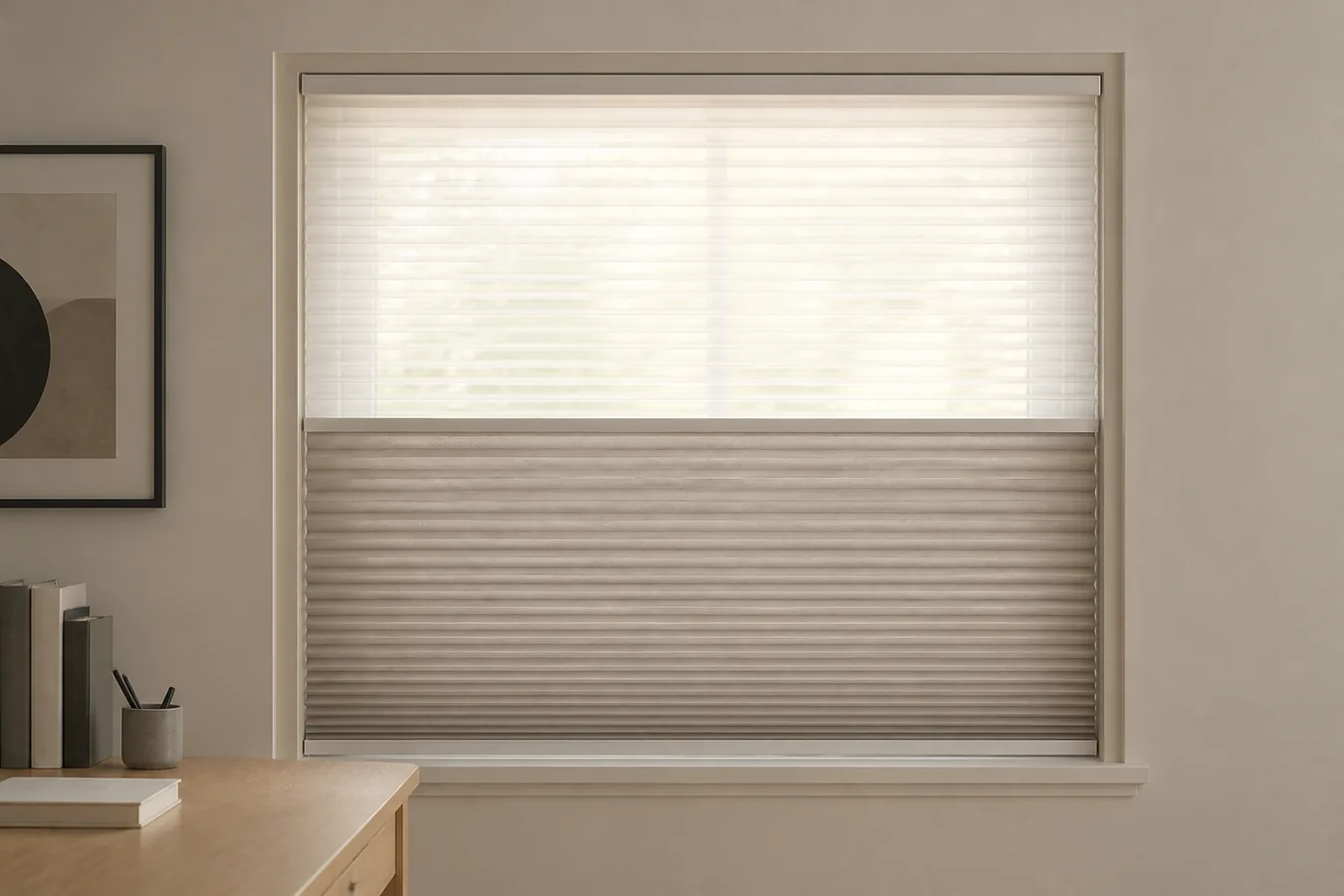
If you want alternating open and closed bands rather than independent-looking vanes, examine the motorized zebra-blind position guide. If you only need a bright filtered panel that moves up and down, a flat roller is mechanically simpler. If high privacy or darkness is essential, an opaque second layer or another shade architecture may be more coherent. the roller, cellular and Roman shade comparison helps reopen that broader choice without forcing a sheer product to solve every task.
Inspect the closure line, not just the center fabric
Closed-vane performance depends on the exact construction. Bali’s current page for a named sheer-shade collection specifies a particular vane overlap and motorized lift options. That product-specific detail illustrates why overlap must be confirmed; its number should not be copied to another collection.
At the sample or demonstration shade, view the upper and lower closure, the center of each vane and both side edges. Ask whether the bottom vane closes in the same way at the quoted finished height. Check whether the fabric bows, whether an edge opens under a side sightline, and whether adjacent shades create a direct inter-panel view. A privacy description based only on the center of a staged sample is incomplete.
The headrail has to coexist with the window
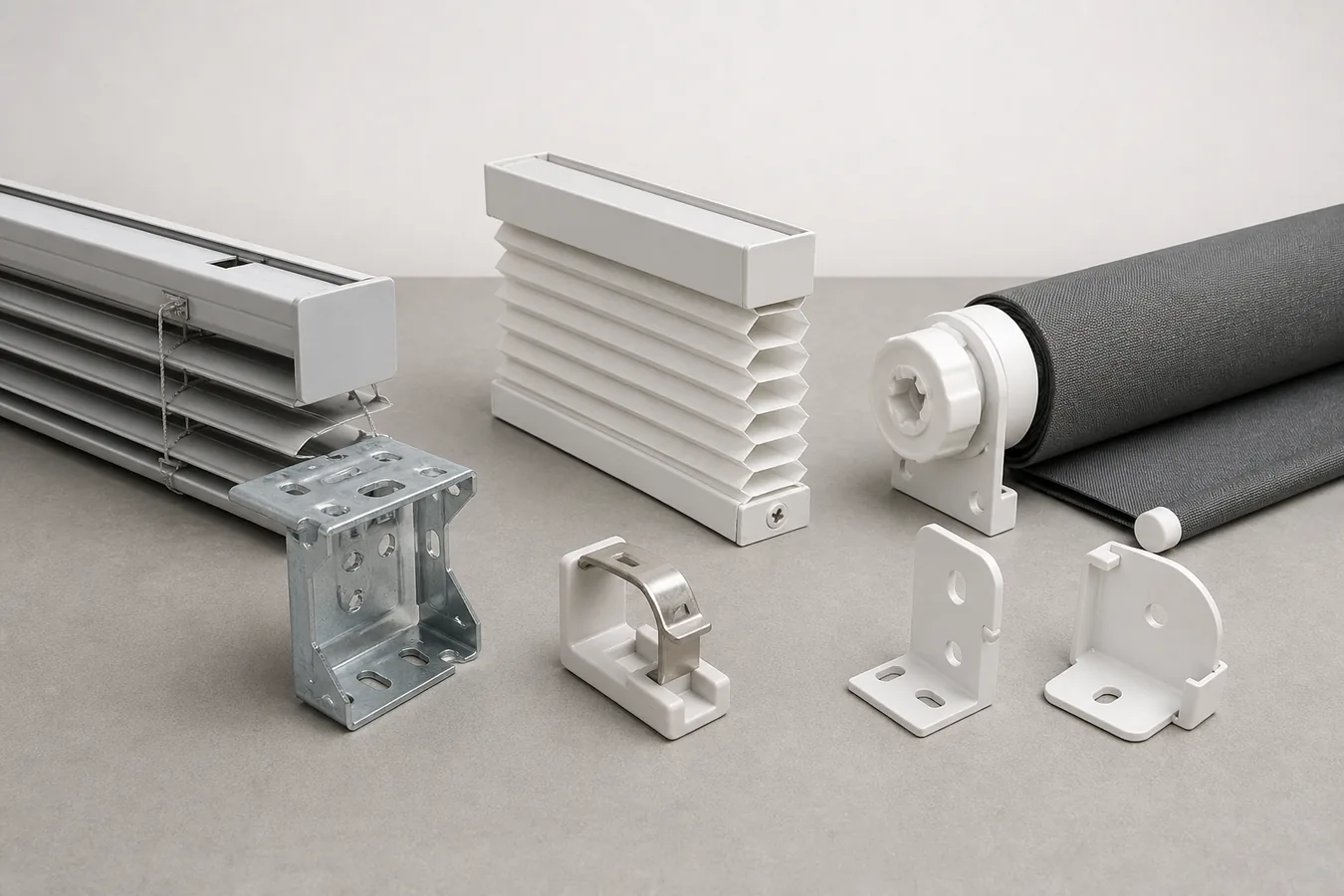
Sheer systems can require more headrail depth and a different raised package than a simple roller. Exact requirements belong to the exact product. Lutron’s current horizontal sheer selection guide, for example, publishes dimensions for its named configurations; those values are evidence that depth is configuration-specific, not a universal template.
Record usable depth, mount surface, trim, handle and lock projection, sash movement, screens, tilt-in cleaning, nearby doors and the direction required to remove the headrail. Start with the Smart Shade Measurement and Compatibility Checker and use the inside-versus-outside mount guide to compare recess and overlap. The seller or fabricator should supply the actual deduction and finished dimensions for the quoted product.
Audition every transition
Operate the demonstration shade through a complete cycle: raise, lower with vanes open, rotate toward closed, reopen, and raise again. For a vertical system, traverse, rotate, reverse and park the panels. Watch for a window handle, door passage, sill object or adjacent panel that conflicts only during movement.
Listen from the actual room distance rather than next to showroom conversation. Hunter Douglas’ current help article says noise in named motorized sheer systems can vary with shade size, motor, design, mount and surroundings. That is a reason to hear the quoted configuration or agree on an acceptance threshold—not evidence for a universal sound level.
Powered sheers have two control questions
For a roller, a favorite height may be enough. A sheer system may need both lift and vane rotation, or traverse and rotation. Ask the supplier to demonstrate every action available on the exact motor and current control generation. Confirm whether a favorite can preserve the useful angled state, whether group commands align the vanes closely enough, and what a wall control or remote can do if the app, gateway or internet is unavailable.
Hunter Douglas’ PowerView page documents remotes, an app, gateway, scenes and schedules for named compatible products. Those features do not transfer to an unverified system. Run the position cards from the proposed control, starting from different states, and reject any automation that cannot reliably return to the angle that made the product worth choosing.
Maintenance belongs in the demonstration
Ask where power components, program buttons and connectors are located; how the shade is removed; how the sheer facings are cleaned; and who restores limits or vane alignment after service. A current named sheer motorization manual combines mounting, remote operation, cleaning and battery/service instructions. Use only the delivered manual for the selected system, but insist that the same subjects are resolved before purchase.
If a battery, charge port or release tab cannot be reached safely, the design is not finished. If children can reach the window, inspect the completed product for operating or accessible inner cords. The U.S. Consumer Product Safety Commission identifies cordless coverings as the safest option where young children may be present.
Bring eight answers to the order review
- What exact product line, horizontal or vertical architecture, fabric, color and vane size were demonstrated?
- What did each of the four position cards accomplish in the real room?
- Did the exterior night view meet the stated silhouette and detail threshold?
- Do headrail, finished height, side gaps and closed-vane overlap match the quoted window?
- Can the window or door operate and can the shade be removed and cleaned?
- Which lift, tilt or traverse actions can the exact controls reproduce?
- What remains usable without app, gateway or internet access?
- Who handles power, reset, realignment and future service?
Do not place the order while a staged daytime image is the only privacy evidence, the demonstrated line differs from the quote, the required vane state cannot be repeated, depth and closure are assumed, or an opaque night requirement is being assigned to an unproved sheer layer.
The transition, not the glamour photo, decides
Sheer shades are compelling when open, angled and closed vanes each create a genuinely useful room state. They are unnecessary complexity when the household only needs a flat filtered panel, and they are the wrong single layer when the closed state misses a hard darkness or night-privacy requirement.
Sheer shades earn their complexity when open, angled, and closed vanes each create a useful room state. If the household needs only a flat filtered panel—or requires darkness the closed vanes cannot deliver—a simpler or layered treatment is the better buy.