Find the darkest-state visible-light transmission on the product sheet. Then find the power condition that produces that state. If the quote provides neither, blackout is a product name—not proof that the room can lose its shade.
That does not make switchable glass a poor choice. It makes the choice product-specific. Current products sold with similar language range from milky privacy glass to view-preserving tint and from dark film to multi-layer glass that reports near-total visible-light blocking. Decide which job the pane performs before deciding whether it can stand alone.
Privacy, tint and blackout are three different jobs
A privacy state obscures detail. It may look white or hazy while still admitting a noticeable amount of light. A tint state darkens the view and can reduce glare while preserving a line of sight through the glass. A blackout state is supposed to reduce visible light enough for a darkness-sensitive room. Those outcomes can overlap, but one does not prove the others.
The word smart is just as broad. View positions its current dynamic windows around heat, glare, daylight and preserved views. Smart Films International describes standard PDLC as switching between milky privacy and clear, while its dyed-liquid-crystal variants add a dark state. Smartglass International describes a different, multi-technology product with clear, opaque, solar and blackout states.
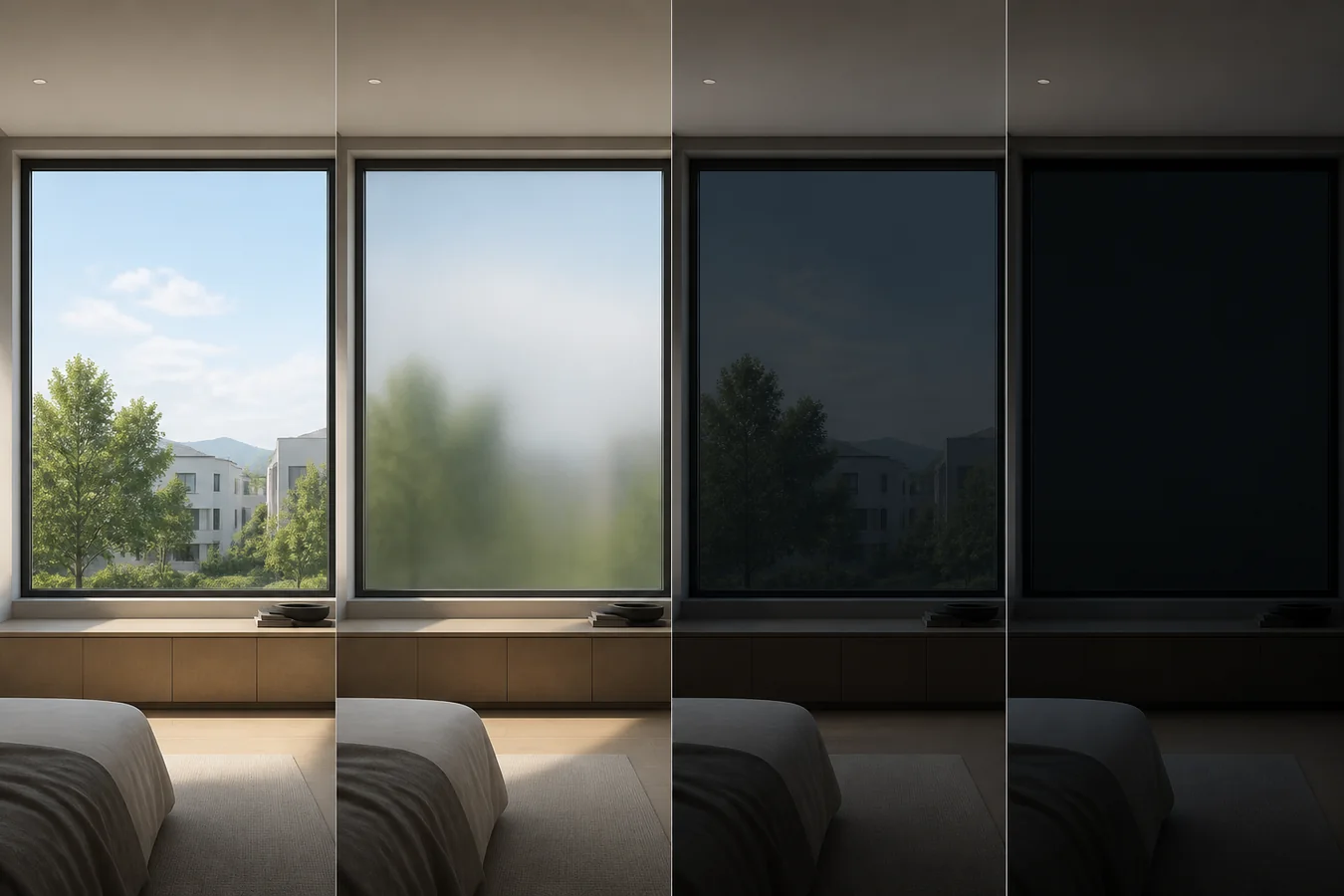
The illustration shows the vocabulary, not measured product performance. Your quote still needs numbers for the exact pane or film.
Build the state table before discussing controls
Do not let a smooth phone demo become the specification. Put every advertised state into one table, even if the seller uses only two names.
| State on the quote | Power or control condition | Visible-light transmission | View and haze | Night privacy | Room job completed | Evidence attached |
|---|---|---|---|---|---|---|
| Clearest state | Record it | Record it | Record both | Verify | Daylight and view | Named current document |
| Privacy state | Record it | Record it | Record both | Verify | Visual separation | Named current document |
| Tint or solar state | Record it | Record it | Record both | Verify | Glare or solar control | Named current document |
| Darkest state | Record it | Record it | Record both | Verify | Darkness target | Named current document |
| Power loss or controller fault | No input power | Record it | Record both | Verify | Acceptable fallback | Written system behavior |
Add the exact manufacturer, product, film or laminated-glass format, glass makeup, panel size, controller and document date above the table. Otherwise the rows can quietly combine a showroom sample, a different variant and a generic brochure.
Visible-light transmission, or VLT, is the percentage of visible light passing through the finished filmed glass. Haze describes scattering and clarity, not how much visible light remains. Night privacy also needs its own answer: a dark-looking pane from inside can behave differently when the room is bright and the exterior is dark.
The darkest number can change the answer
Current manufacturer pages show why the number matters. Smartglass International reports that its named Blackout Smart Glass can block 99.5% of light and offers four states. Its current technical page also lists a slight-blue clear appearance, a very dark-blue off appearance, a maximum switch time, size limits and a particular electrical load.
Edgeglass uses the Black Out name for a product whose page reports up to 86% light reduction and explicitly says the darkest state does not eliminate light. DreamGlass also reports 86% visible-light blocking for its residential PDLC Black Out product. Those may be useful privacy or glare results, but they are not interchangeable with a stated 99.5% block.
Smart Films International publishes a different basis for its DLC film: its 1% variant is reported at 0.9% ±0.3% VLT when off, while the 3% variant transmits 3%; both are reported at 100% haze in that state. These are manufacturer claims for named products, not a universal smart-glass scale. Their value here is to show what a usable state specification looks like.
If your darkness target is demanding, compare the exact pane with the exact blackout shade or edge-control system that would otherwise serve the room. The light-filtering versus room-darkening guide explains why a strong material label still does not erase perimeter light.
Decide what happens when power disappears
Some switchable films are dark or private with power off and clear with power on. Other dynamic glazing systems have several controlled tint levels, and a hybrid can use more than one switching layer. Do not infer the failure state from the technology acronym.
Write down what the glass does when the wall switch is off, the controller loses input power, a low-voltage lead is damaged, automation is unavailable, and one panel stops responding while its neighbors still work. A bedroom may tolerate a dark fail state but reject a clear one. A main living-room view may prefer the opposite. A bank of facade windows may need a defined visual result when only one controller fails.
The controller belongs in the system record. Smartglass International currently lists 110 VAC and approximate power for its named glass; SFI lists a 48 VAC operating system and says its named dark film consumes power in the transparent state. Those figures cannot be transferred to another film or local project. They demonstrate why the electrician, transformer or controller, control wiring, commissioning and future replacement must appear on the same scope as the glass.
Film and laminated glass create different service calls
A retrofit film can preserve existing glazing, while a factory-laminated pane or insulating glass unit can protect the active layer inside a new glass build. That is a physical distinction, not merely an installation preference.
SFI currently offers its dyed technology as self-adhesive film and as laminated smart glass. Smartglass International lists a standard glass thickness, an insulating-glass build on request, and minimum and maximum panel dimensions for its named product. Once the switching layer is laminated into the pane, the future service unit may be a finished glass assembly rather than a peel-and-replace surface film.
Ask who owns each boundary: existing glass suitability, edge preparation and sealing, busbar or electrode area, visible wiring, controller location, glass breakage, seal failure, delamination, electrical fault, removal and replacement labor. The guide to windows with built-in blinds examines the same lifecycle coupling for a mechanical treatment sealed or protected inside a window; smart glass adds electrical and optical state evidence to that decision.
Do not assume retrofit means universally compatible. Obtain the film manufacturer’s written approval for the exact pane makeup, coating location, size, exposure and installation method. Keep the window warranty, film warranty, controller warranty and installer workmanship terms separate unless one written warranty truly owns them together.
Energy evidence belongs in another column
Darkness, glare, UV, solar heat and window insulation are related only when the exact product data relates them. A high UV-rejection figure does not prove a dark room. A solar-heat claim does not prove night privacy. Low VLT does not by itself establish whole-window U-factor, solar heat-gain coefficient or condensation performance.
3M’s current residential-film explainer separates VLT, total solar energy rejected, visible-light reflection, UV rejection and glare reduction. NFRC says it independently tests and labels window films for energy efficiency and directs buyers to its certified-product directory. If energy performance is part of the purchase case, attach the applicable film or finished-window record rather than borrowing a generic smart-glass benefit.
That is especially important when a new insulating glass unit is proposed. Compare the whole window configuration, not an active layer in isolation.
Choose the layer the room is still missing
Blackout smart glass can stand alone when the exact finished configuration documents a darkest state that meets the room, delivers acceptable privacy and view in every other state, fails in an acceptable direction, fits the glazing, and has a service path you are willing to own.
Keep a room-side shade when the glass solves daytime heat, glare or on-demand privacy but leaves too much light, a visible perimeter, an unacceptable clear/fault state or an uncertain repair interval. The motorized-blackout-shade room guide handles that separate layer; it can remain independent of the glass and be replaced without replacing the pane.
Start with the smart shades by room planner to freeze the actual daylight, privacy, glare and darkness requirements. Then use the smart blinds versus motorized shades comparison to decide whether the complete job belongs to smart glazing, a motorized shade, or both. The cleanest-looking answer is not automatically the simplest system. The right answer is the smallest set of layers whose documented states cover daylight, view, night privacy, glare, darkness and failure—without asking one attractive word to do all six jobs.