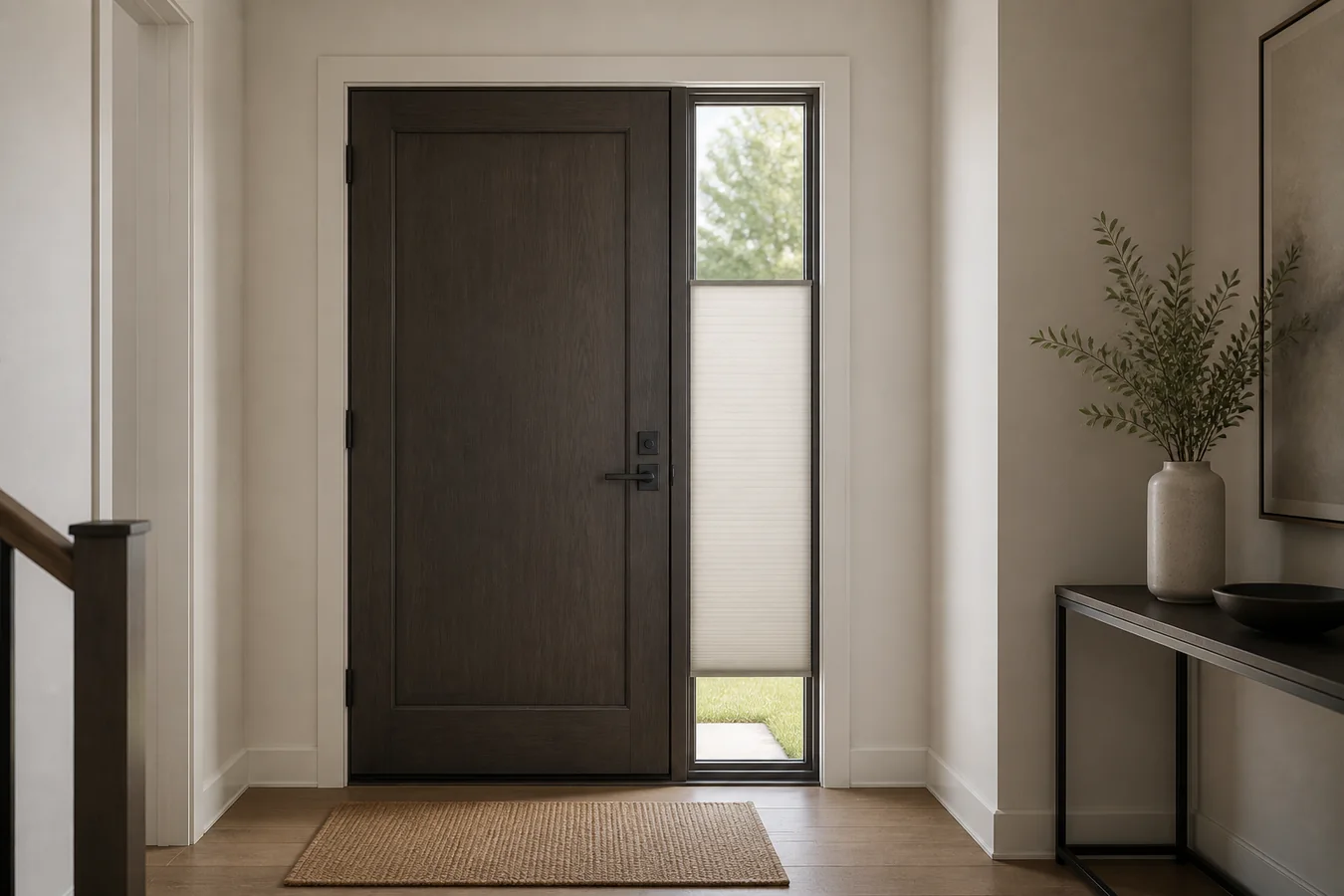
A sidelight does not always need to disappear behind a full-height covering. Stand outside where a visitor, passerby or neighbor can actually see the entry. Mark the vertical band that exposes a person, the lock area or the occupied hall, then preserve the clear upper glass if it still delivers useful daylight without exposing the room.
Only after that sightline is drawn should you compare privacy film, a narrow shade, an add-on blind, between-glass blinds or a fixed insert. Width alone cannot establish fit beside a moving door.
Draw the outside eye line on the sidelight
Photograph the door and sidelight straight on from inside, then repeat from each relevant exterior approach. On the inside image, divide the glass into the band that must be obscured, a daylight band worth keeping and any low band that can remain clear without exposing the entry.
| Map layer | Record | It changes | Hold when |
|---|---|---|---|
| Exterior sightline | Observer position and eye height | Partial versus full coverage | Privacy is judged only from inside |
| Entry exposure | Body, activity and lock or handle zones actually visible | Where opacity begins and ends | “More privacy” has no defined view |
| Daylight | Useful clear upper or lower glass | Whether a fixed full panel wastes light | No one has observed the entry by day |
| Frame | Glass and outside-frame dimensions; raised or flush profile | Film edge, shade brackets and add-on frame | Frame identity is guessed |
| Door hardware | Lever, deadbolt, trim and their projection | Available envelope and hand clearance | Only glass width is measured |
| Motion | Swing, slam, vibration and nearby wall or trim | Retention and service requirement | The proposed unit is tested on a stationary sample only |
Treat this as a privacy map, not a security promise. Obscuring the view changes visibility; it does not prove resistance to entry or replace door and lock decisions.
The handle and raised frame take space before a shade does
Open the door fully and operate every lock and lever. Measure the sidelight glass and the frame around it separately. Record how far the lever, escutcheon and raised frame project toward the proposed treatment. Check the narrow strip between the sidelight frame and the door slab, plus any trim on the outer side.
A shade that fits the glass can still collide with the lever or make the lock awkward to use. An outside-mounted headrail may overlap a raised frame; fabric can swing or tap when the door closes; a bottom rail can sit exactly where hands and bags pass. Add the finished hardware envelope, not just nominal fabric width, to the drawing.
If the glass is in a fixed wall beside the door rather than in the moving slab, slamming may be less important, but handle, trim and cleaning access still own the space. If the treatment attaches to the door or frame, the exact fastener and warranty boundary belongs to the manufacturer and responsible installer.
Film is the quietest answer, but only after the glass says yes
Privacy film can cover a precise band without adding a headrail or moving control. It is useful when the desired state is fixed: conceal the entry while leaving a clear upper strip, or diffuse the whole sidelight without needing a changing view.
The quiet installation does not remove product questions. Identify the exact door-glass construction, coatings, impact rating and warranty, then obtain written compatibility from the film and glass or door source. Do not assume every film is acceptable on every insulated, laminated, coated or impact-rated assembly. Heat absorption, edge preparation and removal are product-specific.
Judge the exact film in daylight and after dark with the hall lights on. Frosted appearance may conceal detail while preserving brightness, but the required privacy level and viewing distance must be accepted at the real entry. A mirror-like daytime effect can reverse when the interior becomes brighter, so it is not a substitute for the night test.
A narrow shade earns its control only if the door can move
A roller, cellular, pleated or Roman construction can change the covered height. That flexibility matters when the household wants daylight while occupied and fuller privacy at night. It also introduces top hardware, a lower edge, side gaps and a control into a very narrow area.
Ask for the exact minimum finished width, hardware width, fabric width, side gaps, bottom-rail size and retention method for the named product. Narrow products can have control or motor limits that differ from the fabric sample. An outside mount may gain overlap while moving the hardware into the lever or trim envelope.
Operate the door through normal opening and a firm close. The treatment should not swing into the handle, release from its retention, rattle against glass or block the lock. A designer can specify the intended result, but only the named product instructions and accountable installer can approve attachment to the actual door or frame.
For a treatment mounted on a moving French-door slab, use the French-door motorized-blind guide for handle, hold-down, power and motion details. This page stays focused on the adjacent narrow sidelight.
Add-on and between-glass blinds are door systems, not generic blinds
An add-on blind encloses slats behind an additional glazed frame over a supported door-glass opening. Between-glass blinds are part of a compatible insulated glass assembly. Both can protect the slats and keep the operating parts away from normal contact, but neither is a universal accessory for any sidelight.
For example, ODL’s current Add-On Blinds guidance tells buyers to identify the existing frame and measure outside it. The named product page gives a lever-clearance requirement and frame projection for its system. ODL also states on its application page that the named add-on product is not for impact or hurricane glass. These are ODL-specific constraints, not sidelight-wide dimensions. Use the current chart for the exact product and stop if the glass or frame identity is unknown.
Between-glass options may require a compatible replacement door-glass unit rather than an overlay. ODL’s blinds-and-glass application overview is one manufacturer example; the door, opening, glazing, energy or impact requirements and installation responsibility still need exact approval.
For any current US stock covering with an operating cord, include the CPSC operating-cord requirements in the product review. “Enclosed” or “cordless” should describe the exact mechanism, not a visual assumption.
Make one entry elevation close the order
Return to the straight-on entry photograph. Draw the privacy band, retained daylight, glass and frame edges, handle envelope, door swing and every finished treatment edge. The proposal should add the exact product or film identity, dimensions, gaps, control, retention, glass compatibility, care path and responsible installation party.
Test the proposed opacity after dark, the handle with the treatment in every position and the door through its real movement. If a partial treatment is used, confirm the outside observer cannot simply change position and see around the band. If full coverage is selected, confirm the lost daylight is accepted.
Use the Smart Shade Measurement and Compatibility Checker for the opening, depth and obstruction record; do not substitute its dimensions for a manufacturer’s door-glass method. The broader sliding-door and large-opening guide can route a project where the sidelight is actually part of a larger moving glazed system.
Approve only when the entry elevation owns the sightline and the exact product owns the door, frame, glass and handle. Otherwise, leave the upper daylight alone and hold at the first unproven interface.