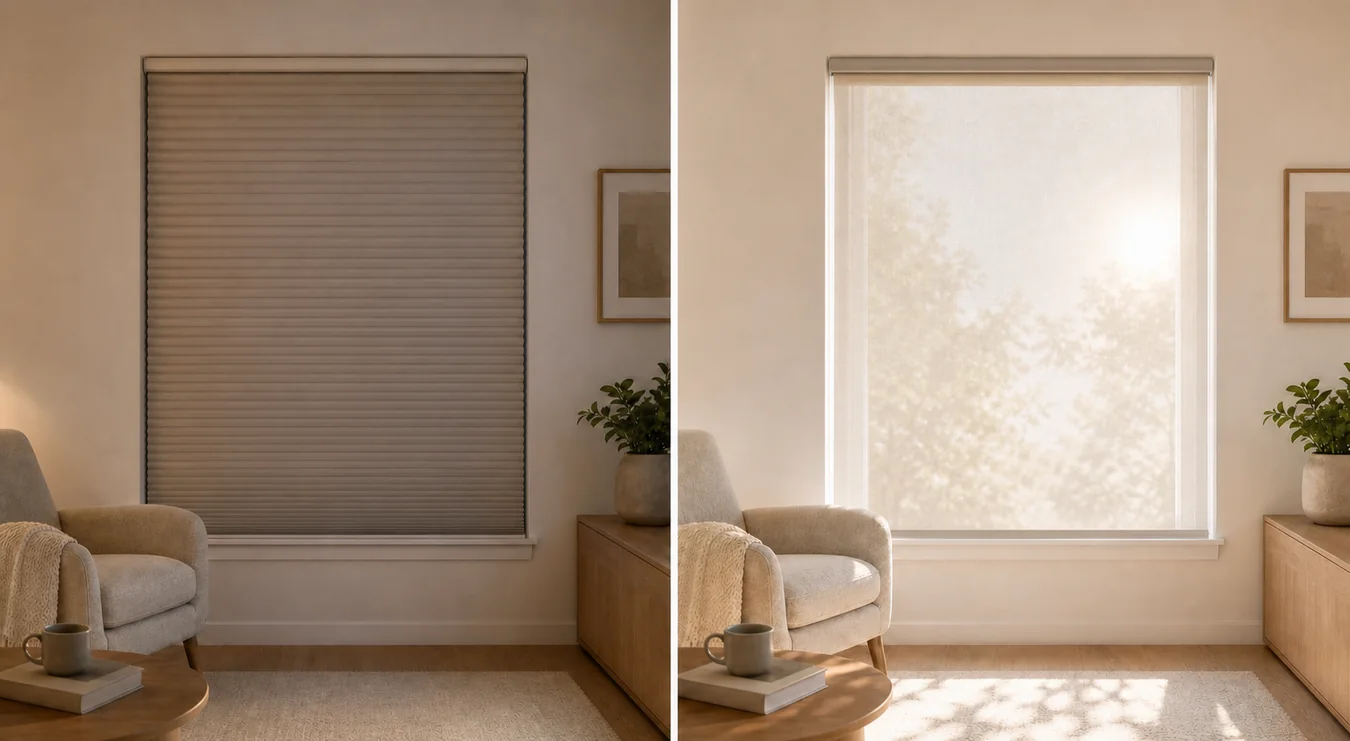
A bedroom that feels cold beside the glass on a winter night and a west-facing room that overheats at 4 p.m. do not have the same window problem. The first needs better resistance to heat flowing out. The second needs solar heat controlled before it enters the room.
The useful choice is not the blind with the strongest “thermal” wording. It is the exact covering whose AERC climate rating, finished fit and real open/closed schedule match that window. Cellular shades are the first category to investigate for winter insulation; roller, solar and slatted coverings can be more relevant when direct summer sun is the dominant load. The product name alone does not settle either decision.
First, name the heat you are trying to stop
Stand at the problem window when the discomfort actually occurs. Note whether the glass feels cold, direct sun strikes the room, air moves around the sash or moisture is present. Then use the seasonal job—not the room name—to choose the evidence you need.
| What happens at the window | Prioritize | Covering starting point | When it must work | Do not assume |
|---|---|---|---|---|
| The glass area feels cold after sunset in heating season, with no obvious moving air | The exact product’s Cool Climate rating, insulating construction and finished perimeter fit | A rated cellular shade; compare other constructions only with product-level evidence | Closed during the cold period; daylight decisions handled separately | Every honeycomb, double cell or “thermal” fabric performs alike |
| Direct sun overheats the room or creates an afternoon hot zone | The exact product’s Warm Climate rating plus solar, view and glare requirements | A rated roller/solar screen or another product with suitable warm-climate evidence | In place before the critical sun reaches the glass | A dark room proves the covering controlled heat efficiently |
| Winter loss and summer gain both matter | Both climate ratings, orientation and a schedule that can change by season | Compare exact rated products rather than declaring one category the winner | Different positions by season, sun and time of day | One permanent closed position is efficient year-round |
| Air moves through the frame, water appears, or trim/sash damage is visible | Window and envelope diagnosis before a stronger fabric claim | Pause the covering decision until the source is understood | Not applicable | A shade can repair air leakage, failed seals or water entry |
This distinction is supported by Lawrence Berkeley National Laboratory’s residential window-attachment research, which models results by climate, covering category and whether the attachment is open, half open or closed. A covering can help in one state and give up useful daylight or winter solar gain in another. That is why “best energy-efficient blind” is incomplete without a season and a schedule.
Read the AERC label before the fabric story
The Attachments Energy Rating Council gives shoppers a product-level comparison path. Its consumer label includes Warm Climate and Cool Climate ratings, while the category maximum shows the best score available within that type of attachment. The two ratings answer different climate jobs; neither is permission to treat all products in the same category as equivalent.
Before comparing prices, record:
- the exact manufacturer, collection, model and operating option;
- whether that exact configuration appears in AERC’s current certified-product search;
- its Warm Climate and Cool Climate ratings;
- the category maximum shown with the rating; and
- any size, material, control or installation conditions attached to the listing.
Use the rating relevant to the problem you named first. Then use the other rating to expose a tradeoff rather than hiding it. A seller page that says only “energy efficient,” “insulated” or “thermal” has not yet identified a comparable product.
Different coverings control different heat paths
Cellular shades start with trapped air, not the cell-count label
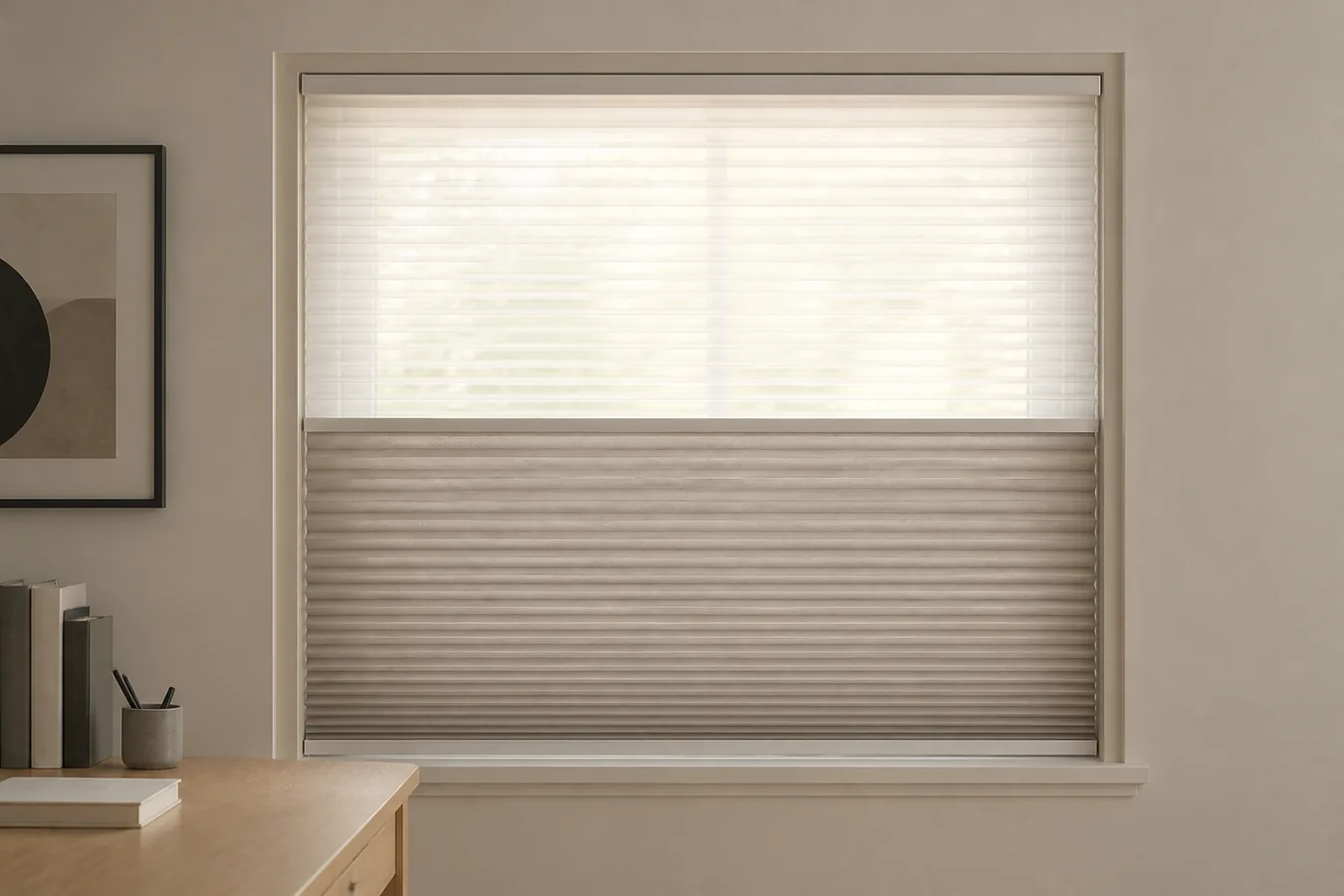
Cellular construction creates air spaces between the room and the glazing. DOE’s 2021 cellular-shade factsheet found that this mechanism could matter materially: in its defined scope—five commercially available shades, a Knoxville test home and modeling across 15 climate zones—it reported up to 20% heating-energy savings and 15% total-energy savings compared with no shade. Those are research results for that test and modeling program, not a forecast for a household or a promise attached to any honeycomb shade.
Start with the exact rated product, then check how it will be installed and operated. If reliable movement is part of the plan, the guide to motorized cellular shades explains how fabric configuration, mount, power and control remain separate choices; a motor does not upgrade the shade’s thermal construction.
Roller and solar coverings start with the sun and the view
A solar or roller product can be a practical starting point for a window with direct summer sun, but “solar shade” is still a category name. Openness, color, backing, glazing, orientation and finished edge gaps can change the balance among solar control, glare, daylight and view. Compare exact warm-climate evidence and use the motorized-solar-shade guide when the critical requirement is getting a selected fabric into position before a known sun period.
Slats can redirect light without becoming insulation
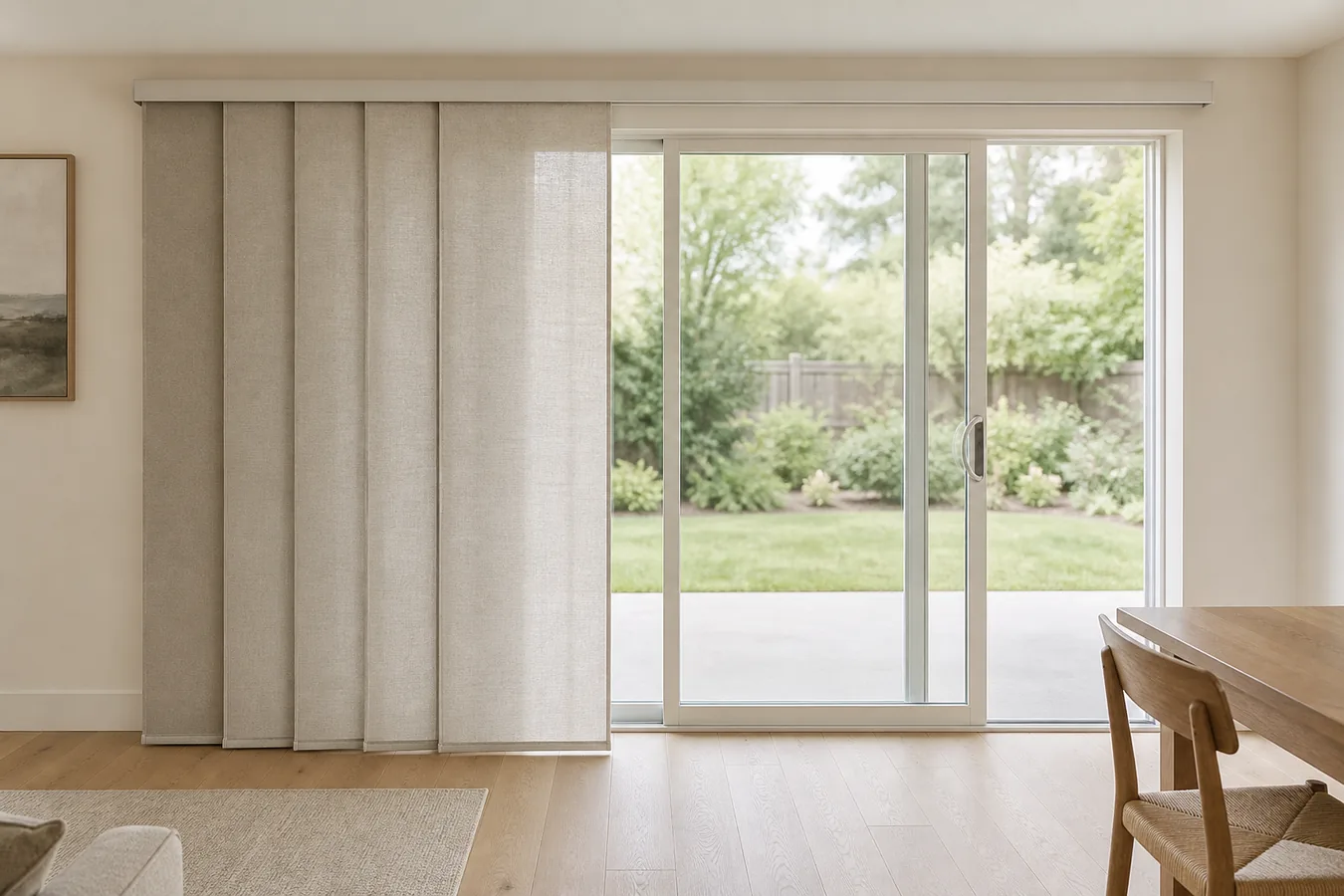
Horizontal or vertical slats can block or redirect part of the incoming radiation and preserve adjustable daylight. In the DOE factsheet’s scope, however, conventional vinyl and metal blinds provided limited insulation. Do not transfer a cellular result to a slatted product because both are sold as blinds.
For a broader explanation of how cellular, roller and Roman constructions differ before motor and control choices are added, use the shade-type comparison. It is the category map; the AERC listing and the actual window still own the energy decision.
Perimeter gaps are part of the product
A high-performing center section can be undermined by the way air and heat move around it. LBNL studies of cellular configurations and perimeter gaps in shading systems found that distance from the glass, cell stretch, mounting hardware and perimeter gaps affect measured or modeled thermal transmittance. They do not establish one universal acceptable gap for every shade. They establish that finished geometry belongs in the specification.
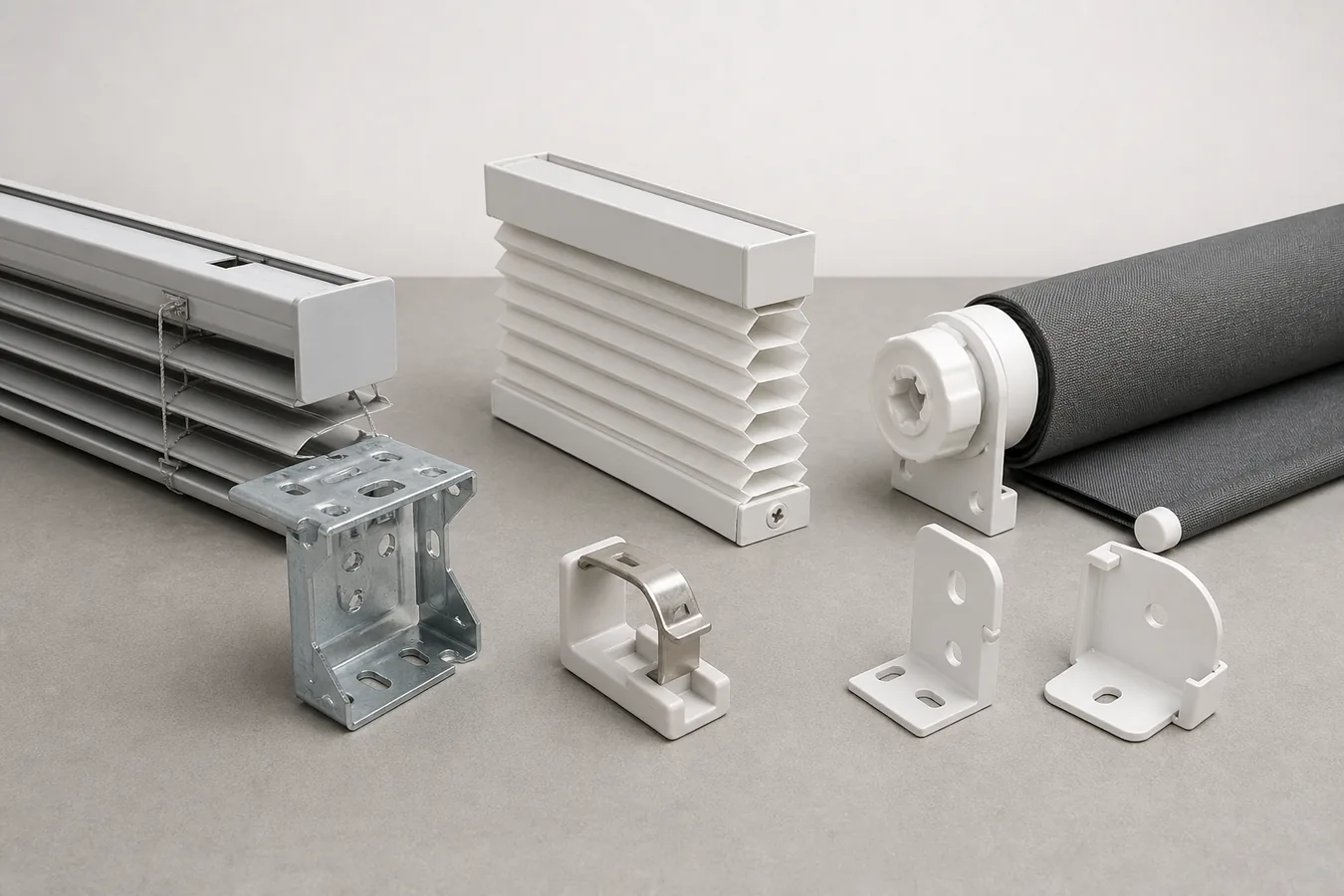
Ask the seller or installer to put the proposed mount plane, finished width and height, bracket deductions, side and top clearances, sill relationship and any spacer or projection in writing. “Fits the window” is not enough if the quote never says where the covering sits or what gap remains.
Record the opening and its obstructions with the measurement checker, then decide whether an inside or outside mount actually suits the depth, coverage and trim. An outside mount may offer more overlap in some windows; an inside mount may preserve trim and appearance. Neither is automatically more efficient without the exact geometry and rated product.
Closed at the wrong time can work against the season
In winter, an insulating covering is most useful when heat is trying to leave through the window—often after the sun is gone. On a sunny heating-season window, opening it while useful solar gain is available can be part of the plan, followed by closing before the cold period. Cloud cover, orientation, privacy and glare can change that timing.
In summer, the useful action usually happens earlier. Put the selected solar-control covering in place before the direct sun creates the hot zone, then reopen it when the load passes if view and daylight matter. Closing it only after the room is already uncomfortable is a different result from preventing the exposure.
In mixed climates, give each important orientation its own rule. A south-facing winter window and a west-facing summer window may need different positions at the same hour. PNNL’s laboratory-home work with specific double-cell cellular shades and multiple control schedules is useful here because it shows that operation changes the outcome. It does not prove that automation guarantees savings.
Motorization earns a place only when it makes a justified schedule more repeatable—for example, because a high window is rarely adjusted or the critical sun arrives when nobody is home. The schedule, local override and safe fallback should be written before choosing the motor ecosystem.
Build the quote around one uncomfortable window
Do not ask three sellers for their “most energy-efficient blind” and compare category names. Give each one the same window record:
- Window identity and problem: room, orientation, glazing if known, and the exact season and time discomfort occurs.
- Exact product identity: manufacturer, collection, model, material, operating option and current certification listing.
- Climate evidence: Warm Climate rating, Cool Climate rating and category maximum for that configuration.
- Finished geometry: inside or outside mount, mount plane, finished size, deductions, overlap and expected perimeter clearances.
- Non-energy requirements: privacy, view, daylight, glare, child safety and any access constraint.
- Deployment plan: when it will open and close by season, whether movement is manual or motorized, and what happens when a sensor, schedule or power source is unavailable.
Now the quotes are comparable. One seller may offer stronger evidence but an unacceptable view; another may promise a better fit but cannot identify the certified configuration; a third may make the daily schedule realistic. Those are useful differences. A generic percentage-savings claim without the window, baseline, climate and operating state is not.
A shade cannot repair every window problem
Pause the purchase if you feel air moving through the sash or frame, see recurring water entry, find soft or damaged trim, or still have severe discomfort while an existing covering is fully closed. Those observations can point to a window, seal, moisture or enclosure problem that a new fabric layer should not be asked to diagnose.
An interior covering can still be part of the eventual solution, but it should not hide the real owner of the problem. Buy when the exact rating, finished fit and seasonal schedule agree. Investigate the window first when the evidence points beyond the covering.