Light-filtering roller shades work best when you want a bright room without an exposed view through clear glass. They can soften daylight and obscure detail, but the label alone cannot tell you whether a screen will remain readable or whether a person outside can see a silhouette after dark. Test the exact fabric and color at one representative window through four real moments—ordinary daylight, peak glare, dusk and night with the lights on—before choosing the mount or adding a motor.
That order matters. Motorization can repeat a useful shade position; it cannot turn an unsuitable fabric into a private or glare-controlled one. A small trial at the most demanding window is cheaper and more informative than selecting every shade from a sample-book label.
The four frames that expose a bad fabric choice
Choose the window most likely to expose a bad decision: the west-facing office screen, the street-facing living room, the largest roller, or the window where night privacy matters most. Record the exact manufacturer, fabric collection, color and weave. Then define four observations in plain, pass-or-fail language.
| Moment | What to observe | A useful pass condition | What failure changes |
|---|---|---|---|
| Normal daylight | Room brightness, diffusion and lost or retained view | The room stays comfortably bright without needing electric light | Try another color, weave or a more open solar fabric |
| Peak sun or glare | The actual television, monitor, camera or seating sightline | The task remains comfortable at a repeatable shade position | Use a denser fabric, solar path or different coverage |
| Dusk | The point at which indoor and outdoor brightness reverse | The required privacy remains acceptable through the transition | Plan an earlier close or an opaque second layer |
| Night, lights on | Faces, clothing, movement and silhouettes from relevant exterior positions | Nothing more than the household’s stated privacy threshold is visible | Do not use this fabric as the only night-privacy layer |
“Some privacy” and “good glare control” are not pass conditions. “A person on the sidewalk cannot identify a face with the normal lamps on” and “the west monitor remains readable between 3:30 and 5 p.m.” can actually be tested.
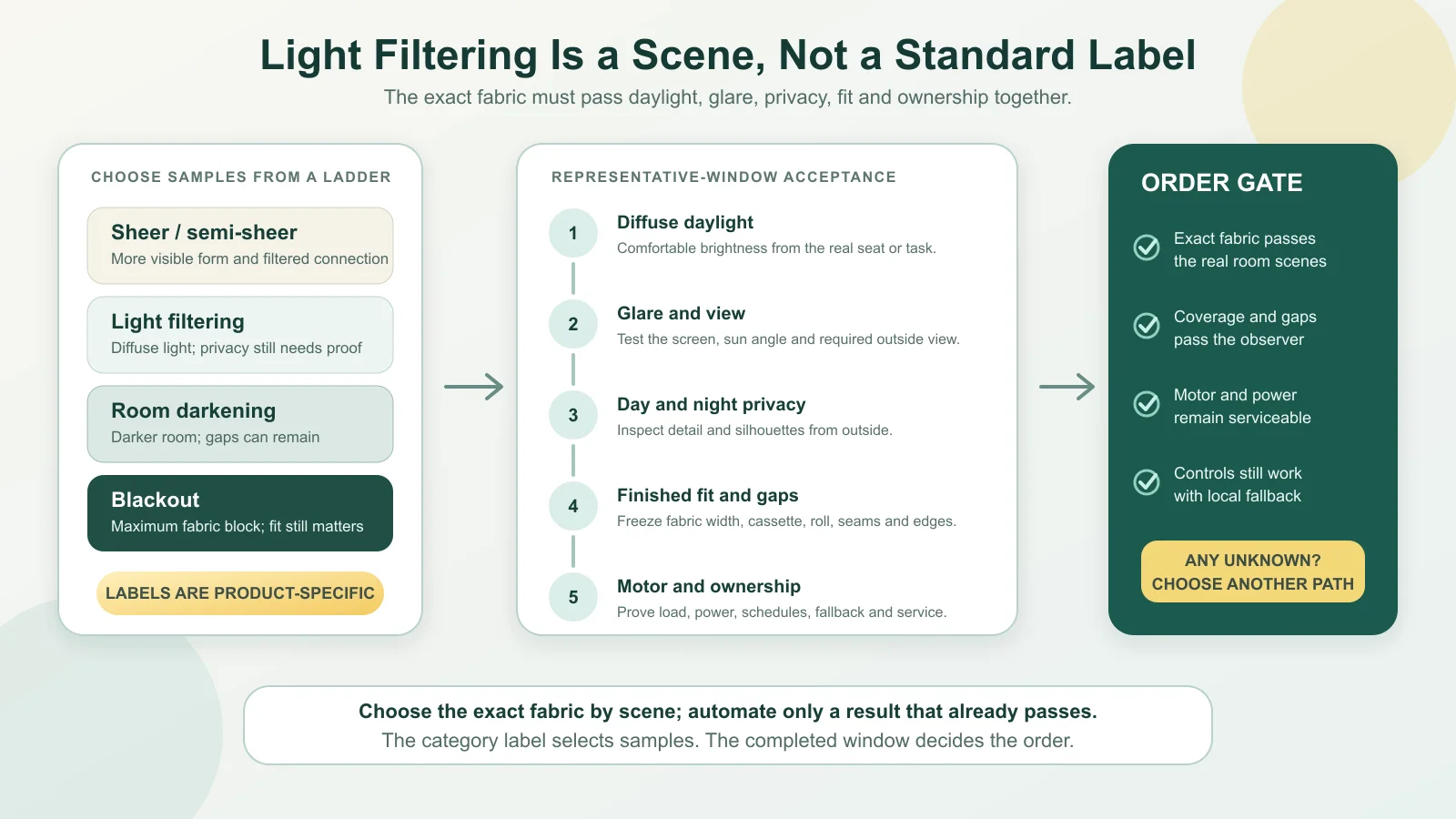
The opacity label selects samples; it does not certify the room
Manufacturers commonly group fabrics as sheer, light filtering, room darkening or blackout. Hunter Douglas’ current opacity guide also notes that fabric type and color affect opacity. That makes the terminology useful within a collection, but it is not a universal transmission or privacy scale.
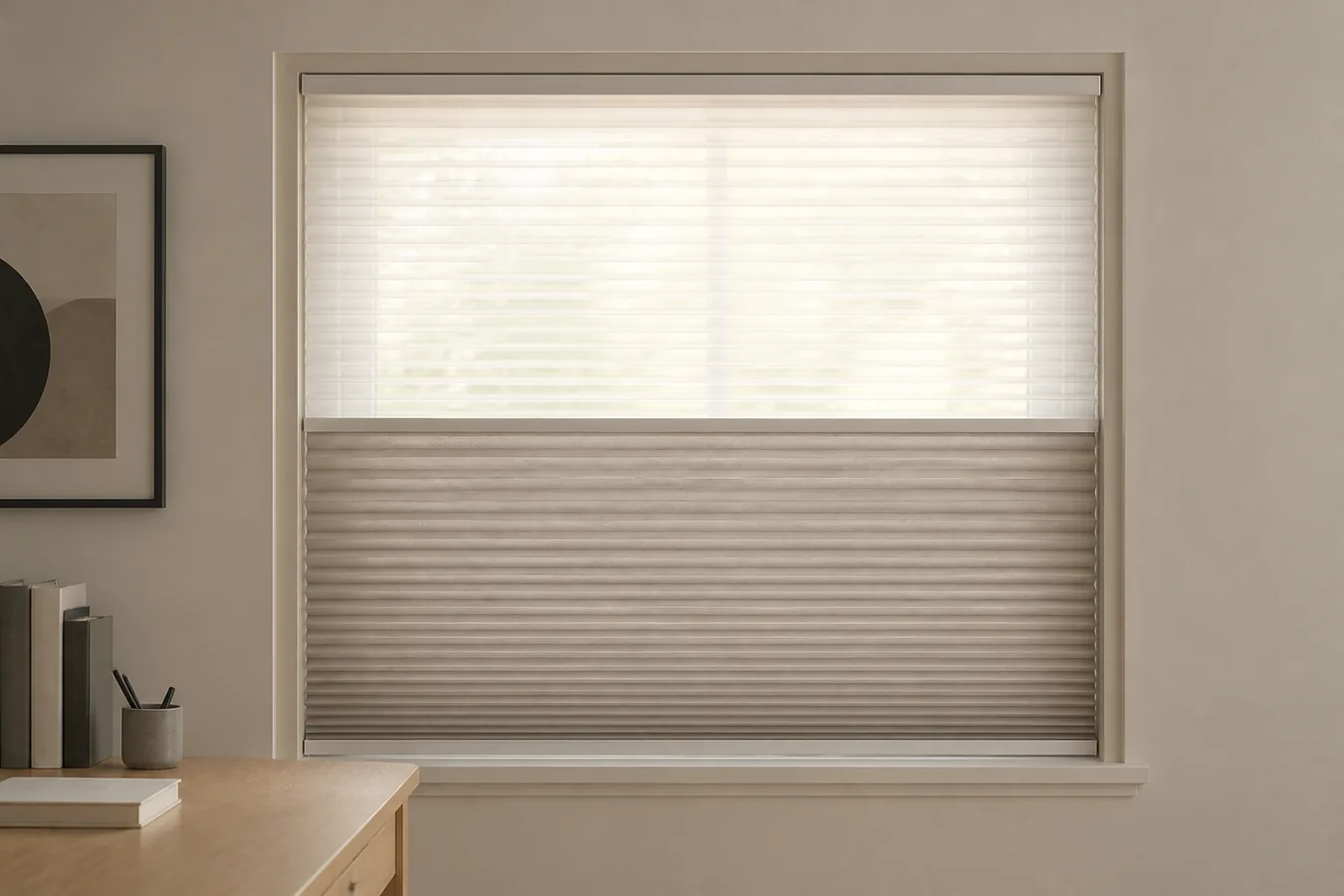
A light-filtering fabric normally admits and diffuses more daylight than an opaque fabric. It may obscure a direct view, yet still glow or show forms when the room is brighter than outdoors. A darker-looking swatch can also create more contrast or make the room feel dimmer without solving edge gaps. Keep the product name, collection, color and sample identity together; a color or collection substitution reopens the trial.
Use a sample large enough to see the fabric rather than the uncovered glass around it. Place it near the intended shade plane, view it from the normal chair or desk, and take it through all four moments. A showroom lamp, phone image or seller’s category tile cannot reproduce the window’s orientation and observer geometry.
Let the failed moment select the material path
Graber’s current roller-shade range separates light-filtering, room-darkening and blackout fabrics and presents dual-shade configurations. The useful point is not that one category always wins. Different room tasks may require different material paths.
- Keep the light-filtering roller when diffuse daylight is the priority and the exact sample passes glare and both privacy observations.
- Try another light-filtering color or weave when the overall path works but brightness, contrast or silhouette detail misses the threshold.
- Move toward a solar screen when daytime view and direct-sun glare matter more than visual obscurity.
- Move toward room darkening or blackout when sleep, projection or high night privacy is non-negotiable.
- Use two layers when the room genuinely needs bright filtered daylight and a separate opaque night state.
the motorized roller, cellular and Roman shade comparison is the cluster’s broader choice point when the failed requirement suggests that a roller is no longer the best architecture.
Night privacy is an observation from outside
Run the night part of the trial with the room arranged as it is normally used. Turn on the usual lamps, move near the shade, sit where occupants sit, and inspect from every realistic exterior line of sight. A sidewalk, neighboring window and lower driveway can produce different results. Record whether an observer can identify only a glow, a silhouette, clothing detail, a face or an activity.
Move the sample closer to and farther from the person. The result often changes with distance and backlighting. Also look at the left and right edges: a fabric that obscures the center can still expose a narrow direct view. If the required threshold fails, the honest answer is an opaque layer or a different window treatment—not a stronger description of the same fabric.
Glare is a geometry problem, not a brightness adjective
A room can feel pleasantly bright while a small patch of sun makes one screen unusable. Test the exact task at the worst time. Lower the sample through several positions and note the lowest position that blocks the offending angle while preserving acceptable daylight or view. That position becomes useful later if motorization is considered.
Light-filtering fabric can itself become a bright field beside a dark screen. If that reflection remains uncomfortable, compare a darker or denser sample, a solar fabric selected for the view task, greater outside overlap, or a second opaque layer. Do not infer a heat, UV or energy result from a glare improvement unless the exact product supplies evidence for that separate claim.
The sample ends where the roller hardware begins
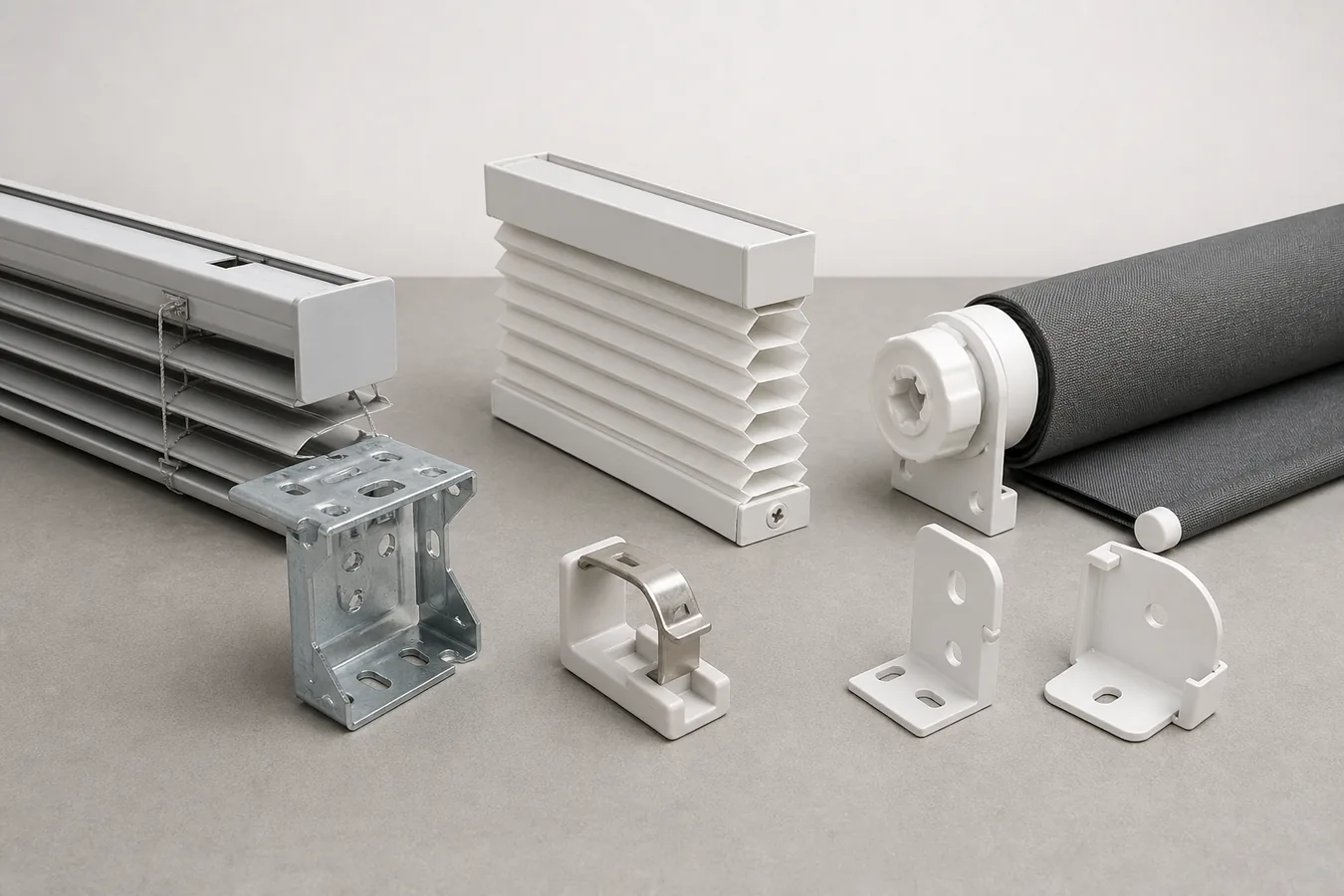
The sample proves only the center of the material. The completed roller adds deductions, side clearances, roll direction, cassette projection and the bottom bar. Begin with the Smart Shade Measurement and Compatibility Checker, then compare the coverage consequences in the inside-versus-outside mount guide.
Ask the supplier to show the ordered shade width and the expected fabric width separately. Record the left and right gaps, distance from glass, regular or reverse roll, cassette or fascia dimensions, bottom position and clearance around handles, locks, cranks, screens and sash. An inside mount may preserve trim but needs operating clearance. Outside overlap can cover more glass, but it may project over casing or conflict with nearby hardware. Hunter Douglas’ current light-gap explanation describes these physical tradeoffs; it does not guarantee an installed privacy or darkness level.
Sketch the completed elevation and inspect it from the same exterior and screen positions used in the trial. If the planned gaps expose a face or a bright stripe, adjust the mount or select another system before ordering.
Wide rollers may force a different material decision
Fabric roll width, finished shade size, seam rules, railroad orientation, tube selection and motor load interact. Levolor’s current roller technical guide is one example of these limits varying by collection and configuration. Its numbers belong to the named products; the ordering lesson applies more broadly.
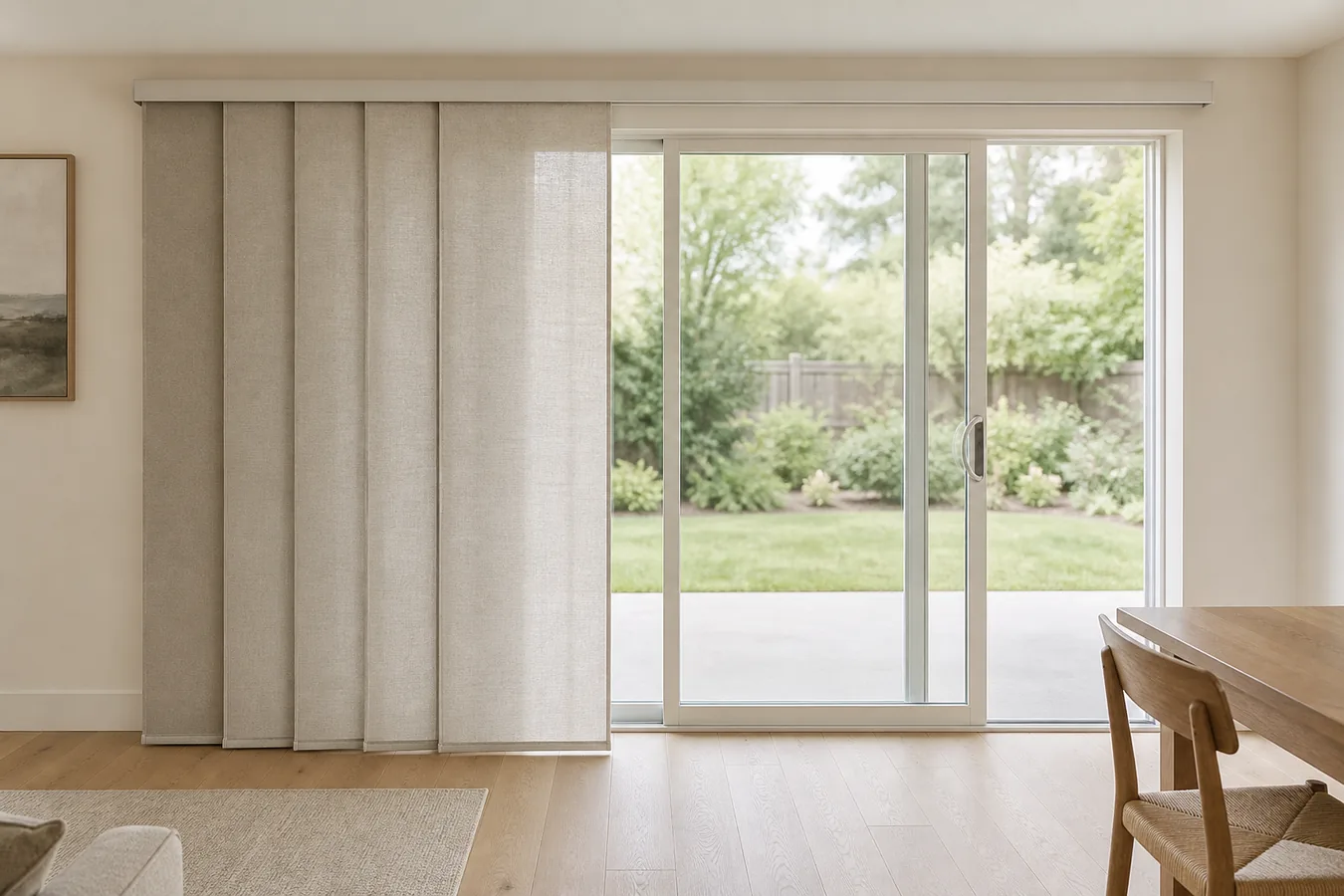
For a wide picture window or door, make the supplier identify whether the chosen fabric must be rotated, seamed or divided. A substitution can change diffusion and privacy; a split introduces a view and light gap. Use the large-opening shade planning guide when panel access, multiple motors or alignment becomes part of the decision.
A motor earns its place by repeating the accepted state
The four-moment trial produces one or more useful positions: perhaps fully lowered for night privacy and partially lowered for afternoon glare. Motorization earns its cost when the shade is high, heavy, grouped, changed frequently, or must reach those positions before a recurring event. A reachable shade that stays in one position may be better as a manual cordless roller.
Control capability is system- and generation-specific. Hunter Douglas currently includes named roller products in its PowerView control system, while Levolor’s control guide distinguishes remote, hub/app and legacy paths. For the quoted motor, confirm limit setting, a favorite or intermediate position, group behavior, schedule dependencies and the physical control that remains useful without an app or internet connection.
At the representative window, start the shade from several positions and recall the accepted glare or privacy state repeatedly. If position variation reopens the bright strip or exterior sightline, the automation has not reproduced the room result.
Service starts at floor level
Rechargeable, replaceable-battery, plug-in and hardwired paths vary by exact motor. Hunter Douglas, for example, lists rechargeable and hardwired capabilities within the named PowerView scope. Do not transfer those options—or a battery-life claim—to another system.
Mark the charge port, battery, transformer, connector, program button and shade-removal direction on the window sketch. Then rehearse charging, reset and removal. A high shade that solves daily access can still be a poor choice if routine service requires unsafe equipment. Also record who restores limits and groups after a motor or battery replacement.
Where young children may reach the window, inspect the delivered control and any accessible inner cords. The U.S. Consumer Product Safety Commission states that cordless coverings are the safest option in that setting.
When one fabric cannot serve both day and night
A single roller is elegant only when one material can meet the room’s competing scenes. If light-filtering passes the daytime test but fails night privacy, do not sacrifice the useful daylight or accept the privacy failure automatically. A dual system can assign filtered daylight to one layer and high privacy or darkness to another. Hunter Douglas’ named Duolite configurations show that this architecture exists, though availability and controls remain product-specific.
Two layers add depth, projection, hardware, possible gap interactions, controls and service work. Test light-filtering only, opaque only, both raised and every transition. The dual path wins only if the completed system still fits, operates and can be maintained.
Give the supplier the four-moment record
Bring a one-page record for each distinct window group:
- exact fabric collection, color, sample ID and stated opacity category;
- the four moments, observer/task positions and pass thresholds;
- the tested sample result and any remaining unknown;
- opening, mount plane, ordered width, expected fabric width and side gaps;
- cassette, roll direction, bottom bar, obstructions and operating clearances;
- any railroad, seam, split, tube or motor-load consequence;
- accepted manual position or named motorized scene;
- exact motor generation, power path, local control and service access.
Pause the order if the exact fabric is unavailable, night privacy is inferred from daytime appearance, the critical glare hour was not observed, actual fabric coverage is unknown, a wide-window substitution changes the material, or a critical motorized state has no usable local fallback.
Scale only what the demanding window has proved
Install or mock up the most demanding window first. Confirm the delivered identity, measure the real gaps, repeat the four observations, recall any motorized positions, disconnect the app or hub, and rehearse service access. Record the conditions as well as the result. Passing that window supports scaling the same verified configuration to genuinely similar openings; it does not make the fabric a universal solution.
Let the exact sample prove the daylight benefit, let the after-dark view expose its privacy limit, and let the finished gaps decide whether the roller layout works. Add a motor only after those three parts of the shade are right.