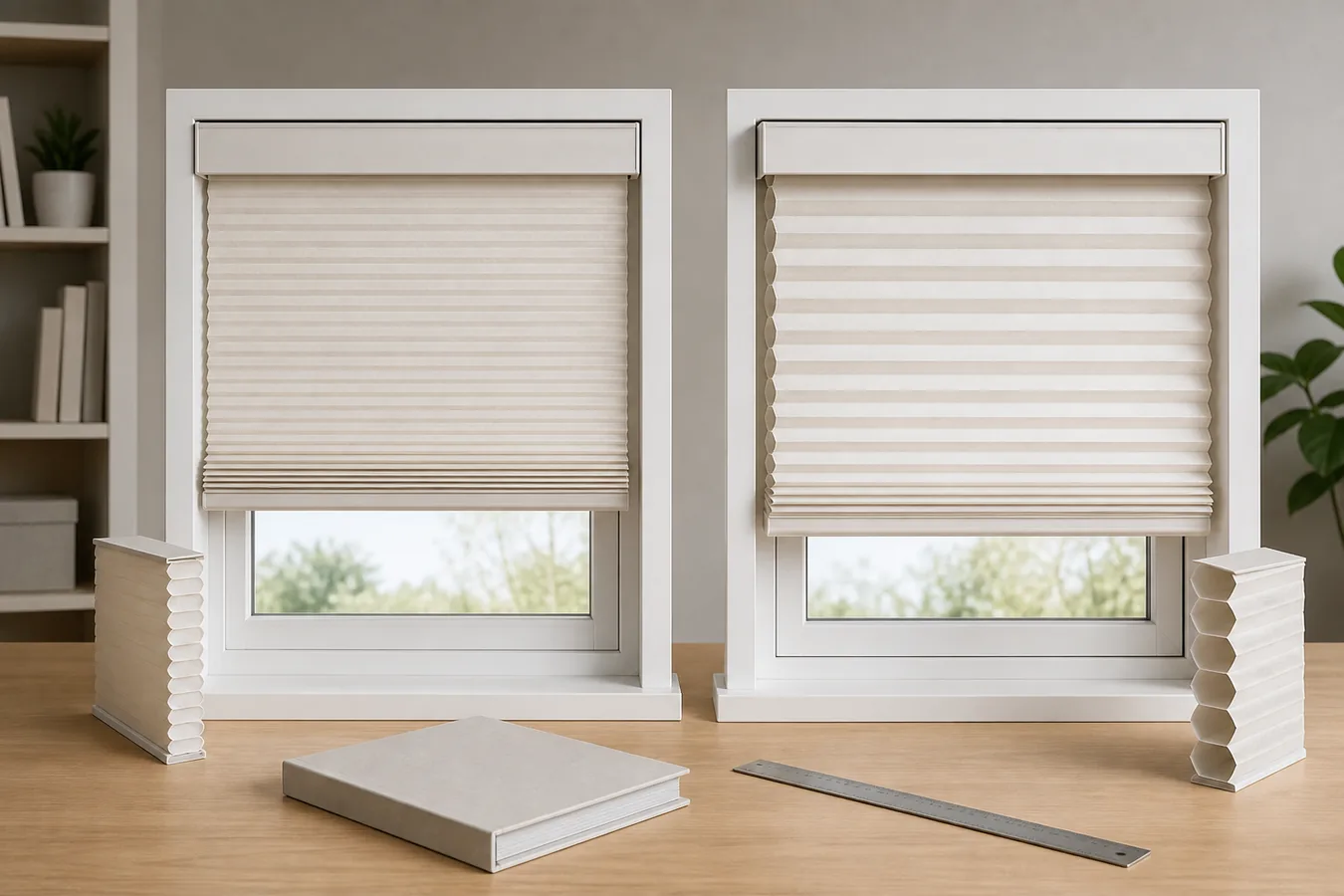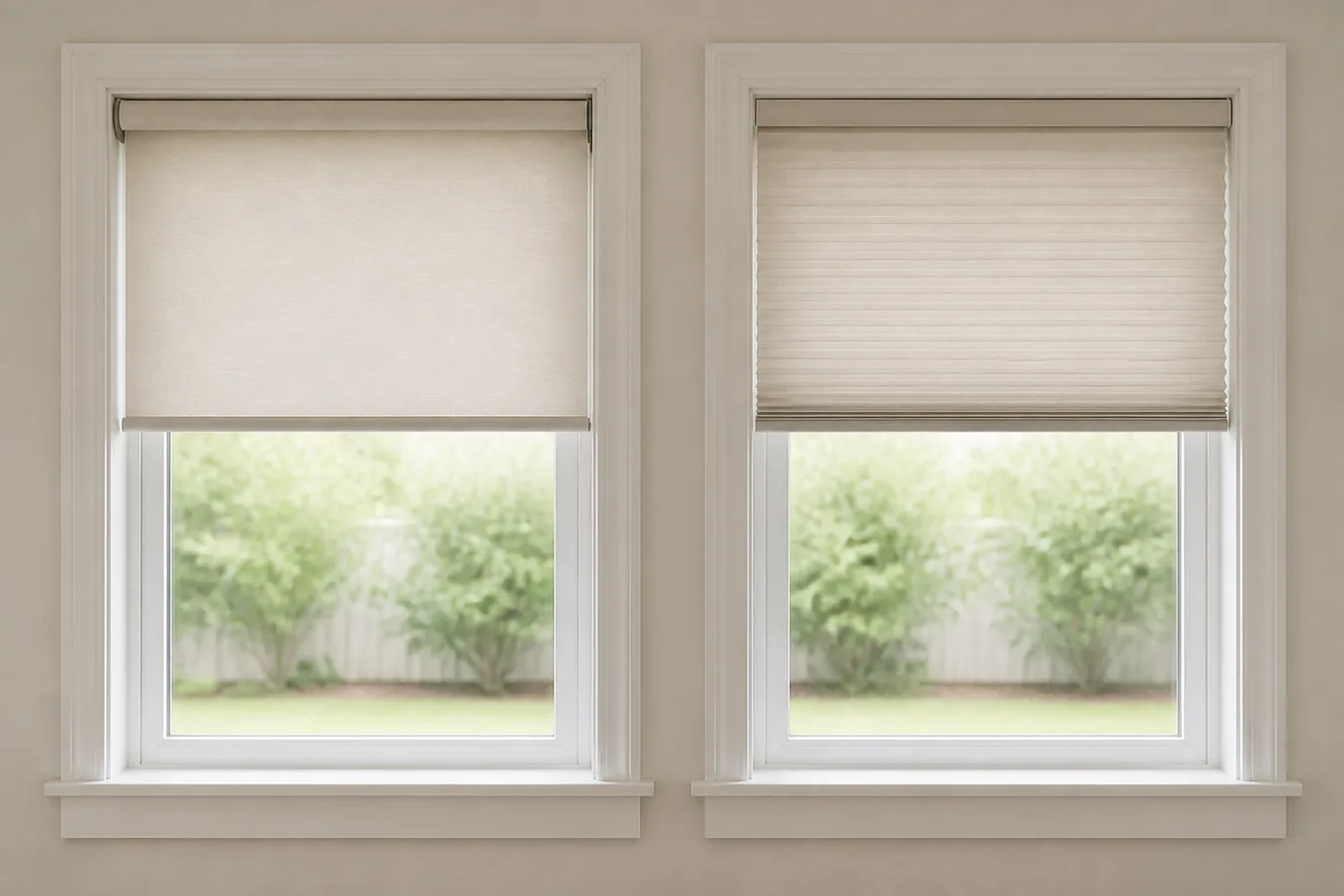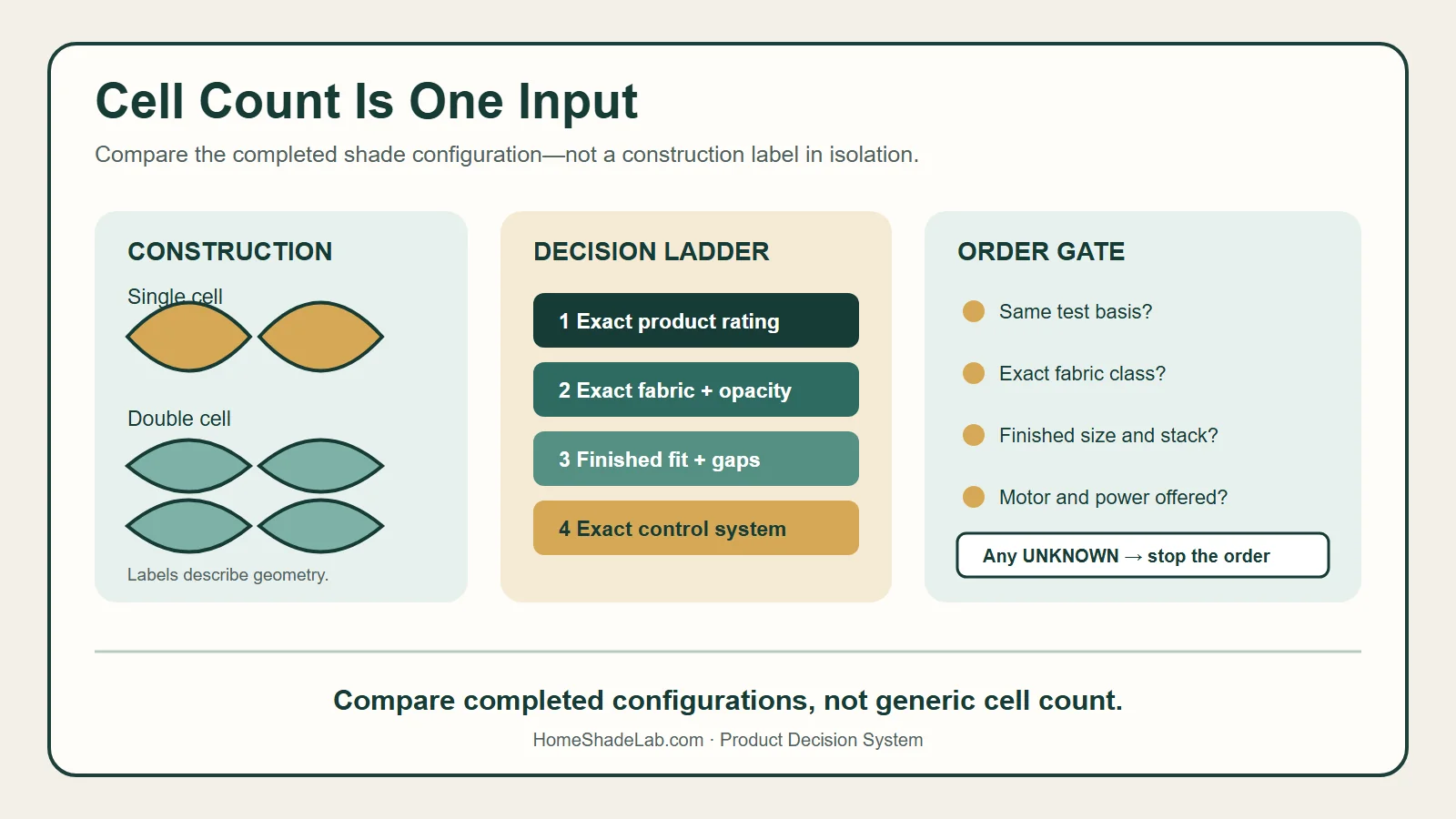
Double-cell cellular shades are not automatically better than single-cell shades. They add another layer of cell geometry, but cell count alone does not prove the exact thermal performance, darkness, fit, stack, motor compatibility or value of the finished shade. The right comparison is between two orderable configurations—not two construction labels.
If verified thermal performance is the deciding goal, compare exact product ratings on the same basis. If the double-cell option loses the required fabric, does not fit the recess, blocks more view when raised, or is unavailable with the needed motor or control, the extra cell layer does not win the purchase. When the shortlist mixes complete shades with retrofit motors or loosely labeled smart products, first separate them with the smart blinds versus motorized shades comparison.
Start by removing “better” from the question
Replace “Is double cell better?” with: better at which task, in which exact product, at this window, with which fabric and control? Most decisions reduce to one of four tasks:
- improve a verified thermal rating for a specific window;
- meet a light/privacy goal with an exact fabric;
- fit the mount and preserve an acceptable raised view;
- obtain the required manual or motorized control configuration.
Rank those tasks before requesting samples. Otherwise a salesperson’s generic construction claim can quietly replace the room requirement.
Decode what the seller means by a cell
Cellular fabrics form air spaces in the pleated construction. Single, double and cell-within-cell describe different geometries, but naming is not fully interchangeable across brands. A branded cell-within-cell design should not be assumed to be identical to every product called double cell.
AERC recognizes single, double and cell-within-cell residential cellular attachments and points consumers toward product-specific energy ratings. See the current AERC attachment types and rating path. Hunter Douglas likewise uses single-cell and a named cell-within-a-cell construction alongside different pleat sizes, fabrics and opacities. Review the current named Hunter Douglas options.
Write down the exact product family, cell construction and cell/pleat size for each candidate. “Double” without a model is not enough identity to support a performance claim.
| Claim | Admissible evidence | Not enough | Decision affected |
|---|---|---|---|
| Construction | Exact product, cell geometry and pleat size | Single/double label alone | Physical configuration identity |
| Thermal performance | Current exact product rating or test on the same stated basis | Generic R-value, “more cells,” or another brand’s result | Thermal priority |
| Light and privacy | Exact fabric/color/opacity plus installed gap plan | Cell count or blackout label alone | Room-light task |
| Fit and view | Finished depth, headrail, gaps and stack for the quoted size | A hand sample or collection photo | Mount feasibility and clear glass |
| Operation | Exact lift, motor, power and control combination is orderable | The brand offers motorization somewhere | Configuration availability |
Thermal evidence needs a product identity
DOE explains that cellular shades create insulating air spaces within the cells and between the shade and window. Its fact sheet also describes research based on a limited set of cellular shades and a heating-focused study/modeling scope; cooling effects needed more research. Use that work to understand the mechanism and evidence limit, not to promise a specific household saving. Read the DOE cellular-shade fact sheet.
For a purchase, look for a current rating tied to the exact finished attachment, or a manufacturer test whose method, configuration and date are stated. Compare like with like. If one quote offers only a marketing statement and the other provides an exact rating, the missing evidence is the conclusion: the thermal comparison is not closed.
Do not borrow a value from a different fabric, cell size, control type or product generation. Lutron’s technical material shows that thermal values and stack behavior can vary by exact cellular configuration, reinforcing the need to bind the evidence to what is actually ordered. Check the exact Lutron technical scope.
Your existing window sets the value of the improvement
A shade is an attachment to a window, not a replacement for the window. The same rated shade can have different practical value depending on glazing, frame condition, leakage, climate, exposure and how consistently it is used. This guide cannot convert a cell count into an energy bill or payback.
Define the actual task: winter comfort near a cold window, reducing a verified attachment-related heat path, or simply choosing between two otherwise similar configurations. If the window has unresolved air leakage or moisture problems, fix or professionally assess those separately rather than expecting another fabric cell to repair the building envelope.
Fabric decides the light task
Cell count does not determine whether the room is light-filtering, private or dark. Those results depend on the exact fabric/color/opacity and on light paths around the installed covering. A room-darkening fabric may still show side, top or bottom gaps; a double-cell light-filtering fabric may transmit more light than an opaque single-cell option.
Choose the fabric from a physical sample under the room’s light. Then keep two separate order fields: material opacity and expected installed gaps. For sleep-critical darkness, a different mount or side treatment may matter more than adding a second cell layer.
Cell geometry still changes the physical shade
Even when thermal evidence is not decisive, the exact cell construction can change headrail depth, visual scale, fabric bulk and the stack retained at the top. It may also change size limits and the fabrics offered. These effects belong to the exact product, not to a universal single-versus-double rule.
Measure at the intended mount plane with the measurement checker. Then compare the exact headrail and full-recess depth, finished fabric width, expected edge gaps and raised stack. The inside-versus-outside mount guide helps decide whether recess fit or overlap is the better use of the opening.
Mark the quoted stack on the window. If preserving view is important, the physically smaller completed shade may be worth more than a construction advantage that has not been rated for the exact product.
Motorization can remove a construction from the choice
Do not select cell count and add automation later. The cell style, cell size, fabric, finished dimensions, lift mode, motor, power and controls must exist as one orderable row.
Lutron’s current cellular page, for example, places 3/4-inch single, 7/16-inch double and 9/16-inch single constructions in different product families with different power/control combinations. That does not make one family better; it proves that configuration availability is specific. Verify the current Lutron family and control combination.
Ask whether top-down/bottom-up, cordless manual lift or motorization is available with the exact cell and fabric. Confirm local fallback, power/charging and service access. If the required operation is unavailable in the higher-rated candidate, the choice may be decided by function rather than cell count.
Compare two complete quote rows
Ask the same supplier—or two suppliers using clearly identified evidence—for one single-cell and one double/cell-within-cell configuration that both meet the room task. Keep every field visible:
| Field | Single-cell candidate | Double/cell-within-cell candidate |
|---|---|---|
| Identity | Product, cell/pleat size, fabric/color | Product, exact construction, cell/pleat size, fabric/color |
| Comparable performance | Rating/test, method/scope and date | Same-basis rating/test, method/scope and date |
| Finished fit | Size, headrail depth, fabric deduction, gaps and stack | Size, headrail depth, fabric deduction, gaps and stack |
| Operation | Lift/motor, power, control, service and safety | Lift/motor, power, control, service and safety |
| Quote delta | Dated complete installed configuration | Dated complete installed configuration |
Where young children are present, require an appropriate cordless completed configuration; CPSC says cordless window coverings are the safest option in that setting. See the current CPSC cord guidance.
Let the deciding evidence name the winner
The outcome should state why it won:
- Single-cell—fit priority: it meets the room task and exact rating requirement while fitting the recess or preserving more acceptable raised view.
- Double/cell-within-cell—verified thermal priority: its exact same-basis rating is stronger and its fabric, fit and controls still pass.
- Fabric decides: one exact opacity/color solves the light/privacy task that cell count does not.
- Availability decides: only one construction is orderable with the required size, lift, motor or control.
- Insufficient evidence: the candidates lack comparable exact ratings or completed configuration details, so no thermal winner is claimed.
Choose between single-cell and double-cell only after two complete configurations are on the table. The extra cell is worthwhile when verified performance improves enough to justify any loss in fabric choice, fit, stack, motor availability, or price—not simply because “double” sounds better.