The word arched describes a shape, not an operating capability. A product may be cut to fill a curve yet remain fixed; another may cover only the rectangle below the arch; a much smaller set is documented to move across the curved area itself.
Motorized shades for arched windows are ready to compare only after the seller identifies exactly what moves, on which arch shapes, along what path, and with which power and control package.
The word “arch” says nothing about movement
| Coverage claim | What may move | Proof to request | What remains unresolved |
|---|---|---|---|
| Static arch insert | Nothing in the curved section | Exact product drawing showing fixed coverage | Whether a separate lower shade is needed |
| Manually adjustable specialty shade | A user-operated fan, rail or specialty mechanism | Current operating instructions for the exact shape | Motorization, access and repeatable positions |
| Motorized lower rectangle | The rectangular section below a fixed arch | Drawing that separates the static and motorized portions | Light/privacy through the upper curve |
| Motorized curved coverage | The documented portion of the arch itself | Exact shape, size and movement documentation plus motor/power details | Template, gaps, service and control limits |
Do not let a collection page or the presence of a remote collapse these rows into one. The useful question is: “Show me the exact area this configuration moves from fully open to fully closed.”
Name the curve before requesting a price
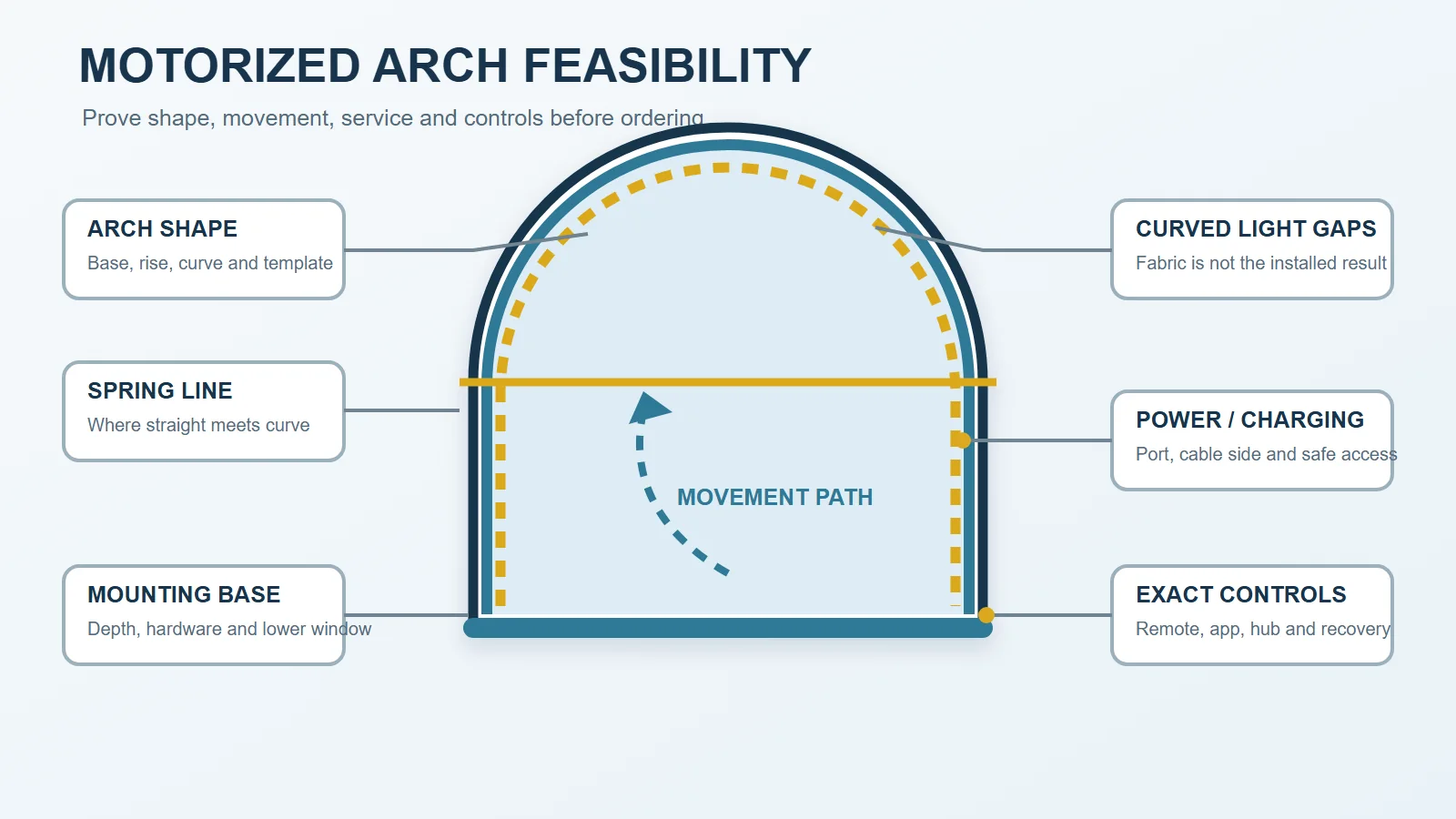
Record the base width, rise, spring line where the curve begins, usable depth and the relationship to any rectangular window below. Photograph the whole opening square-on and note whether the curve appears symmetric.
Seller categories can include perfect or half-circle arches, elongated or Palladian shapes, quarter arches and other specialty curves. Blinds.com distinguishes several arch types and calls for shape-specific measurements. Those labels help route the inquiry; they do not let a homeowner infer a perfect-arch ratio or reuse one seller’s allowance.
Use the Smart Shade Measurement and Compatibility Checker to organize base, rise, depth, trim and lower-window obstructions. The exact specialty-shade maker still owns shape acceptance and final order inputs.
A template transfers shape, not operating proof
An out-of-square opening, a non-perfect curve or an inside mount may require a physical template under the seller’s current rules. The template records geometry. It does not prove that the chosen product can move through that geometry, clear its rail or fit its motor and charging components.
The Blinds.com arch instructions show why the spring line, interior shape and neighboring objects matter. Ask who creates the template, how its orientation is marked, which surface it represents, and who accepts it before fabrication.
Keep the geometry owner and the movement owner visible. A seller may accept a template for a static insert while offering no motorized mechanism for that curve. Conversely, a real motorized product may accept only a limited shape family. Both answers must be “yes” for the same configuration.
The lower rectangle may deserve a different job
Many arched openings combine a curved top with a rectangular lower window. Treating them as one decorative shape can hide a useful functional split.
A static arch insert above a motorized lower shade can provide different control from a fully moving arch. An outside-mounted rectangular shade may cover the complete opening when closed but also cover trim and require space above the arch when raised. A documented motorized arch can preserve the architectural curve but may impose tighter shape, power or gap constraints.
Choose the layout based on the room task: whether the upper curve must open for daylight or view, whether the lower rectangle carries the privacy burden, and whether a covering may extend beyond the opening. The inside-versus-outside mount guide helps define projection and coverage, but only the exact arch product can accept the curve.
Watch the covering through its full travel
Request a movement drawing or operating video for the exact current model. Observe which edge leads, whether material divides or changes speed, where rails or carriers move, and what occupies the base and curved perimeter at both end positions.
Hunter Douglas documents specific PowerView Gen 3 behavior for named Duette and Applause arches and angled shades, including product-specific operating, power and accessory details. That is evidence for those configurations only—not a general promise that all motorized arch shades split, move at a certain speed or have a manual bypass.
If the seller cannot show full open, intermediate and full closed positions for the quoted shape, the phrase “motorized arch” remains incomplete. A motor somewhere in the assembly is not the same as useful movement across the desired area.
Power belongs to the side chosen by the exact system
High arches make charging and recovery part of fit. Record the motor side, cable or battery location, charging connector orientation, reach required for reset, and what local control remains available if an app or network is unavailable.
Do not choose a preferred motor side from symmetry alone. The exact mechanism may fix the motor, cable or charging side. A nearby wall, trim return or neighboring shade can then block access. Mark the service envelope on the same drawing used for the arch and mount.
Ask explicitly whether manual movement is allowed when power is unavailable. The Hunter Douglas support document above, for example, sets exact-system operating limits; it must not be turned into an industry-wide manual-override rule. App, bridge, ecosystem and recovery claims likewise belong to the quoted motor generation.
Edge light follows the geometry
A curved perimeter creates a different installed result from a flat fabric swatch. Light can appear along the curve, base rail, spring line, template variance or the joint between a static arch and lower moving shade.
A current Graywind product page demonstrates that custom motorized perfect-arch products exist and that fit, power/control and edge light are configuration questions. Its marketing, prices and reviews are not a cross-brand performance guarantee.
Specify the observable goal—soften direct glare, preserve daytime light, improve nighttime privacy, or achieve stronger darkening—and ask for a finished perimeter drawing. A blackout material cannot promise a blacked-out room when the curved interface and neighboring section remain unknown.
One configuration sheet closes the claim
The seller’s returned sheet should identify the arch type, accepted drawing or template revision, exact moving coverage, open and closed positions, mounting base, finished rails and gaps, motor/power side, charging/reset access, local control, bridge or hub requirements and any absence of manual override.
Keep static and moving portions labeled separately. If the lower rectangle uses another shade, identify its overlap and control relationship rather than assuming the two pieces behave as one product.
An arched window does not have to be fully motorized to work well. Choose the simplest moving portion that solves the real light or privacy problem, and keep the fixed arch visible when that produces a cleaner, more reliable result.
When the arch is one of several unusual openings, return to the Smart Motorized Blinds Planner and compare its fit, power, and room job with the rest of the project before choosing a control system.