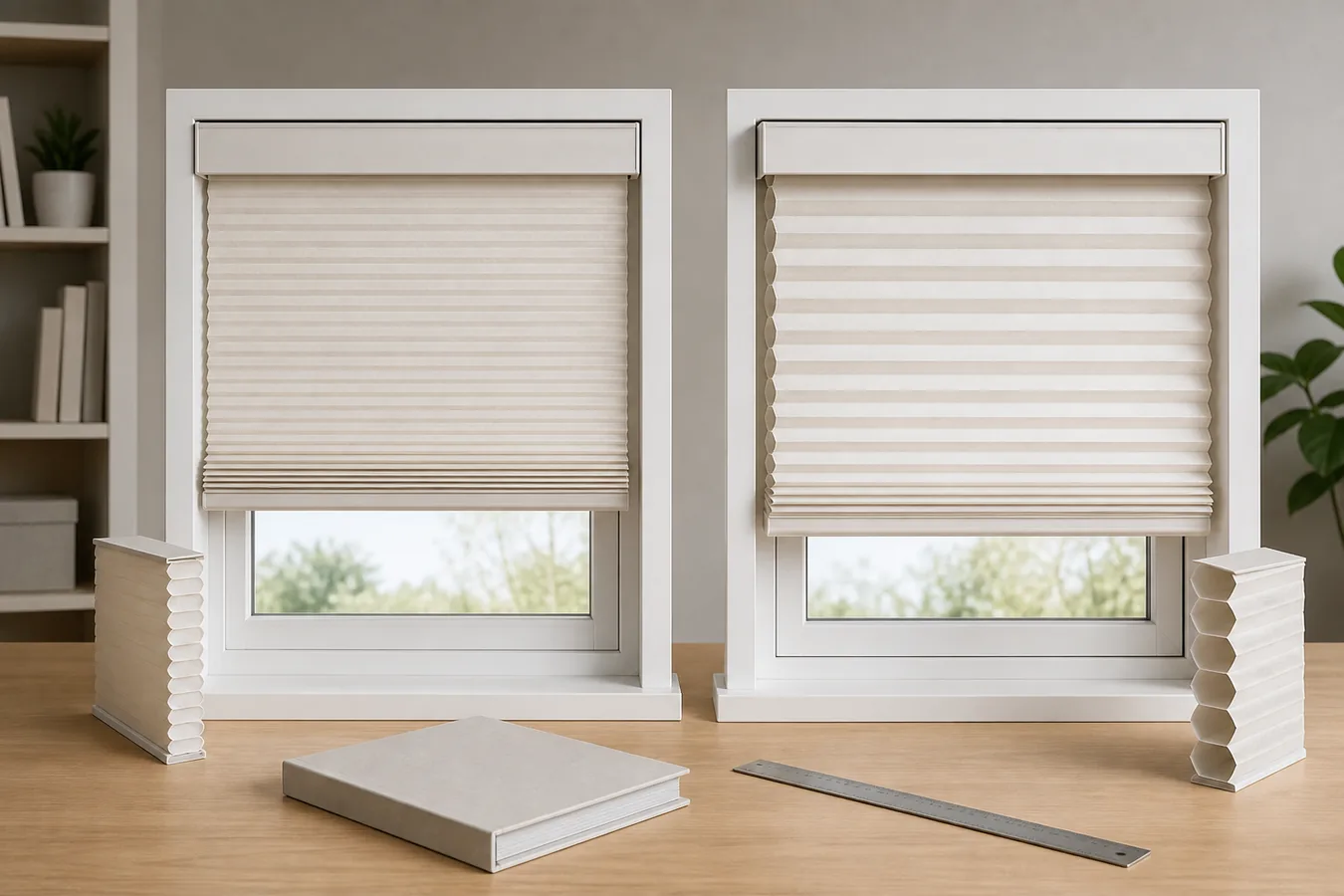
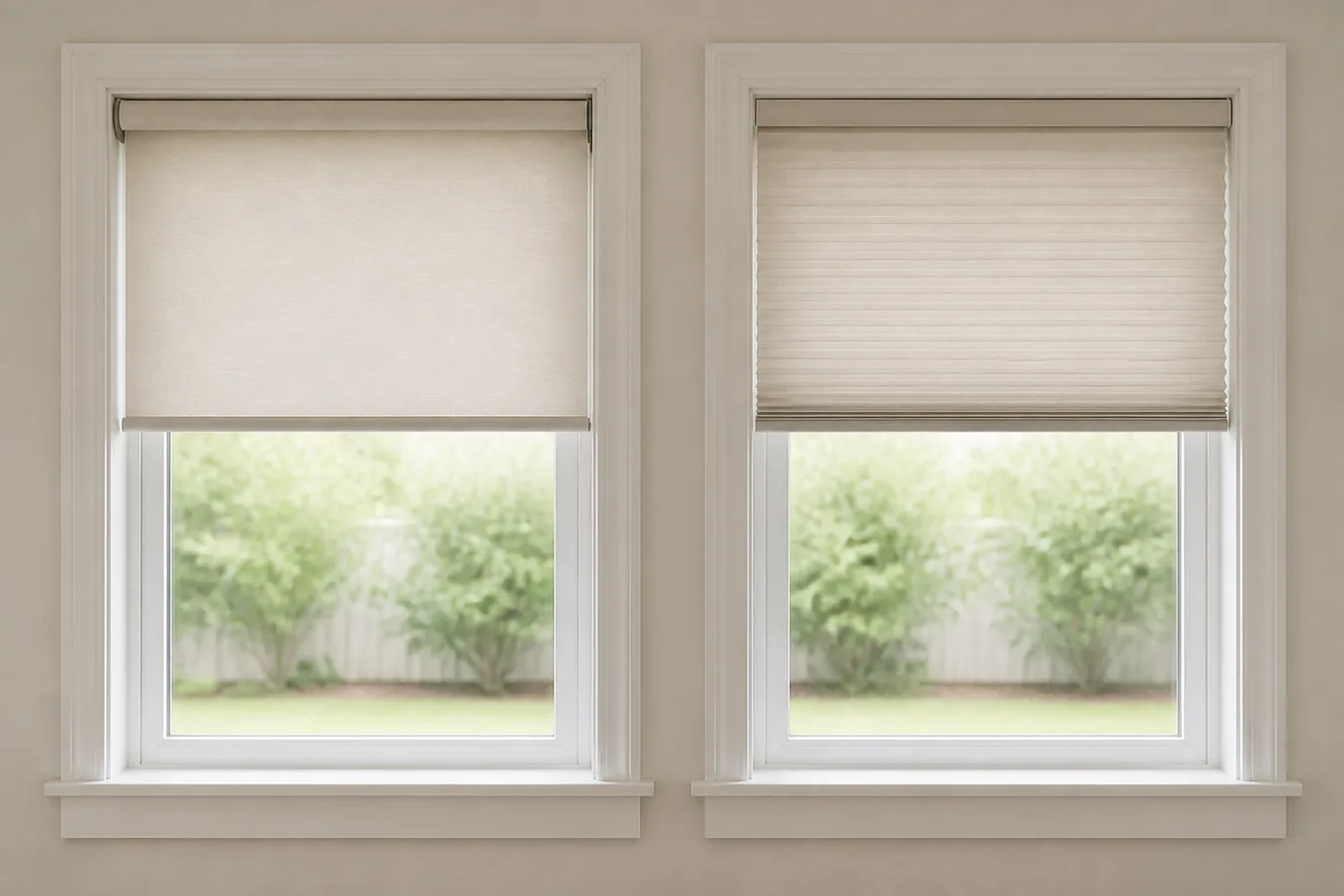
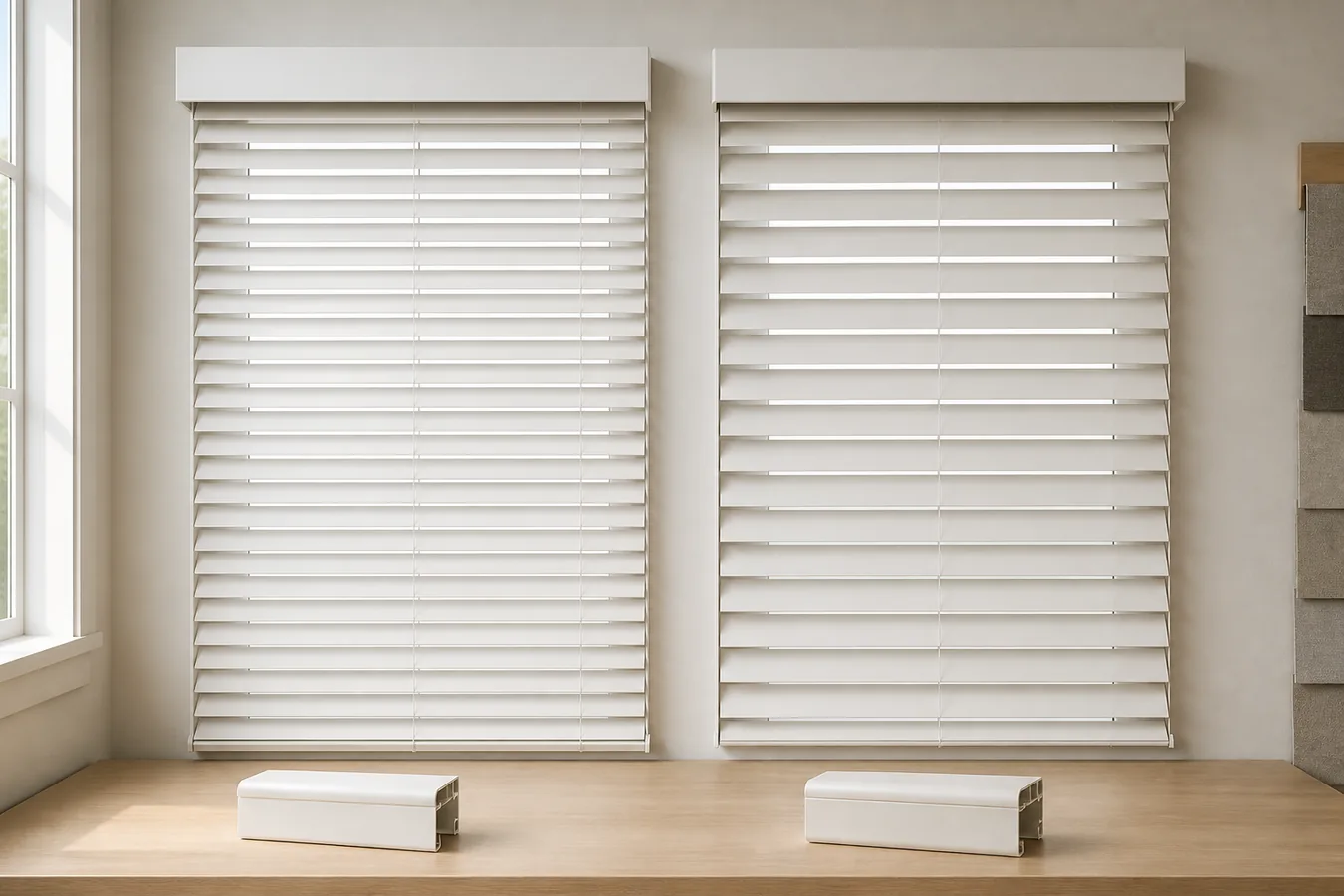
Roller, cellular, Roman, and zebra shades solve different room problems. Roller shades offer a clean fabric panel; cellular shades add insulating pockets; Roman shades create soft folds; zebra shades use alternating bands to shift between view and coverage. Choose the construction that fits the room first, then verify fabric, mount, motor, power, and controls.
No shade type wins every room. “Blackout,” “smart,” and “motorized” are not substitutes for fit, fabric opacity, side-gap control, service access, or exact ecosystem compatibility.
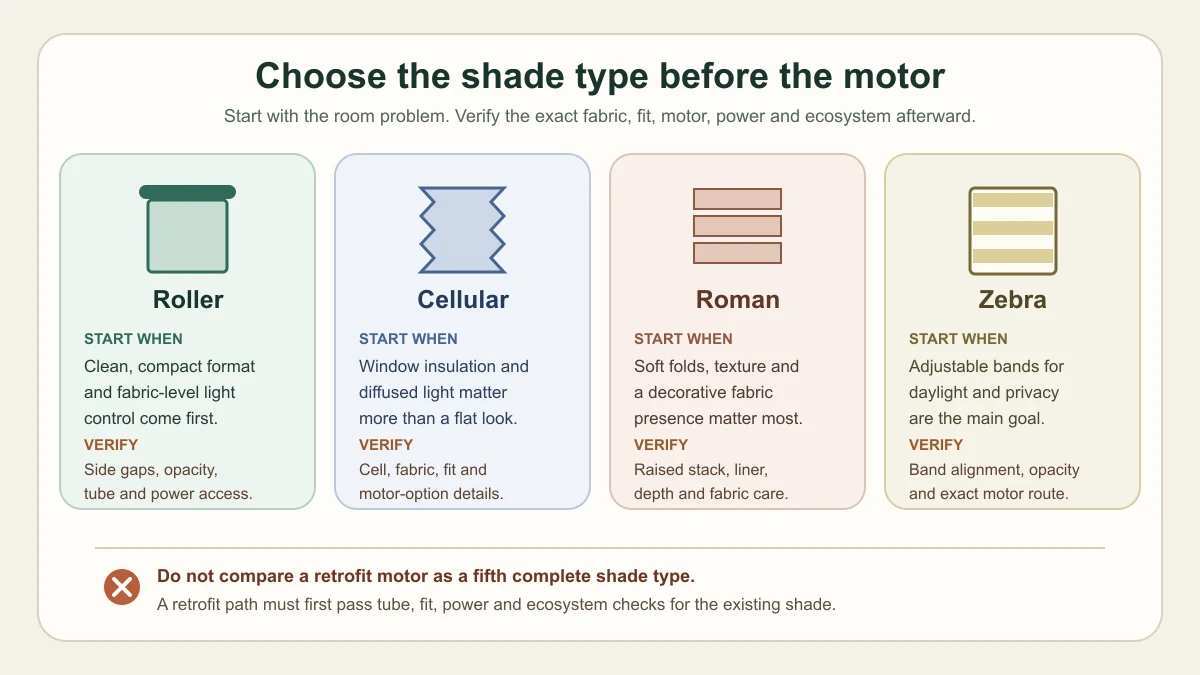
Start with the room problem, not the shade name
This matrix identifies a useful starting category. It does not replace exact-product dimensions, fabric samples, motor documentation or merchant measuring rules.
| Type | Start here when | Light and privacy | Insulation evidence | Look and open position | Maintenance question | Smart-control rule |
|---|---|---|---|---|---|---|
| Roller | You want a clean, compact format and fabric-driven glare, privacy or room-darkening choices. | Depends on fabric opacity, openness, mount and edge gaps; a blackout fabric is not a complete-darkness guarantee. | Do not assume cellular-level insulation from a standard roller construction; verify an exact rated product if energy performance is decisive. | A flat panel rolls onto a tube, which can suit a minimal visual goal; cassette and roll direction affect the final profile. | Check the exact fabric cleaning method, exposed roll, charging access and whether handles or cranks need clearance. | The shade type does not prove protocol support. Verify the selected motor, hub, app and power option. |
| Cellular | Reducing heat transfer at the window is more important than a flat-panel look. | Fabric opacity and configuration still determine filtering, room darkening and privacy; top-down/bottom-up is product-specific. | The honeycomb cells create insulating air pockets; fit and exact construction still matter. | Pleated cells compress into a stack; cell size, rail and stack dimensions need exact-product review. | Check manufacturer care instructions for the cells and fabric, plus access to the battery, wand or charging point. | Confirm that the chosen cellular model actually offers the required motor and that its control path matches the household ecosystem. |
| Roman | Soft folds, texture and a more decorative fabric presence are central to the room decision. | Fabric and optional liner drive the result; do not infer blackout or nighttime privacy from “Roman” alone. | A liner may add another layer, but the exact Roman shade needs its own thermal evidence. | The fabric forms folds and may create a taller raised stack that reduces the clear view. | Verify fabric-care limits, liner access, fold behavior, stack height and the depth required by the exact mechanism. | Motorization availability and compatible controls are exact-product options, not automatic category features. |
| Zebra | Alternating sheer and opaque bands are useful for changing daylight and privacy without fully raising the shade. | Band overlap changes the light path; opacity, alignment and edge gaps still require exact-fabric and fit checks. | Do not assign a universal insulation advantage from the zebra label; use exact evidence if thermal performance is a hard requirement. | The layered striped fabric has a distinct visual pattern and rolls into a headrail or cassette. | Check care instructions for both fabric layers and preserve access to the motor and charging path. | SmartWings examples show that the selected motor changes the protocol and hub route; verify the exact motor choice. |
Match the construction to the room problem
If insulation is the first priority
Start with cellular shades, then verify the exact cell construction, fabric, fit and operating option. The U.S. Department of Energy describes cellular shades as pleated fabric folded into honeycomb cells that trap air within the cells and between the shade and window. That supports cellular as the first research path for insulation; it does not guarantee a particular product’s savings or comfort result.
If insulation is only a secondary goal, a roller or Roman product may still fit the room better. Ask for product-specific performance evidence instead of transferring a category claim across constructions.
If a clean profile and fabric choice come first
Start with roller shades. The construction is visually simple, but the buying decision is not: fabric openness or opacity, roll direction, cassette size, side gaps, mount position and power access can change the result. A room-darkening or blackout fabric field describes the material or product option, not the whole installed opening.
If fabric texture and folds are part of the room design
Start with Roman shades, then check the raised stack before treating the style as practical for the window. Roman products can use different fold styles and liners. The exact liner affects light and privacy, while the folded stack and mechanism affect clear view and required depth. Motorization is an option on some products, not a fact proven by the category name.
If adjustable daylight and privacy are the main task
Start with zebra shades. Their alternating transparent and non-transparent bands can change the light path while the shade remains lowered. The tradeoff is another alignment variable: privacy and light control depend on band overlap, fabric opacity, mount and edge gaps. The selected motor can also change the protocol and hub requirements.
Blackout and privacy depend on the finished installation
A shade can use a fabric described as blackout and still allow light around the sides, top or bottom. The finished result depends on the opening, mount position, deductions, hardware projection, fabric width and any channel or overlap strategy supported by the exact system.
- Blackout fabric: a material or product field, not a promise of complete darkness in the room.
- Light filtering: describes transmission through the fabric; it does not prove nighttime privacy.
- Top-down/bottom-up: can improve the daylight/privacy tradeoff on supported products, but must be verified with the exact motorized configuration.
- Zebra alignment: changes the balance between sheer and opaque bands but does not remove edge-gap or fabric-opacity questions.
Add motorization only after the shade type works
After choosing a shade type, run a second gate for the motor. Two products in the same shade category can use different power sources, protocols, hubs and control paths.
- Power: identify rechargeable battery, replaceable battery, solar-assisted, plug-in or professionally planned wired requirements.
- Local control: confirm whether a remote, wall control or manual fallback exists for normal use.
- Protocol: record the exact motor’s Thread, Matter, Zigbee, Z-Wave, Bluetooth, Wi-Fi or proprietary path.
- Infrastructure: distinguish native support from a required hub, bridge or border router.
- Service access: confirm that charging, battery replacement, reset and removal remain practical after installation.
UNKNOWN means the current evidence cannot support a conclusion. via_bridge is not native support. VARIES_BY_MODEL means the selected product and motor must be checked before ordering.
Use product examples to expose configuration limits
The examples below show how documented fields constrain the comparison. They are not a shortlist, winner table or recommendation.
| Category path | Product examples | Allowed use here | Stop condition |
|---|---|---|---|
| Roller shade | Graywind Vinyl Roller, Yoolax Blackout Roller, and SwitchBot Roller Shade. | Shade type, selected mount/depth, fabric field, rechargeable or solar path and exact disclosed compatibility caveats. | Graywind protocol/hub remain unknown; Yoolax and SwitchBot SmartThings remain unknown; hub-bound routes cannot become native-support claims. |
| Zebra shade | SmartWings Ingrid and Chloris zebra shades. | Zebra construction, selected depth, light-control or fabric-blackout fields and power-family planning. | Motor and ecosystem route vary by selected motor; brand-level options cannot prove the exact ordered configuration. |
| Retrofit motor | Eve MotionBlinds Upgrade Kit as a retrofit example. | A Matter/Thread retrofit research path for a compatible existing roller-blind tube. | It is not a complete shade. Tube, fit, model, power and required infrastructure must be verified separately. |
| Cellular or Roman shade | Category-level construction guidance; exact Roman shade specifications still need to be chosen. | Category construction, insulation, fold, light/privacy and motorization questions supported by the linked category sources. | Do not invent product examples, measurements, compatibility, warranty, price or recommendations until exact rows pass data QA. |
Ask how the finished shade will be cleaned and serviced
There is no responsible universal “lowest maintenance” winner without the exact fabric and mechanism. Compare the work the owner will actually need to perform:
- How does the manufacturer say to clean the exact fabric, folds, cells or layered bands?
- Can the battery, charging port, solar cable, reset control and brackets be reached after furniture is in place?
- Will a Roman stack, cellular rail, roller cassette or zebra headrail block part of the desired view?
- Does the shade clear handles, cranks, trim, sensors and opening panels through its full travel?
- What happens if the custom measurement is wrong, and which remake, return or warranty terms apply to the exact order?
Turn the room decision into a product shortlist
- Record the room’s primary problem: insulation, glare, daytime privacy, nighttime privacy, room darkening, appearance or automation.
- Choose the construction that best addresses that first problem without assuming a product winner.
- Use the Smart Shade Measurement and Compatibility Checker to capture depth, obstruction, power and compatibility risks.
- Compare inside and outside mount tradeoffs before relying on a fabric or blackout label.
- For unusually wide windows or doors, review the large-opening shade planning guide before assuming one shade section will work.
- Return to the Smart Motorized Blinds Planner when the room requires a different power, compatibility or scenario path.
Product documents checked
Specifications and merchant policies were rechecked on July 19, 2026. Confirm the exact model, fabric, motor, and current order terms before buying.
- U.S. Department of Energy cellular-shades fact sheet supports the category-level honeycomb-cell and insulation explanation.
- Hunter Douglas shade-category overview, Roman shade guide, and Blinds.com Roman shade guide support category-level construction, motorization, liner, depth and raised-stack questions.
- SmartWings Ingrid zebra shade and SmartWings Chloris zebra shade support the limited zebra examples and selected-motor caveat.
- Graywind Vinyl Roller, Yoolax Motorized Blackout Roller Shade, and SwitchBot Roller Shade support only the limited roller-shade fields and caveats shown above.
- Eve MotionBlinds Upgrade Kit and MotionBlinds support documentation support the retrofit-not-complete-shade and Matter/Thread verification boundary.
Take the room’s hardest requirement—insulation, clean roll-up, soft folds, adjustable bands, darkness, or view—and let it choose the construction. Then verify the exact fabric and motorized configuration; category names alone cannot finish the decision.