Before comparing colors or slat sizes, take a pen to the window quote. Circle the manufacturer, series, window style, glass package, blind construction, operator, and warranty. If the only specific phrase you can find is “internal blinds,” the quote is not specific enough to approve.
The blind is not a detachable accessory in this decision. Its location can affect the glass configuration, the offered sash, everyday operation, and what must be serviced after a failure. Choose it only after the exact window already passes as a window—and after the treatment itself delivers the privacy and light result the room needs.
Circle the nouns before you compare prices
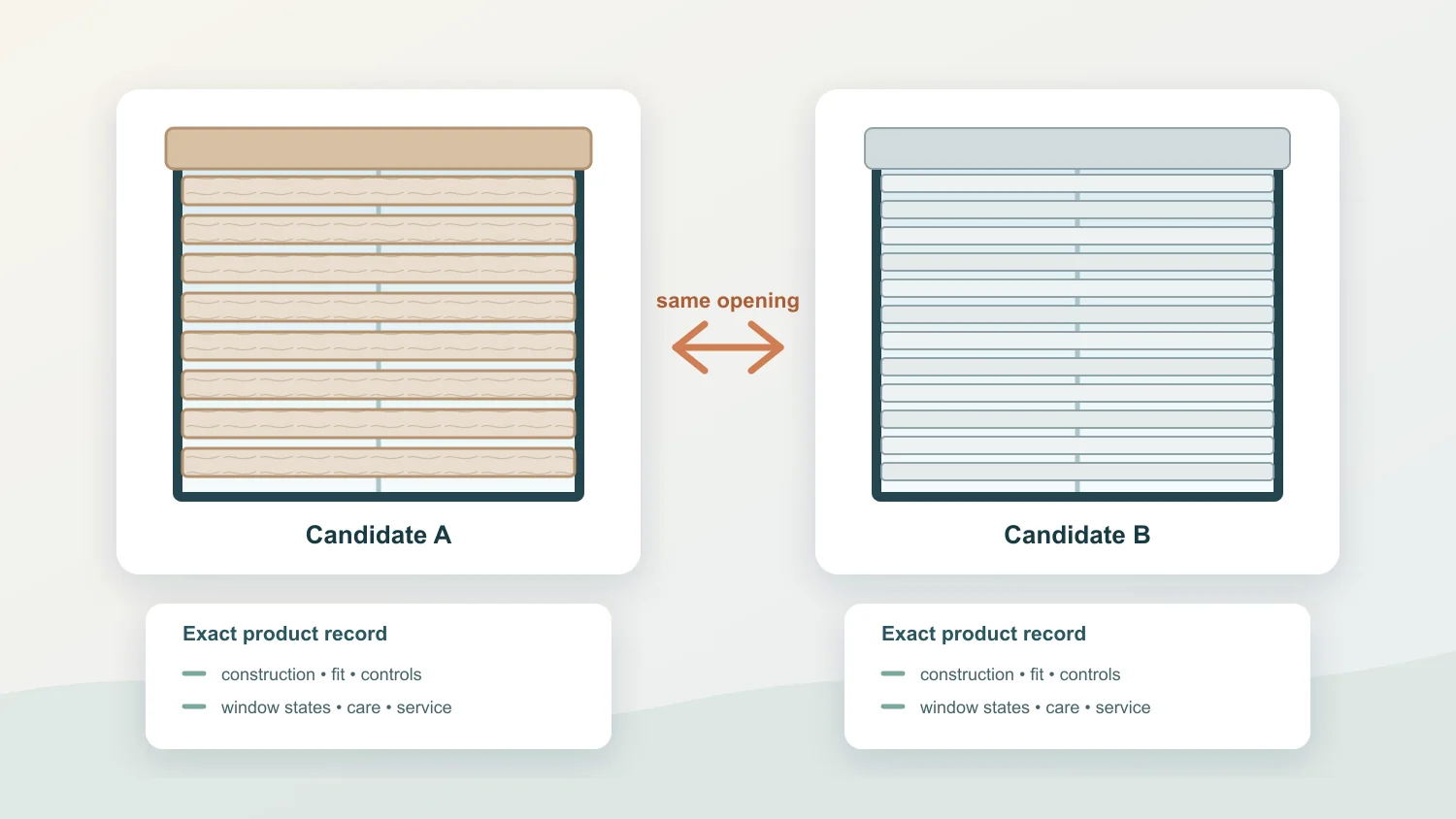
Put competing options into the same record. A lower total is not a useful comparison if one seller quoted a fixed picture unit, another quoted an operable casement, or the word “accessible” means different things.
| Complete this field | Copy from the quote or technical return | Pause when |
|---|---|---|
| Unit identity | Manufacturer, product series, window style, size, new-construction or replacement configuration | The quote names only a dealer package or generic window type |
| Treatment architecture | Blind or shade type; sealed inside the insulating glass unit or reachable through an interior access panel | “Between glass” is the only construction description |
| Movement | Fixed, hung, sliding, casement, or awning sash; normal opening and cleaning path | The treatment is demonstrated only on a different sash style |
| Operator and screen | Raise, lower, and tilt functions; operator side and reach; screen removal or interference | The control cannot be reached in the installed condition |
| Room result | Daytime glare, raised view, tilted sightline, nighttime privacy, and darkness expectation | “Privacy” or “blackout” is promised without a named fabric or slat and test condition |
| Rated performance | Exact NFRC record for the quoted series, style, size, glazing, spacer, and options | A brochure value cannot be matched to the quoted configuration |
| Service unit | Covered component, access method, labor, glass or blind replacement scope, lead time, and warranty owner | The seller cannot say what is replaced or who performs the work |
This page is about residential window units. If the moving product is a patio, sliding, or hinged door, use the separate guide to patio doors with built-in blinds; passage, panel movement, threshold, and door-glass service create a different decision.
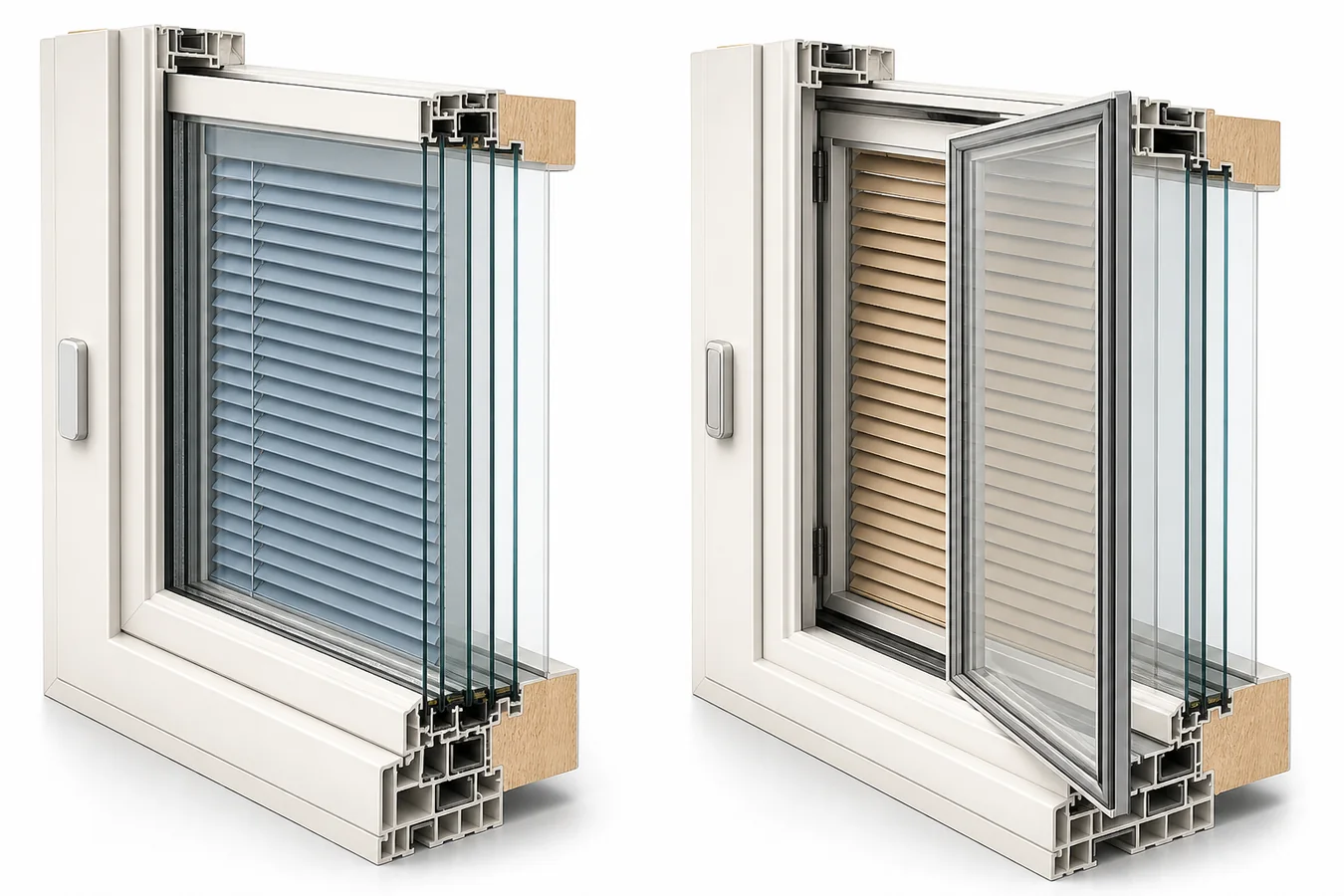
The cutaway is conceptual. It distinguishes two possible relationships between the treatment and the glazing; it does not depict a promised brand construction, pane count, spacer, rating, access direction, or repair method.
The blind may be sealed—or merely protected
“Blinds between the glass” tells you where the treatment appears. It does not tell you whether the treatment shares a sealed insulating glass unit or occupies an accessible cavity protected by an interior glass panel.
ProVia’s current internal-blind material provides one sealed example. The company describes aluminum blinds inside the insulated glass unit, operated to raise, lower, and tilt. Its current window page lists the option for named hung, slider, casement/awning, and picture-window configurations. Those details belong to those ProVia products, not to every window carrying an internal-blind label.
Pella’s current Lifestyle Series information provides a different named example. Pella says its between-the-glass treatments are protected from dust and damage yet accessible if a problem occurs. The 2026 Lifestyle Series casement design manual locates named integrated fashions between exterior glazing and a hinged interior glass panel, with those options tied to the specified triple-pane configuration.
Neither example proves that sealed is maintenance-free or that accessible is automatically easy to repair. It proves that the category name is too broad. Ask for the exact section drawing, owner manual, and warranty for the series on the quote. Then have the seller mark which barrier is factory sealed, which panel a homeowner or technician may open, and which component the warranty treats as the replaceable unit.
A moving sash changes the daily bargain
The same blind concept can feel very different in a fixed picture window and an operable casement. Do not accept a tabletop sample as proof of the installed control path.
For a hung or sliding window, check whether the operator remains reachable when the sash is open, whether tilt-in or lift-out cleaning still works, and whether a hand can use the latch without moving the blind first. For a picture window, confirm that the high or wide glass still leaves the control within comfortable reach. A blind that is technically operable but awkward every morning is the wrong configuration.
Casement and awning windows deserve a full motion check: handle or crank, sash swing, insect screen, blind operator, and interior access panel if one exists. ProVia, for example, says the screen must be removed to operate its internal blind on its named casement and awning windows. That is a product-specific interaction worth discovering before purchase, not a rule to assume for every brand.
Write down four ordinary actions—vent the room, close the window, adjust the blind, and clean the glass. Ask the seller to demonstrate their sequence on the exact style. The blind passes this section only when one action does not make another unreasonably inconvenient.
Slats can control sightlines without creating blackout
“Raises, lowers, and tilts” describes movement. It does not specify what someone can see at night, how bright the perimeter remains, or whether the room becomes dark enough for sleep or a screen.
One current ProVia Aspect brochure makes the limitation unusually clear: its named internal blind is not intended as a full-privacy or blackout device. Keep that statement attached to that product, but use it as a prompt for every quote. Ask for the slat or shade material, overlap, edge condition, available colors, and the maker’s exact privacy or light-control language.
Test the decision against the difficult state, not the showroom state. Imagine the interior lit after dark and the blind tilted in both directions. Consider the view through edge gaps and around hardware. Then consider the fully raised state: does the stack or housing preserve the view you are buying the window for?
If the room needs a stronger darkness result, compare light filtering and room darkening before assuming an integrated slat can do the job. A separate room-side treatment may offer more fabrics, side-channel options, style changes, and independent replacement. The site’s roller, cellular, and Roman shade comparison helps make that second path concrete.
Carry the blind option onto the exact NFRC record
An internal blind can keep slats protected, but the phrase itself is not an energy rating. Compare the complete window that will arrive at the opening.
The National Fenestration Rating Council label reports whole-product characteristics. Depending on the record, these can include U-factor, solar heat gain coefficient, visible transmittance, air leakage, and condensation resistance. The relevant line is the one for the exact manufacturer, series, operator type, size or size range, glazing, spacer, gas fill, coatings, and installed options—not the best number printed anywhere in the brochure.
ENERGY STAR likewise explains that qualified windows are independently tested and certified under NFRC procedures, with qualification based on U-factor and solar heat gain coefficient. An integrated blind neither grants nor cancels that qualification by name. The quoted unit must match the certified product and the criteria for the applicable climate zone.
Ask the seller to attach the NFRC label or certified product record to the quote and identify the selected configuration. If adding the blind changes the glass package, pane arrangement, grille availability, or rating, the revised values belong on the same return. If the seller cannot connect the option to the exact record, treat the energy comparison as unresolved.
Price the failure unit before choosing the color
The service question is not “Does it have a warranty?” It is “What happens to this exact window when this exact blind no longer moves correctly?”
Start with the warranty’s component names. Does it cover the blind mechanism, operator, insulating-glass seal, interior access panel, finish, and labor separately? Is coverage different for the glass unit and the window frame? Note the term, transfer conditions, exclusions, required registration, and who is authorized to diagnose the problem.
Then ask the dealer to describe the physical remedy without promising that a failure will happen. Can an operator be adjusted from the room? Can a named access panel be opened under the owner instructions? Does a technician replace a blind assembly, glass assembly, sash, or larger window component? Who orders it, who measures it, and who pays removal, installation, finishing, and disposal if labor is outside the written coverage?
Do not fill an unanswered line with a category assumption. A sealed treatment is not automatically unserviceable, and an accessible treatment is not automatically inexpensive to fix. Product architecture, parts policy, dealer support, warranty language, and local labor determine the actual path.
Read the finished quote back as one system
Before accepting the order, ask the seller to return one marked document containing:
- manufacturer, series, window style, size, installation type, and opening ID;
- complete glazing package and exact NFRC reference;
- blind or shade material, color, slat or fabric designation, and offered functions;
- sealed or accessible construction, plus the relevant section drawing and owner instructions;
- operator location and reach, screen interaction, sash movement, cleaning access, and the installed demonstration sequence;
- the manufacturer’s written language for privacy, room darkening, and raised-view obstruction;
- blind, glass, sash, frame, labor, and transfer coverage; and
- the component replaced, service provider, expected order path, and owner-paid work outside warranty.
Read it aloud from the opening to the service event. If every detail still describes one exact window, the quotes are comparable. If the glass rating comes from one configuration, the blind demo from another, and the warranty answer from a generic dealer promise, the package is still incomplete.
Built-in blinds make the strongest case when the exact window already fits the opening, climate, ventilation, and cleaning needs; the protected treatment gives the required room result; and the service coupling is acceptable. If the existing window is sound or the room needs broader fabric, blackout, styling, or replacement freedom, keep the window and treatment decisions separate. Start that comparison with smart blinds versus motorized shades rather than letting the phrase “inside the glass” decide the whole purchase.