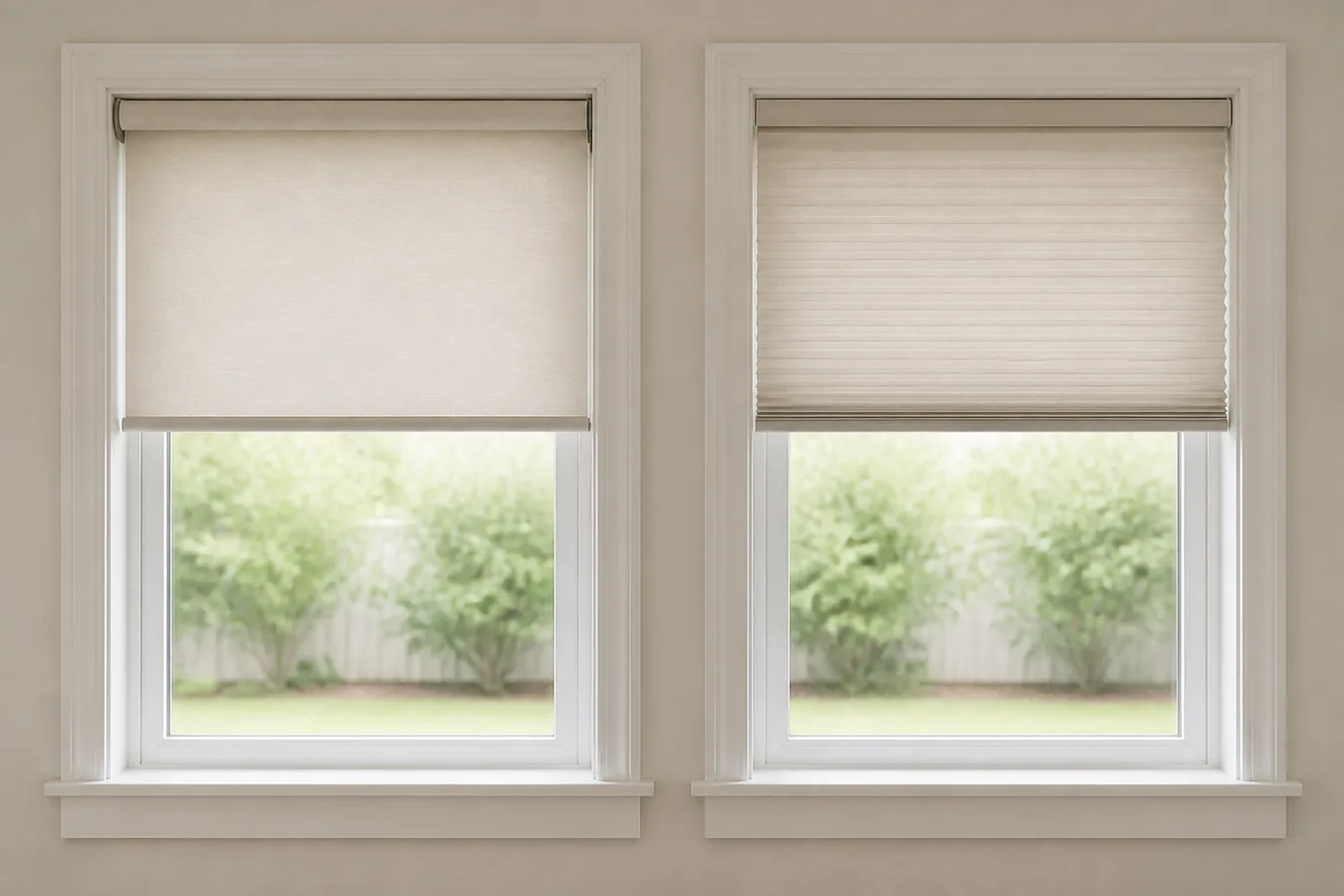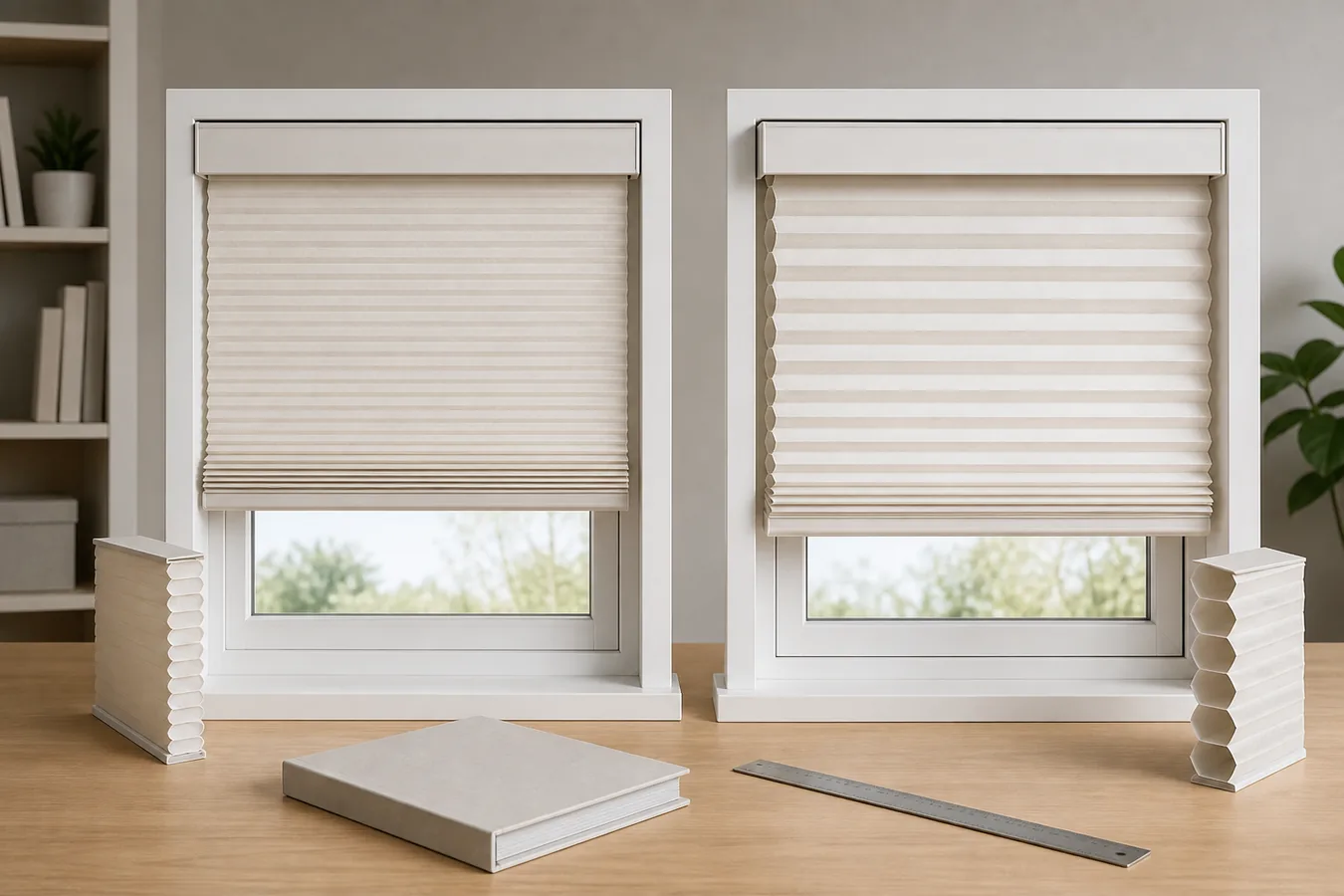
Two cellular-shade samples can make the choice look almost trivial. One honeycomb measures 9/16 inch deep, the other 3/4 inch. The larger fold looks bolder on the sample board, so it is tempting to assign it a larger stack, a deeper headrail and better insulation before seeing either finished shade.
The samples cannot answer those questions. They leave out the headrail, bottom rail, selected fabric, cell count, operating system, finished height and product rating—the parts that turn a pleat into an order.
There is no universal winner between 9/16- and 3/4-inch cellular shades. Compare two exact configurations for the same window. Choose only after the supplier returns the height-specific raised stack, minimum and flush-mount depth, available controls and a named energy record for each product.
Put the missing hardware back into the comparison
Begin with one opening and one room task. Record the width, height, mounting surface and obstructions in the Smart Shade Measurement and Compatibility Checker. Then ask each supplier to complete a row for the exact fabric, color, opacity and operating system being quoted. A generic specification for the product family is not enough when an option changes the headrail or stack.
| Field | 9/16-inch bid | 3/4-inch bid | What the field decides |
|---|---|---|---|
| Exact identity | Product, collection, version and source date | Product, collection, version and source date | Which specification table actually applies |
| Cell construction | Single, double or another named construction | Single, double or another named construction | Whether cell size is the only variable |
| Selected material | Fabric, color and light-filtering or room-darkening option | Fabric, color and light-filtering or room-darkening option | Light, privacy, weight and which stack row applies |
| Finished envelope | Ordered and finished size, rail width and edge condition | Ordered and finished size, rail width and edge condition | Whether both bids cover the same window |
| Mounting depth | Minimum depth, flush depth and headrail dimensions | Minimum depth, flush depth and headrail dimensions | Full recess, partial projection or outside mount |
| Fully raised stack | Value for the exact fabric, control and finished height | Value for the exact fabric, control and finished height | How much clear glass remains when open |
| Operation | Bottom-up, TDBU or day/night; manual or motorized | Bottom-up, TDBU or day/night; manual or motorized | Availability, reach, power and possible stack additions |
| Energy record | Exact AERC listing or UNKNOWN | Exact AERC listing or UNKNOWN | Whether an energy-performance comparison is allowed |
| Ownership path | Care, warranty, removal, parts and service | Care, warranty, removal, parts and service | What happens after installation |
| Installed bid | Dated total for this completed configuration | Dated total for this completed configuration | The real tradeoff after both rows are comparable |
Do not erase differences just to make the table look tidy. If the 9/16-inch option uses one fabric and the 3/4-inch option requires another, record that change. You are comparing two orderable products, not running a laboratory test on loose honeycombs.
Read the stack chart at your finished height
A raised cellular shade is a bundle of fabric plus its hardware. The chart may include the headrail and bottom rail, and it may change with fabric, finished height and operating system. That is why “larger cells make a larger stack” is not a safe ordering rule.
The current Bali cellular specification illustrates the problem. Its stack tables divide products by named fabric and cell groupings, then return values by shade height. At a 96-inch shade height, one table spans approximately 4 1/8 to 6 5/8 inches across the listed configurations. The document also says its stack measurement includes the headrail and bottom rail. The useful comparison is therefore not “9/16 versus 3/4” in isolation; it is the exact column for the product you are buying at 96 inches.
Operation can rewrite that result. The same Bali record tells buyers to add 3/4 inch for its listed cordless top-down/bottom-up configurations, while a sun-up/sun-down configuration combines two fabric stacks. Those additions belong to that documented system. Ask another supplier for its own rule instead of carrying the number across brands.
Current LEVOLOR cellular tables likewise organize stack by fabric collection, opacity, operating system and shade height. Request the row that contains your exact collection and control. If the seller returns only a loose fabric-stack estimate, ask whether the rails are included before comparing it with a finished-stack figure.
The recess belongs to the headrail
The honeycomb depth is visible at the fabric edge; the hardware depth is what occupies the window recess. Those measurements are not interchangeable.
One current cellular mounting-depth chart groups 3/8-inch single, 9/16-inch single, 1/2-inch double and 3/4-inch single constructions together for several lift systems. In those rows, the control and headrail determine the listed inside- and semi-inside-mount depths. Larger 3/4-inch double and 1 1/4-inch single constructions move into another group. This is a product-specific counterexample to the idea that every 3/4-inch cell needs a deeper recess than every 9/16-inch cell.
Return three numbers to the card: the minimum depth that supports the bracket, the depth needed for a fully recessed headrail and the headrail’s actual projection. Compare them with usable depth after handles, cranks, trim and an out-of-square opening are accounted for. Use the inside-versus-outside mount guide when the recess cannot support the desired result. Changing the mount to rescue one bid also changes edge coverage and the finished look, so record it as a new configuration rather than a minor footnote.
Cell size and cell count are two separate switches
A 9/16-inch single cell and a 1/2-inch double cell differ in two ways: the depth of the visible honeycomb and the number of cellular layers. A 3/4-inch listing may also describe a single or double construction. Seller shorthand sometimes makes those labels look like one scale, but they are separate product fields.
Hold cell count constant when both quotes make that possible. When it is not possible, name the constructions in the comparison and use the single-cell versus double-cell guide to resolve the extra layer. Do not credit a difference to cell size when the second quote also changes the number of cells, fabric backing or opacity.
This distinction matters visually as well. Order a sample of the exact fabric and color in each available construction. View the full-sized sample against the window in daylight and after room lights come on. The pleat scale may affect appearance, but the selected fabric still controls much of the visible color, texture and transmitted light.
A larger air pocket is not an energy label
Cellular construction can reduce heat transfer by trapping air within the cells and between the shade and window. The US Department of Energy cellular-shade factsheet explains that mechanism and points consumers to AERC’s qualified product information. It does not turn one cell-size fraction into a universal savings claim.
AERC’s residential label guidance treats U-factor, solar heat gain coefficient and cool- or warm-climate improvement as metrics for a particular window-attachment product. Compare the exact certified entries when both bids have them. If only one configuration has a current listing, the other row remains unrated; a deeper honeycomb is not a substitute rating.
Keep the room objective attached to the metric. Lower U-factor addresses heat retention, while SHGC describes solar heat gain. The broader energy-efficient blinds guide separates winter heat loss from summer solar control and daily use. Cell size should not outrank climate, window condition, edge fit or whether the shade will actually be closed when the benefit is needed.
Availability may make the choice before appearance does
A sample board can display two cell sizes that never coexist with the fabric, control and window dimensions you need. Run both candidates through the current option table before choosing the prettier pleat.
For example, the current Hunter Douglas Duette page lists 3/4- and 1 1/4-inch pleat sizes for that product. It does not offer a universal menu of every common cell size. That single product page cannot decide a 9/16-versus-3/4 purchase, but it demonstrates why availability belongs to the named collection rather than to the category “cellular shades.”
Check the exact fabric code, opacity, width and height limits, bottom-up or top-down/bottom-up function, day/night construction, manual control, motor option and power path. Current LEVOLOR documentation, for instance, separates operating-system combinations and applies additional fabric limits to some functions. A 9/16-inch fabric that disappears when motorization is selected is not a motorized candidate.
If motorization changes one row, reopen the motorized cellular-shade plan for fit, power, controls and service. If the seller’s terms blur connected and non-connected products, the smart blinds versus motorized shades comparison keeps those system labels separate. Finish with a dated installed bid for the exact surviving configuration; do not compare one bare shade with another shade plus motor, charger, hub or installation.
Keep the product name attached to the answer
Choose the 9/16-inch configuration when its exact row meets the room’s light and privacy task, fits the recess, leaves an acceptable raised stack, supports the required operation and carries the service or energy record that matters to you.
Choose the 3/4-inch configuration by the same rule—not because “larger” has been assigned a universal benefit. If it wins on appearance but loses the required control or projects beyond the trim, the full specification has already answered the question.
Choose another construction when neither row survives intact. Hold the order when a supplier cannot return a current stack chart, headrail depth, option limit or product identity. A blank cell is a request for one missing specification, not permission to fill it with a category slogan.
The useful answer should still name the product, fabric, cell count, control and date after the fraction is removed. If all that remains is “3/4 is better,” the comparison has lost the shade you are actually buying.