Motorized skylight shades are bought in one of two defensible ways: as an accessory matched to an identified roof-window unit, or as a custom system whose maker accepts the recorded opening and orientation. If a quote cannot say which path it uses, fabric, motor and app comparisons are premature.
The usable answer is not “yes, skylights can be motorized.” It is a written chain connecting one specific skylight to a supported shade system, a finished light result, a maintainable power source and an exact control package.
Choose the evidence path before the product
| Evidence path | Use it when | Identity that owns the order | Proof before proceeding |
|---|---|---|---|
| Manufacturer-matched accessory | The skylight maker offers a shade for the identified unit family and size | Product ID, model/size code and fixed or venting variant | The maker or seller matches the shade to that exact unit and states any age, slope or operating limits |
| Documented custom skylight system | A separate shade maker accepts the opening and orientation under its own skylight rules | Its required finished dimensions, angle/orientation, mount surface and movement details | Written acceptance of the recorded geometry plus the exact guide, motor, power and control configuration |
| No verified route yet | The label is missing, the opening is unusual, or the seller is relying on rough glass size or brand-level claims | None | Identify the unit or find a custom maker willing to own the recorded conditions before placing a custom order |
Both valid routes can produce a good result. The danger is mixing their inputs—for example, using a rough tape measurement to replace a manufacturer size code, or assuming an accessory for one roof-window generation fits another.
The label on the skylight decides the evidence path
Begin with the roof window, not the shade catalog. Record the brand, every readable label or QR code, the model and size code if present, and whether the skylight is fixed or venting. Also note whether the sash is manual, electric or solar operated. Keep separate records for units that look identical; age or product generation may differ.
For a manufacturer-matched accessory, the unit identity can be more important than a homeowner’s glass measurement. VELUX explains that its product ID identifies the skylight model, glass type and manufacture date, and asks owners to locate it when ordering accessories or requesting service. That is a VELUX-specific example, not a universal label system, but it shows why “same brand” is not enough.
For a custom system, the shade maker’s current order rules own the inputs. It may require finished opening dimensions, mounting-surface details, orientation and other geometry. Do not borrow measuring rules from another product and do not silently substitute visible glass size for the maker’s requested dimension.
Photograph the full opening and any label only from a safe position. There is no reason to remove covers, lean over a stairwell or climb onto a roof to complete early research. The Smart Shade Measurement and Compatibility Checker can organize the opening and obstruction facts, but final order dimensions must still come from the exact system’s instructions or responsible measurer.
The first useful sentence in a quote is therefore not a fabric name. It is either “matched to skylight unit ___ under the manufacturer’s accessory table” or “accepted as a custom skylight opening under drawing/revision ___.” Anything less leaves fit ownership unclear.
A roof angle turns the covering into a guided system
A shade on a wall can rely on gravity differently from a shade that travels along a slope or overhead. The relevant product is the complete moving system—fabric or cellular material, rails or other retention method, brackets, drive and limits—not a material sample by itself.
Ask the seller to document:
- the supported installation orientation or angle for the exact system;
- how the moving material stays controlled across its full travel;
- the required recess, frame or mounting surface;
- the finished envelope of the headrail, side components and bottom rail;
- the approved minimum and maximum finished sizes;
- clearance around sash, screen, handle, rain sensor and service points;
- any restriction tied to a fixed or venting roof window.
VELUX keeps skylight and shade installation information separate, while its shade help center distinguishes issues such as older-unit compatibility, low slope, calibration and travel. The transferable lesson is the required level of specificity: exact unit, exact shade and exact operating condition. It is not evidence that a different product supports the same slope.
A venting skylight adds another moving envelope. On paper, account for the sash closed and open, the shade open and closed, and any manufacturer-approved combined movement. Handles, screens and sensors need clearance in the states the owner will actually use. A seller who has only checked the shade’s static width has not closed this risk.
The inside-versus-outside mount guide helps describe the mount line, usable depth, projection and obstructions. It cannot convert a vertical-only shade into a skylight system; its job is to make the geometry legible once the product’s orientation is supported.
Specify the finished light result, not a fabric adjective
“Blackout,” “room darkening” and “light filtering” are not complete room outcomes. First decide what the skylight needs to change:
- reduce a band of direct glare without losing all daylight;
- darken a bedroom or media room at a particular time;
- limit a privacy sightline;
- soften contrast while keeping useful daylight;
- reduce discomfort associated with solar exposure.
The U.S. Department of Energy treats solar heat gain, daylight, glare and maintenance as separate fenestration considerations. That distinction matters here. A material choice may affect more than one condition, but a generic fabric label does not establish a room-temperature change, an energy-saving percentage or a darkness guarantee.
Request the exact fabric or cellular option and, when the decision is sensitive, a current sample. Then ask for the installed side, top and bottom gap description. A room-darkening material can still leave visible edge light; a dark sample cannot show the result around rails, trim or an out-of-square opening.
Phrase the requirement as an observable finished condition. “Reduce afternoon screen glare while retaining diffuse daylight” gives a seller something to configure. “Blackout shade” invites each seller to use a different definition. For demanding darkness, require the maker to describe the complete gap-management arrangement and any limits in writing.
Ceiling height makes power a maintenance commitment
The best power option is the one the owner can operate and service over the life of the shade. A skylight above a stairwell or tall room changes the cost of every recharge, battery replacement, reset and repair.
For each option, identify the exact battery, rechargeable, solar-assisted, plug-in, low-voltage or other power arrangement. Include every charger, panel, transformer and cable required by that configuration. Then answer four practical questions:
- Where does energy enter the system?
- What routine action will the owner perform, and how often does the maker say it may be needed?
- Can that action be completed from a safe, planned access position?
- What happens after low charge, power loss or a control reset?
Hunter Douglas describes remote, app and scheduled operation as available paths for motorized skylight shades. Other manufacturers document different solar, battery or wired arrangements. These examples establish that choices exist; they do not make the names interchangeable or prove that a given skylight receives enough light for a particular solar component.
Treat “no visible wire” as an appearance preference, not the whole decision. A rechargeable system with an unreachable charging point may be less usable than a planned power supply. A wired option may simplify routine ownership but introduce electrical and routing work. When new wiring, structural changes or roof work may be involved, define requirements and use the relevant qualified professional rather than treating a shade guide as installation instruction.
Keep shade, drive and command path on one specification
Smart-home compatibility belongs to the exact motor package, not the brand logo. A complete configuration should name:
- shade model, material and finished size;
- drive or motor variant;
- power components;
- included local remote or wall control;
- optional app or scheduling controller;
- required hub, bridge or gateway;
- supported ecosystem and material limitations;
- behavior when the internet, app or hub is unavailable;
- grouping behavior if several skylights should move together.
The local control matters. A shade should not become unusable because a phone changed, a service is unavailable or a network is down. If several skylights share a room, decide whether they need one group, separate zones or individual correction; “supports groups” does not explain how the quoted controller behaves.
Avoid filling gaps with brand-level assumptions. “Works with Alexa,” “app control” or “smart ready” can refer to a particular motor generation, an extra bridge or a limited set of commands. If the quote changes the motor, power source or controller, recheck the control promise because the configuration—not the fabric family—owns it.
Automation should follow useful room positions. Define a fully open daylight position, the position that solves the observed glare or privacy problem, and any stronger darkening position the exact system can deliver. Scheduling those known states is more defensible than moving a shade at fixed times before anyone has observed the room.
The written answer that makes the order comparable
Put the decision into one short record per skylight:
- Skylight: room label, brand, product ID/model/size code, fixed or venting.
- Evidence route: manufacturer-matched accessory or documented custom system, with the matching table, drawing or written acceptance named.
- Geometry: orientation/angle, mount surface, finished shade envelope and all movement clearances.
- Light result: the room problem, exact material and expected finished gaps.
- Ownership: exact power parts, safe charging/reset/service path and responsible installer or service party.
- Controls: drive, local control, app/controller, hub or bridge, ecosystem and offline behavior.
- Open field: every assumption the seller or manufacturer has not yet answered.
This record lets two quotes be compared without pretending that similar marketing names describe the same system. It also reveals the next action. A missing product label sends the buyer back to unit identification; unsupported orientation sends the choice back to the shade maker; unsafe service access changes the power plan; an unnamed bridge leaves smart control unproven.
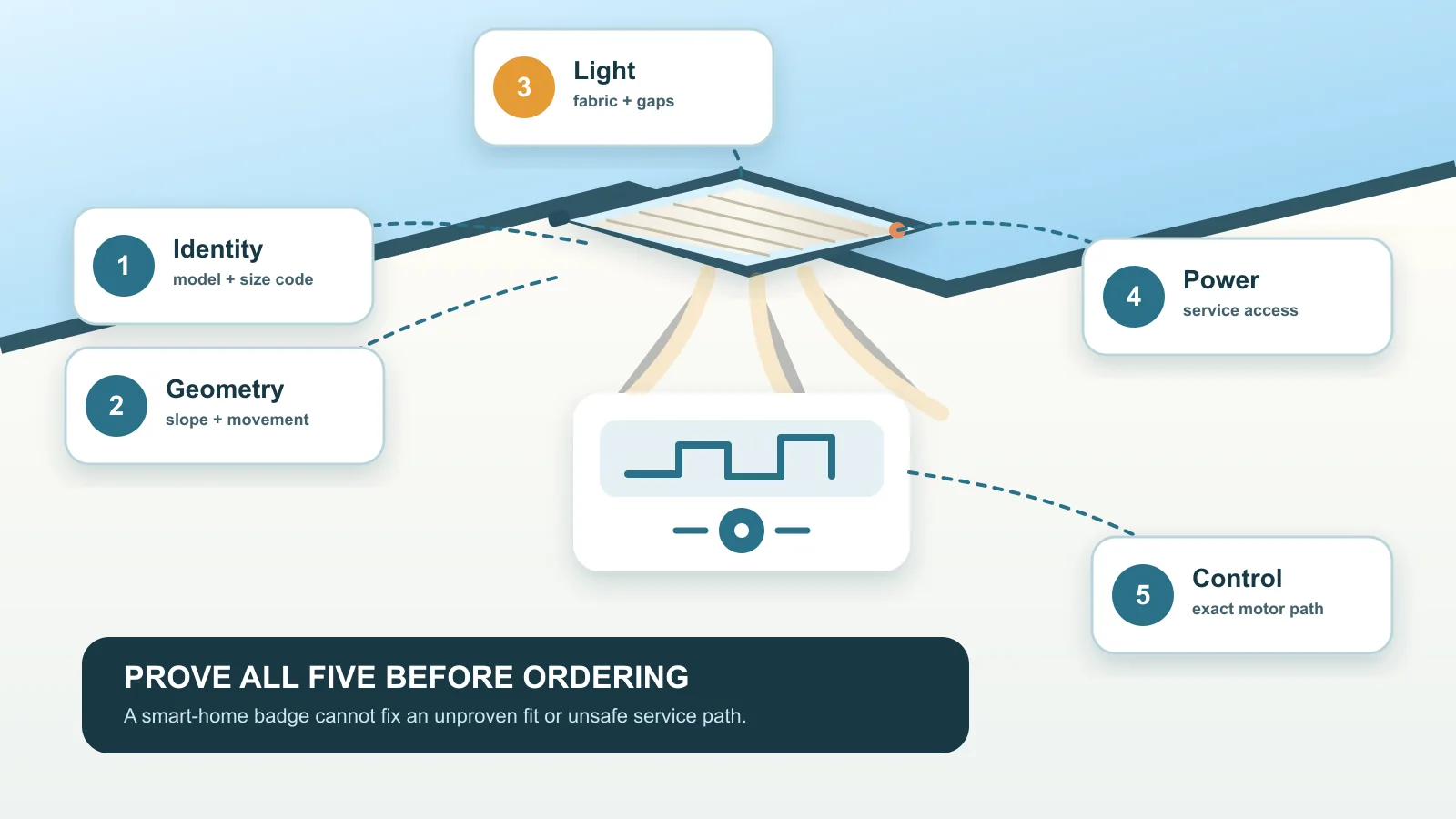
For a skylight, the order is ready when the window identity, supported shade route, finished light result, serviceable power, and exact controls appear on the same current specification. If one link is missing, that missing link—not another product list—is the next job.
If the skylight is one part of a larger project, use the Smart Motorized Blinds Planner to put measurement, power, room goals, and controls back into a whole-home sequence.