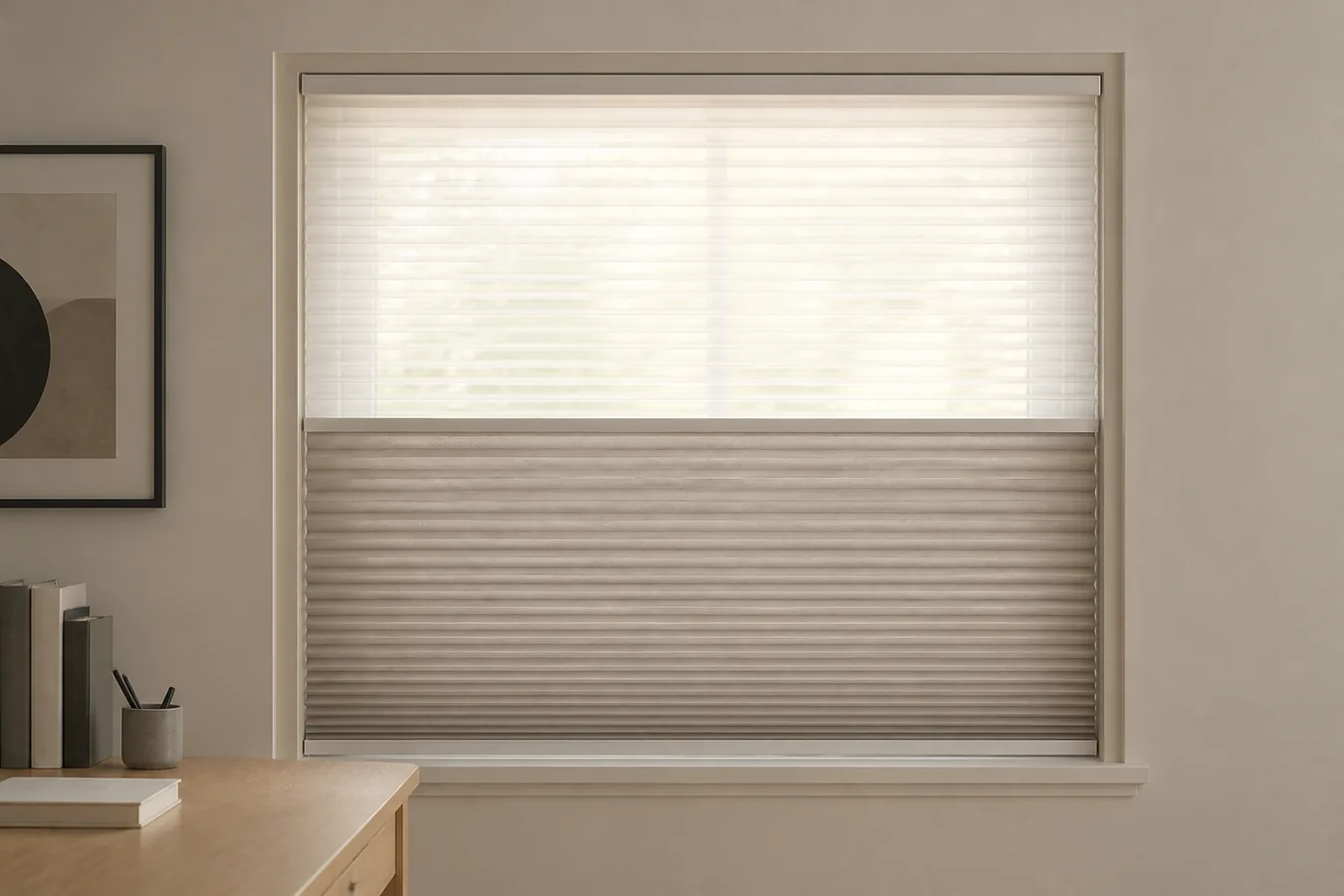
Top-down bottom-up shades are worth considering when one rail position can block the real privacy sightline while leaving useful daylight above it. That position is rarely the visual middle of the window. It depends on where the occupant is, where the observer stands, and whether the observer is lower, level or higher than the room.
Call the minimum covered height the privacy horizon. If the middle rail can sit above that horizon and still leave a meaningful open band, TDBU has a coherent job. If an upstairs neighbor can see over the rail, or the required covered band reaches almost to the headrail, another treatment may be simpler. Compare that alternative by construction—not feature name—in the roller, cellular, Roman, and zebra shade guide.
The important line is not the middle of the window
A TDBU shade can lower from the top, raise from the bottom, or use both positions to create a movable covered band. Hunter Douglas currently describes top-down/bottom-up as an enhancement available in named Roman, cellular, woven and roller/textured families, with manual or PowerView options depending on the product. That proves the concept is broader than one cellular shade, not that every combination exists. Review the current named TDBU families.
The buying mistake is starting with a rail at 50 percent because product photos show it there. The privacy horizon may be below the sill for an isolated upper-floor room, at standing shoulder height for a sidewalk, or near the top of the glass for an uphill or upper-story observer.
Draw the privacy horizon from the outside in
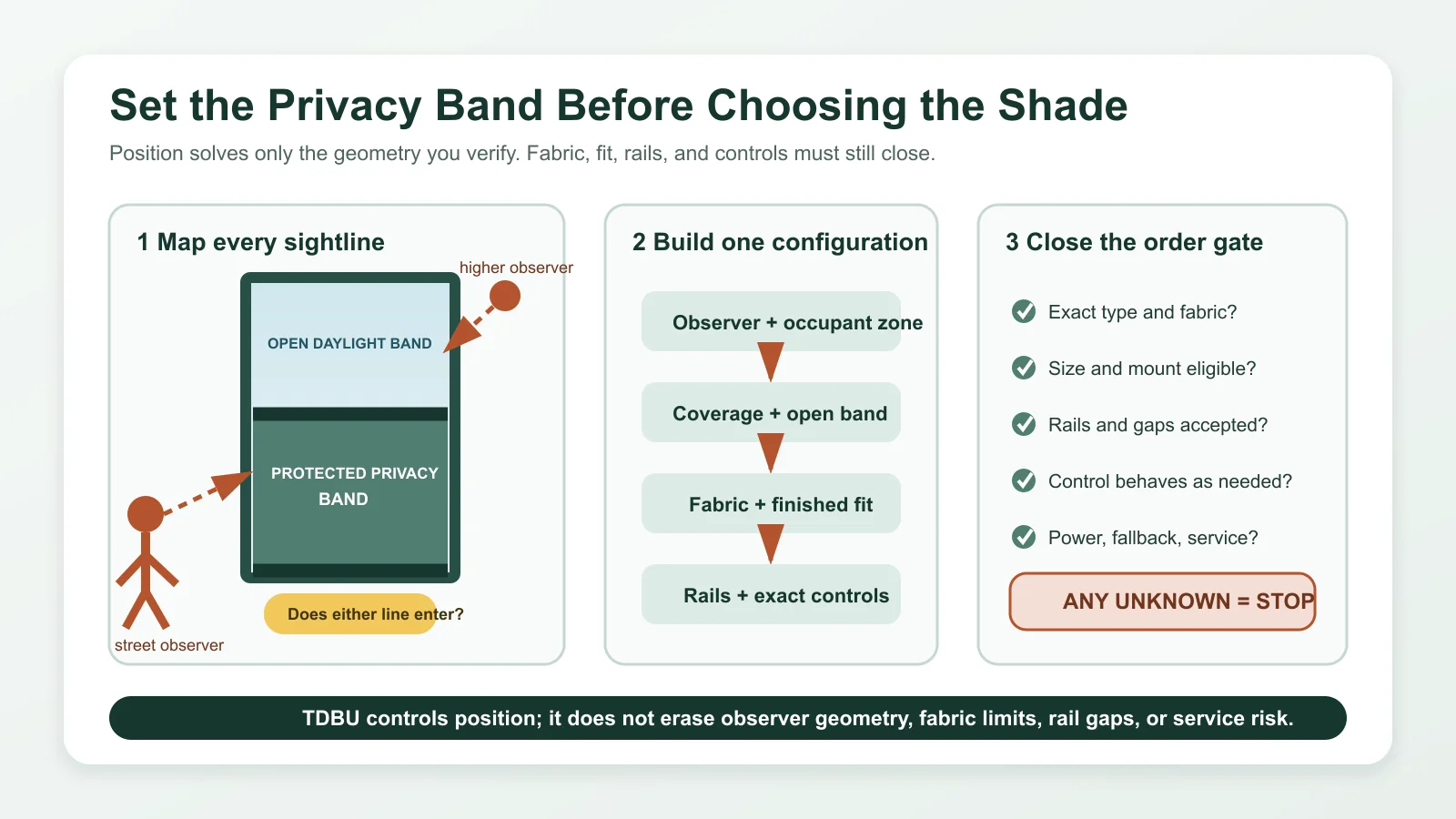
Mark the places inside the room that need privacy: bed, bathtub, desk, sofa, standing path or full occupied zone. Then visit every realistic outside observation point. Include street/sidewalk, neighboring windows, decks, shared yards and sloped ground.
Photograph the window straight on from inside. On the image, draw the lowest rail position that blocks each outside line of sight to the protected occupant zone. The highest of those required lines becomes the privacy horizon. Repeat after dark with the room lit, because fabric and reflections can behave differently when the exterior is darker.
| Observer geometry | Likely privacy horizon | What remains above it | Decision pressure |
|---|---|---|---|
| Lower street or yard | Often a lower-to-middle band, verified on site | Potentially useful sky/daylight opening | TDBU may earn its complexity |
| Same-level neighboring window | Depends on distance and occupant position | May be narrow or shift by room location | Test seated and standing zones |
| Uphill, deck or upper story | Can approach the top of the glass | Little useful open band | Full closure or another layer may be stronger |
| No realistic observer | No privacy-driven lower band | The full view may already be acceptable | Standard bottom-up may be simpler |
| Observer direction changes by time | Several required rail positions | Daylight value varies by scene | Adjustable TDBU or a layered solution needs testing |
An elevated observer can erase the daylight band
TDBU works by trading a protected lower band for an open upper band. An elevated observer looks down through that opening. If the rail must rise almost to the top to block that view, TDBU still functions mechanically but no longer delivers its distinctive daylight benefit.
In that case, compare a standard bottom-up shade for full closure, fixed lower privacy combined with another upper treatment, or a dual-layer solution that handles different scenes. Do not keep TDBU merely because the feature sounds more flexible.
The middle rail is part of the view
The rail that creates the privacy horizon remains visible. Its depth, color and position can cut across a landscape, a neighbor’s roofline or the room’s architecture. When the shade is fully raised or fully lowered, other rails and fabric stack occupy space too.
Mark the intended daytime rail position on a window photo or with removable tape. Check it from seated and standing positions. Also inspect handles, locks and opening sashes. A rail that creates perfect privacy but collides with a handle or sits through the primary view has not solved the room.
Top-down/bottom-up is not Day/Night
TDBU describes how a covered band moves from the top and bottom. Day/Night typically describes two different fabrics or opacities combined in one system. A product can offer one, the other, both in a named configuration, or neither.
Levolor’s current cellular technical guide distinguishes TDBU from Day/Night and shows that operating systems, size eligibility, multi-shade arrangements and fabric gaps vary by configuration. Use that as a reason to name the exact system—not as a cross-brand dimension table. Check the current Levolor configuration distinctions.
Fabric closes the band; gaps can reopen it
The privacy horizon assumes the covered band itself blocks the relevant view. Verify the exact fabric and lighting. A light-filtering or privacy label does not prove nighttime silhouette performance, and a room-darkening material does not remove side or rail gaps.
Measure the intended mount plane with the measurement checker. Then use the inside-versus-outside mount guide to compare recess fit with overlap. For TDBU, ask for finished fabric coverage, side gaps, rail gaps and projection at the exact quoted size.
Availability is a configuration question
Do not approve the idea first and discover later that the desired fabric, size or control is unavailable. Bind shade type, product family, fabric/color, finished size, mount, TDBU operating system and manual or motorized control in one quote row.
Graber’s current cellular page provides one contemporary example: it lists manual top-down/bottom-up choices and a motorized bottom-up/top-down cellular option. That proves motorized versions exist in a named system; it does not establish another product’s fabric, size, hardware, power or service path. Verify the current exact Graber configuration.
Manual reach can defeat an otherwise good geometry
A manual cordless TDBU shade asks the user to reach and position the middle and bottom rails. That can be easy at a normal window and impractical behind a desk, bathtub, counter or at a high opening. Evaluate reach at the positions actually used, not only at full closure.
Where young children may be present, require an appropriate cordless finished configuration. CPSC says cordless window coverings are the safest option in that setting and identifies accessible pull, loop and inner cords as hazards. Read the current CPSC notice.
Motorization creates a three-position system
A motorized TDBU shade can involve top, middle and bottom positions rather than one simple open/close limit. The controller must make the normal privacy horizon easy to recall, while still allowing full closure and the intended daylight state.
Hunter Douglas support for named Legacy PowerView Applause/Duette TDBU cellular shades describes top, middle and bottom rail limits and rail-alignment conditions. Use it only to understand the questions a multi-rail motorized quote must answer; do not follow it as another brand’s setup instruction. Review the exact named-system limit behavior.
Ask which rail each command moves, whether the privacy-horizon position can be saved, what local control works without internet, how power is serviced, and what happens if rails lose alignment. If those answers are unknown, motorization has not yet improved the TDBU decision.
Across several windows, align the decision rather than every rail
Several neighboring shades may need different privacy horizons because the observer angle or occupant zone changes. Perfectly aligned middle rails can look orderly while failing one window’s privacy task. Decide first whether the room needs one continuous visual line or correct coverage at each opening.
Group motorized shades by scene—daylight/privacy/full close—while preserving individual adjustment where geometry differs. Ask how fabric deductions and multi-shade gaps affect the composed view. Do not assume independent soft goods will occupy identical intermediate positions without an exact acceptance test.
Order the privacy horizon, not the feature name
| Order field | Record | Acceptance |
|---|---|---|
| People and sightlines | Occupant zones, observer locations/elevations, day/night lighting | The drawn privacy horizon blocks every required view |
| Daylight band | Normal middle-rail height and useful open area above | The upper band delivers enough value to justify TDBU |
| Finished configuration | Product, fabric, size, mount, rails, gaps, stack and handles | Coverage and hardware match the geometry |
| Control | Manual reach or exact motor, limits/scenes, power, fallback and service | The normal privacy position is easy to reproduce |
Draw the privacy line from the observer’s position and order the rail position that blocks it. If that line reaches nearly to the top of the glass, a simpler bottom-up shade or fixed lower panel may solve the room with less hardware.